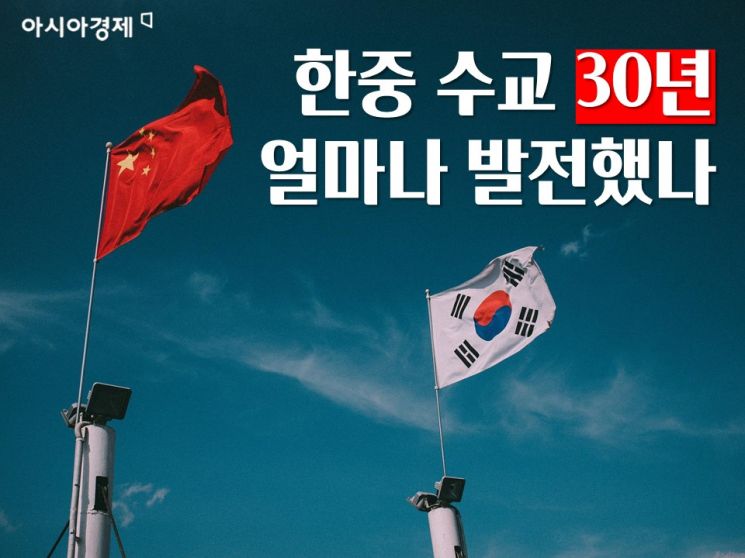
 This year marks the 30th anniversary of diplomatic relations between Korea and China.
 Photo by Song Hyun-do, Asia Economy intern reporter
[Asia Economy Reporter Lim Juhyung, Intern Reporter Song Hyundo] The diplomatic relations between South Korea and China will mark their 30th anniversary on August 24. During this time, China has succeeded in its economic leap, emerging as one of the two major powers (G2) alongside the United States, and South Korea has become one of China's largest trading partners. However, the relationship between the two countries has not always been smooth over the past 30 years. They have experienced conflicts such as the controversy over the deployment of THAAD (Terminal High Altitude Area Defense). We examined the current state of exchanges between the two key partners, from trade to the tourism industry, through figures.
◆ Trade volume between the two countries increased nearly tenfold
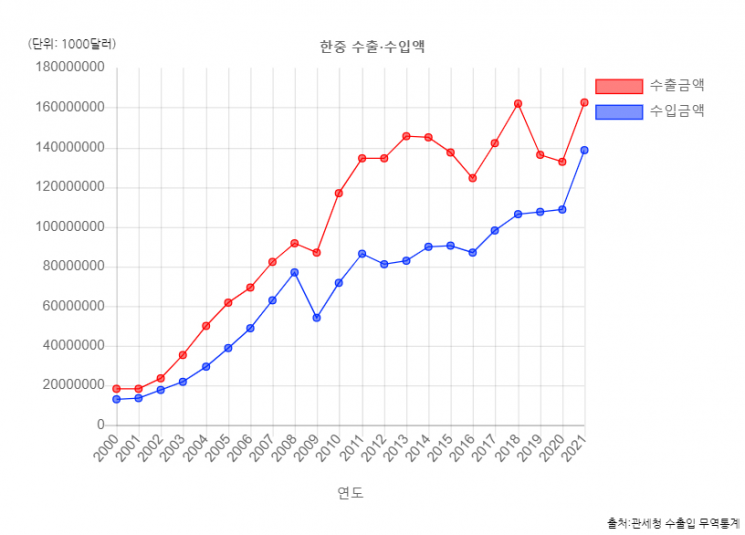 The trade volume between the two countries has surged nearly tenfold over the past 30 years. / Photo by Asia Economy DB
The most dramatic indicator of economic cooperation between South Korea and China since the establishment of diplomatic relations is trade. The total import and export volume between the two countries has increased nearly tenfold over the past 20 years. In 2000, South Korea's exports to China were about $18.4 billion (approximately 24 trillion KRW), but last year they reached $160 billion (approximately 209 trillion KRW), marking an all-time high. Imports increased more than tenfold during the same period, from $12.7 billion (approximately 16.6 trillion KRW) to $138.6 billion (approximately 181 trillion KRW).
◆ Trade balance with China peaked and then declined
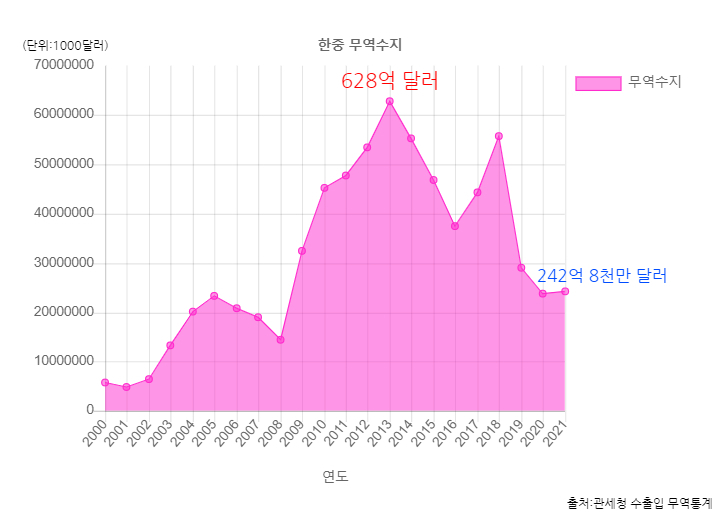 Since the beginning of trade, South Korea's general trade balance has continuously recorded a surplus, but the scale has been decreasing since peaking in 2013. / Photo by Asia Economy DB
South Korea has recorded a trade surplus with China every year from 1992 through last year. However, the trade balance did not always rise steadily, regardless of the increase in trade volume between the two countries. After peaking at a surplus of $62.8 billion (approximately 83 trillion KRW) in 2013, it gradually decreased, dropping to $23.6 billion (approximately 30.84 trillion KRW) and $24.2 billion (approximately 31.63 trillion KRW) in 2020 and 2021 respectively, during the COVID-19 pandemic.
◆ THAAD conflict and the 'Hanhanryeong' led to a halt in Chinese tourists
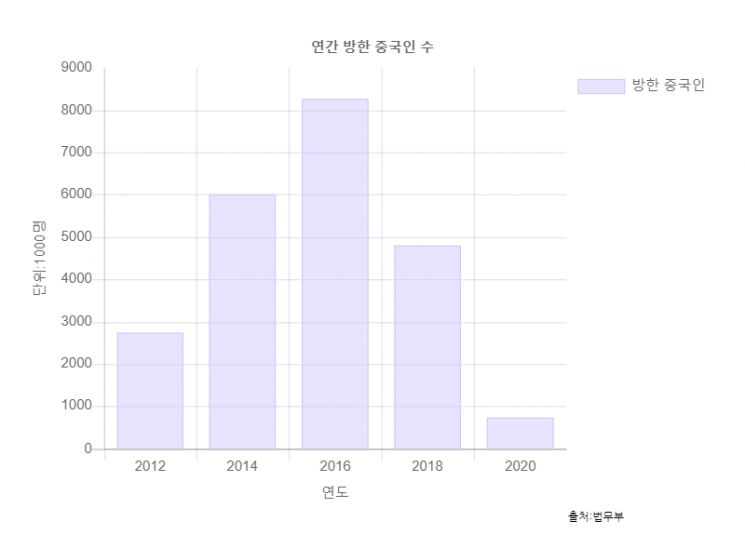 Since the deployment of THAAD and the implementation of China's 'Hanhanryeong' ban, the number of Chinese visitors to Korea has sharply declined. / Photo by Asia Economy DB
According to the South Korean Embassy in China, the number of Chinese visitors to South Korea in 1992, the first year of diplomatic relations, was only about 45,000. However, ten years later in 2002, it increased ninefold to 365,000, and by 2012, it had surged 66 times to 2.96 million. In 2016, it reached an all-time high of 8,268,262 visitors.
However, in retaliation for South Korea's deployment of THAAD that year, China imposed the 'Hanhanryeong' (restrictions on Korean Wave), causing the number of Chinese visitors to South Korea to halve to 4.39 million in 2017. Since then, compounded by adverse factors such as COVID-19, the number of Chinese visitors to South Korea has steadily declined, dropping to only 740,000 in 2020 and plummeting further to 187,906 last year.
© The Asia Business Daily(www.asiae.co.kr). All rights reserved.
![User Who Sold Erroneously Deposited Bitcoins to Repay Debt and Fund Entertainment... What Did the Supreme Court Decide in 2021? [Legal Issue Check]](https://cwcontent.asiae.co.kr/asiaresize/183/2026020910431234020_1770601391.png)

















