Serious Management Crisis in Small Agricultural Cooperatives Due to Government's Failure in Supply Policy
Proposed Alternatives Include Additional 100,000-Ton Isolation and Rice Coupons Paid as Public Institution Allowances
[Asia Economy Reporter Oh Ju-yeon] Members of the Democratic Party belonging to the National Assembly's Agriculture, Forestry, Livestock, Food, and Maritime Affairs Committee have urged the government to take measures to stabilize rice prices. Although efforts were made to stabilize rice prices through market isolation measures, rice prices fell by more than 20% compared to the previous year despite additional isolation, marking the largest decline in 45 years. They emphasized that now the president must personally step in to stabilize rice prices.
On the 9th, Assemblyman Seo Sam-seok held a press conference at the National Assembly Communication Office along with Democratic Party members of the Agriculture, Forestry, Livestock, and Food Committee and lawmakers from Jeonnam and Jeonbuk, demanding the government's stance on stabilizing rice prices and resolving rice stockpiles.
Assemblyman Seo pointed out the government's failure in supply-demand stabilization policies, saying, "During this period of high inflation, only rice prices have not stopped falling, causing multiple hardships for farmers and the Nonghyup (National Agricultural Cooperative Federation)."
He proposed the following alternatives: ▲ Additional isolation of at least 100,000 tons of 2021 rice ▲ Payment of allowances and bonuses from the government and public institutions in rice coupons ▲ Provision of incentives to food companies using rice as raw material and issuance of rice gift certificates ▲ Requesting domestic rice purchases from agricultural import companies as part of profit-sharing ▲ Expanding overseas aid volumes to support North Korea and pursuing overseas loan methods ▲ Increasing government purchase volumes to meet the Food and Agriculture Organization (FAO) recommended stockpile levels ▲ Returning agricultural statistics from Statistics Korea to the Ministry of Agriculture, Food and Rural Affairs to enhance expertise and promptness.
According to Assemblyman Seo's office, although the third phase of market isolation is currently underway, rice prices have not stabilized despite isolating 370,000 tons, which is 100,000 tons more than the government's estimated excess production.
As of the 25th of last month, the farm gate price for 80kg of rice was 175,700 won, a 21% plunge compared to 223,400 won at the same time last year, marking the largest drop in 45 years.
This was due not only to delayed timing beyond the harvest season and the problem of reverse auctions but also serious errors in production and demand statistics.
Assemblyman Seo criticized, "The minister's remark on the 1st at the National Assembly Agriculture, Forestry, Livestock, and Food Committee that rice prices should balance supply and demand clearly reveals a dangerous perception of food security. It is the natural role and responsible attitude of the head of agricultural policy to stockpile excess production as stipulated by law and prepare for food crises through government purchases."
Article 3, Paragraph 1 of the Grain Management Act obligates the minister to establish an annual grain supply and demand plan, and Article 16, Paragraph 1 grants the authority to establish and implement grain supply stabilization measures.
Nevertheless, responsibility for the failure of government supply policies is being shifted to the Nonghyup.
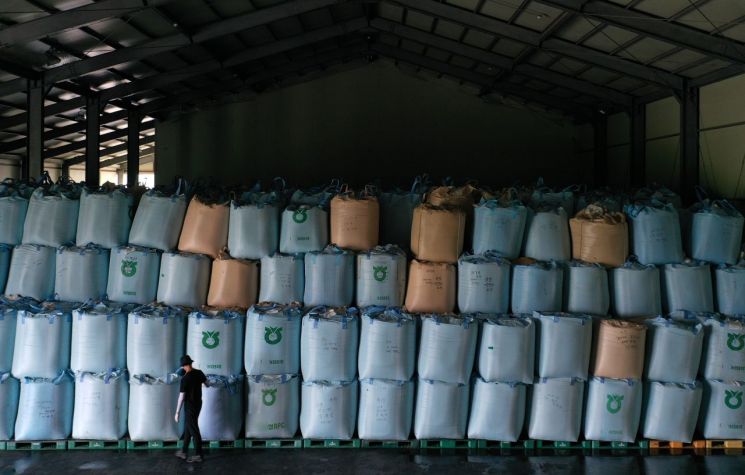
As of July this year, rice stockpiles held by the Nonghyup have surged 73% compared to the previous year, reaching 410,000 tons. Regionally, Jeonnam holds 100,000 tons and Jeonbuk 76,000 tons, accounting for 43% of the total in these two regions.
Assemblyman Seo's office expressed concerns that this could pressure the management of small-scale regional Nonghyup branches.
Assemblyman Seo stated, "In the severe crisis of Korean agriculture and fisheries symbolized by regional extinction, the Nonghyup has continuously played a buffering role to mitigate and protect farmers' losses. If even the Nonghyup collapses, it means the last bastion of agricultural policy will fall," and strongly urged that measures to stabilize rice prices through resolving rice stockpiles must no longer be delayed.
© The Asia Business Daily(www.asiae.co.kr). All rights reserved.

















