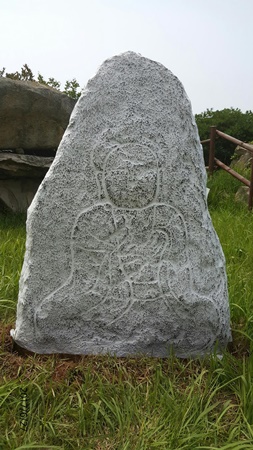
 Jeonnam Cultural Heritage Material No. 108 Wando Cheongsando Stone Bodhisattva Seated Statue (Photo by Wando-gun)
[Wando=Asia Economy Honam Reporting Headquarters, Reporter Choi Kyung-pil] On the 9th, Jeonnam Wando-gun announced that the cultural heritage site previously designated as “Eup-ri Hamabi (邑里 下馬碑)” located in Cheongsan-myeon, which was designated as a cultural heritage material by Jeollanam-do in 1984, has been renamed to “Wando Cheongsando Stone Bodhisattva Seated Statue (莞島 靑山島 石造菩薩坐像).”
The “Wando Cheongsando Stone Bodhisattva Seated Statue,” estimated to have been erected from the late Goryeo to early Joseon period, had its name derived from the inscription “Hamabi” cemented at the bottom of the stone monument at the time. However, it was deemed necessary to name it based on the characteristics of the cultural heritage, so the county promoted a “Project to Find the Name of the Cultural Heritage.”
Hamabi is a stone monument that signifies that regardless of social status, everyone must dismount from their horse and show respect.
Since January, the county reviewed related documents and materials, consulted cultural heritage experts and local historians, and submitted an application to Jeollanam-do in May to change the name of the cultural heritage. The name change was approved on the 3rd.
The “Wando Cheongsando Stone Bodhisattva Seated Statue” located in Eup-ri, Cheongsan-myeon, was erected using natural stone as is, measuring 100 cm in height, 70 cm in width, and 15 cm in thickness. It is evaluated as a religious artifact combining folk beliefs and Buddhism.
The front side is carved with a Bodhisattva statue, with a crown (寶冠) depicted on the head. The statue is estimated to have been erected in the late Goryeo or early Joseon period.
Buddhism is known to have been introduced to Cheongsando during the Goryeo era. It is said that Monk Hyeil (慧日) built a temple and lived on Cheongsando, but there are no records regarding the location or the name of the temple.
In the “Pyohaerok (漂海錄),” a record by Jeju native Jang Han-cheol who drifted at sea while traveling to Hanyang during the Joseon Dynasty, it is recorded that “after being shipwrecked at sea, he arrived at Cheongsando on January 6, 1771 (the 47th year of King Yeongjo’s reign), and on January 9, while touring the island, he visited ‘Yongwangdang’ and saw a stone Buddha.” This stone Buddha is presumed to be the “Wando Cheongsando Stone Bodhisattva Seated Statue.”
A county official stated, “The county has a total of 46 cultural heritage sites, including 12 nationally designated, 13 provincially designated, and 21 county-designated cultural properties,” adding, “We will continue to manage cultural heritage more systematically in the future.”
Wando=Asia Economy Honam Reporting Headquarters, Reporter Choi Kyung-pil alwatros@asiae.co.kr
© The Asia Business Daily(www.asiae.co.kr). All rights reserved.
















