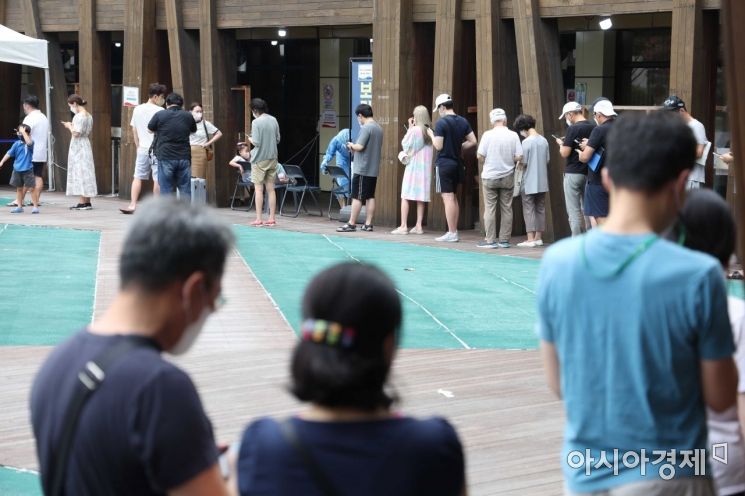
 On the 7th, citizens are waiting for testing at the COVID-19 screening clinic at Songpa-gu Public Health Center in Seoul. Photo by Honam Moon munonam@
[Asia Economy Reporter Kim Young-won] Considering the increase in severe cases and the burden on hospital beds, the quarantine authorities have raised the weekly COVID-19 risk level in non-metropolitan areas from 'medium' to 'high.' The detection rate of the BA.5 variant rose by 9.5 percentage points compared to last week.
On the 9th, the Central Disease Control Headquarters announced that this decision was made considering the rising trends in severe cases and deaths, the number of confirmed cases aged 60 and over, and the increased proportion of cases aged 60 and over relative to ICU medical capacity.
According to the Central Disease Control Headquarters, the severe case bed occupancy rate in non-metropolitan areas was 40.4%, which is 2.8 percentage points higher than that of the metropolitan area. Non-metropolitan areas have 508 severe case beds, about half the number of the metropolitan area's 1,185 beds.
The number of confirmed cases aged 60 and over, who are at higher risk of severe illness and death, is increasing. Lim Sook-young, head of the Central Disease Control Headquarters' situation management team, said, "Due to outbreaks in vulnerable facilities, an increasing trend in cluster outbreaks, the passage of time since the third vaccination, and a fourth vaccination rate of 38%, the size and proportion of confirmed cases aged 60 and over, who are at high risk of severe illness, are increasing."
The proportion of confirmed cases aged 60 and over rose daily: 13.2% in the second week of July, 14.3% in the third week, 17.0% in the fourth week, and 20.2% in the first week of August. In particular, among the elderly, those in their 70s increased from 104.2 to 152.2 per 100,000, and those aged 80 and over increased from 93.3 to 142.9 per 100,000, about 1.5 times the incidence rate compared to the previous week.
The weekly average number of COVID-19 confirmed cases in the first week of August was 97,328 per day, a 22.5% increase from the previous week. The infection reproduction number was 1.14, maintaining above 1 for six consecutive weeks, but it decreased by 0.15 from 1.29 the previous week.
BA.5 Detection Rate Exceeds 70% Both Domestically and in Imported Cases
The detection rate of BA.5, which is leading the current resurgence, was 76.3% in the first week of this month, up 9.5 percentage points from 66.8% in the fourth week of July. It was detected in 75.2% of domestic infections and 78.7% of imported cases, both exceeding 70%.
Previously, BA.5 became the dominant strain as its domestic infection detection rate surpassed 50% from the fourth week of last month.
As of the 6th, an additional 2,020 cases of BA.5 (1,390 domestic, 630 imported), 40 cases of BA.2.12.1 (29 domestic, 11 imported), 70 cases of BA.4 (30 domestic, 40 imported), and 8 cases of BA.2.75 (all imported) were detected.
Accordingly, the total number of Omicron subvariant cases detected domestically are 4,916 for BA.5, 652 for BA.2.12.1, 324 for BA.4, and 24 for BA.2.75.
Regarding the renewed increase in confirmed cases, with nearly 150,000 new cases occurring on this day, Lim explained, "Due to the holiday season, social movement and contact have become more frequent, resulting in a somewhat larger increase."
© The Asia Business Daily(www.asiae.co.kr). All rights reserved.

















