As of 11 AM on the 9th, one more death reported... Missing persons found in underground shopping mall passageways and manhole sewers
230 households and 391 disaster victims counted... 1 highway and 48 general roads closed
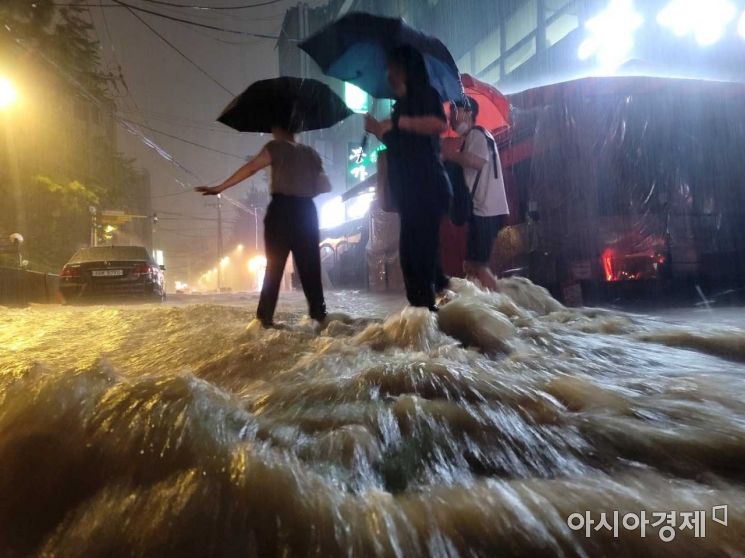 On the night of the 8th, when heavy rain fell mainly in the central region, citizens hurried their steps on the street near Nonhyeon Station in Gangnam-gu, Seoul. Photo by Mun Ho-nam munonam@
[Asia Economy Reporter Lim Cheol-young] The number of casualties is increasing due to the heavy rain that started on the 8th in the central region. It is forecasted that very heavy rain will occur mainly in the central region, Jeonbuk, and northern Gyeongbuk, so the damage is expected to increase further.
According to the Central Disaster and Safety Countermeasures Headquarters on the 9th, as of 11 a.m. that day, casualties from this heavy rain include 8 deaths (4 in Seoul, 3 in Gyeonggi), 6 missing (4 in Seoul, 2 in Gyeonggi), with one more death than the 6 a.m. tally. Injuries were reported as 9 (all in Gyeonggi).
Due to this heavy rain, in Gwanak-gu, Seoul, at 9:07 p.m. on the 8th, a woman in her 40s living in a semi-basement house, her younger sister, and her younger sister’s teenage daughter were found dead one after another due to flooding. Earlier, at 6:50 p.m., a 60-year-old district office employee who was clearing fallen street trees due to the rain in Dongjak-gu, Seoul, died from electric shock, and at 5:40 p.m., one person died due to house flooding.
Deaths also occurred in Gyeonggi. In Gwangju, Gyeonggi, one person was found dead at the site of a collapsed bus stop, and another died due to landslide soil on a road slope. In Hwaseong, one person died at 4:27 a.m. due to being buried by a landslide.
The total number of missing persons is 6. Missing persons disappeared in places such as the underground shopping mall passage in Seocho-gu and manhole sewers, and in Gwangju, Gyeonggi, two people were swept away by floodwaters due to river overflow.
The number of disaster victims is also increasing. As of 11 a.m. that day, the number of disaster victims in Seoul, Gyeonggi, and Incheon was 230 households and 391 people. Most of the disaster victims are known to be staying in schools and gymnasiums. In Dongjak-gu, Seoul, and Gwangmyeong, Gyeonggi, 269 households and 399 people evacuated to nearby community centers and schools.
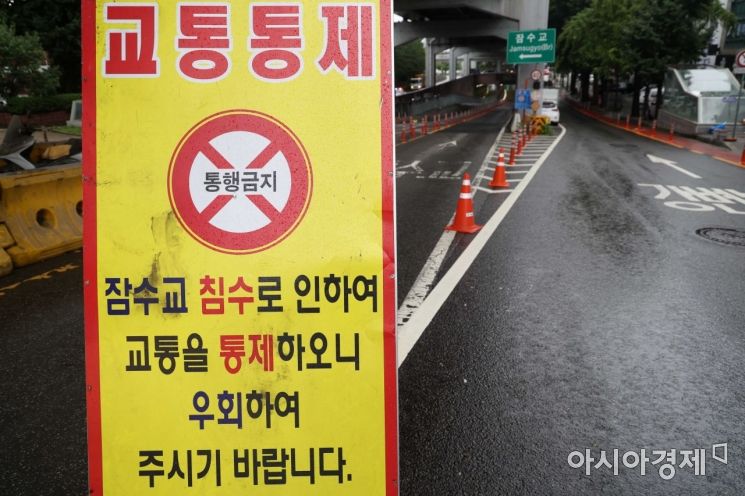 On the 9th, heavy rain centered in the central region caused the Jamsu Bridge in Seoul to be submerged, resulting in a complete closure. Photo by Moon Honam munonam@
Facility damage also continued. There were 741 cases of house and commercial building flooding (684 in Seoul, 54 in Incheon, 2 in Gangwon, 1 in Gyeonggi), 3 cases of retaining wall collapse (1 in Incheon, 2 in Seoul), and 5 cases of soil outflow (4 in Seoul, 1 in Gyeonggi). Additionally, 5 hectares of farmland were flooded. Furthermore, there were 8 cases of railway flooding (7 in Seoul, 1 in Incheon), 1 case of retaining wall collapse (Incheon), 2 cases of embankment loss (Gyeonggi), and 5 cases of slope failure (1 in Yeoncheon, Gyeonggi; 1 in Namyangju; 2 in Seongnam; 1 in Seoul).
Due to the continuous heavy rain, many roads were also closed. Traffic was suspended on 48 general roads including 1 expressway (Yongin?Seoul), 3 underpasses, 26 riverside parking lots, and 45 riverside areas.
The Central Disaster and Safety Countermeasures Headquarters announced that as the damage expands, they will dispatch on-site situation managers related to the heavy rain to Seoul and Gyeonggi, quickly assess the damage situation, provide relief to disaster victims, and promote emergency recovery.
© The Asia Business Daily(www.asiae.co.kr). All rights reserved.


















