Korea Federation of SMEs Surveys Impact of 52-Hour Workweek on Small Shipbuilding Workers
55% of Workers Say "Work-Life Balance Worsened"... 13% Say "Improved"
93.3% Cite 'Wage Reduction Due to Shortened Working Hours' as Reason for Decline
77% Support Expansion of Overtime Work Units

[Asia Economy Reporter Kwak Min-jae] More than half (55%) of workers in small and medium shipbuilding industries reported a decline in their quality of life after the implementation of the 52-hour workweek system.
The Korea Federation of SMEs announced on the 9th the results of the ‘One-Year Impact Survey on Workers in Small and Medium Shipbuilding Industries after Full Implementation of the 52-Hour Workweek System,’ conducted from the 27th of last month to the 2nd of this month with 300 workers from small and medium shipbuilding companies. This survey was conducted to understand changes in workers’ work-life balance (quality of life), wage levels, and necessary system improvements before and after the full application of the 52-hour workweek system to workplaces with five or more employees for one year.
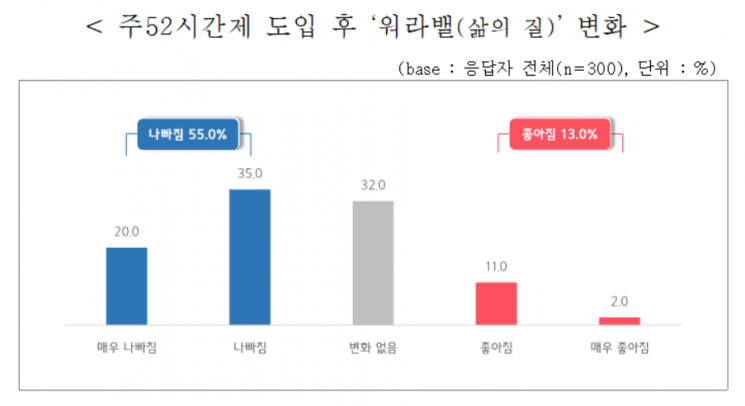
As a result, more than half (55.0%) of workers in small and medium shipbuilding industries responded that their work-life balance worsened after the introduction of the 52-hour workweek system. Only 13.0% responded that it improved.
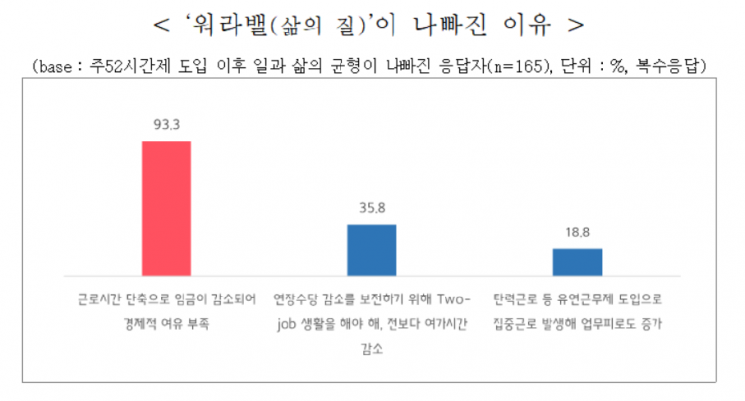
The main reason for the deterioration in work-life balance was ‘lack of economic leeway due to reduced wages from shortened working hours’ (93.3%). This was followed by ‘reduced leisure time due to two-job life to compensate for decreased overtime pay’ (35.8%) and ‘increased work fatigue due to the introduction of flexible work systems such as flexible working hours’ (18.8%).
Regarding the impact of the 52-hour workweek system on wages, 73.3% of workers responded that their wages ‘decreased,’ indicating that most respondents experienced a wage reduction. They reported an average monthly wage decrease of 601,000 KRW compared to before the system’s implementation.
As a response to wage reduction, the highest proportion (73.2%) said they ‘accepted the reduced income without any particular countermeasures.’ This was followed by ‘having additional family members work to secure other sources of income’ (22.3%) and ‘seeking jobs to work outside regular hours (two-job life)’ (21.8%).
Regarding the expansion of the current 12-hour unit limit on overtime work to a monthly unit upon labor-management agreement, 77.0% were in favor, showing that the majority are positive about expanding the management unit for overtime work.
If the overtime work unit is expanded to one month, more than half (58.3%) responded that the most appropriate health protection measure would be ‘guaranteeing at least one continuous day off per week.’ This was followed by ‘guaranteeing at least 11 hours of continuous rest between working days’ (22.7%) and ‘no separate measures needed’ (17.7%).
Lee Tae-hee, Head of the Smart Job Division at the Korea Federation of SMEs, said, “Although one year has passed since the full implementation of the 52-hour workweek system, many workers in small and medium enterprises feel difficulties in maintaining their livelihoods due to reduced overtime pay rather than enjoying an evening life thanks to reduced working hours.”
He added, “Since workers also want a flexible overtime system that allows them to work more if needed, we hope the government will promptly promote the introduction of a monthly unit overtime work system.”
© The Asia Business Daily(www.asiae.co.kr). All rights reserved.



















