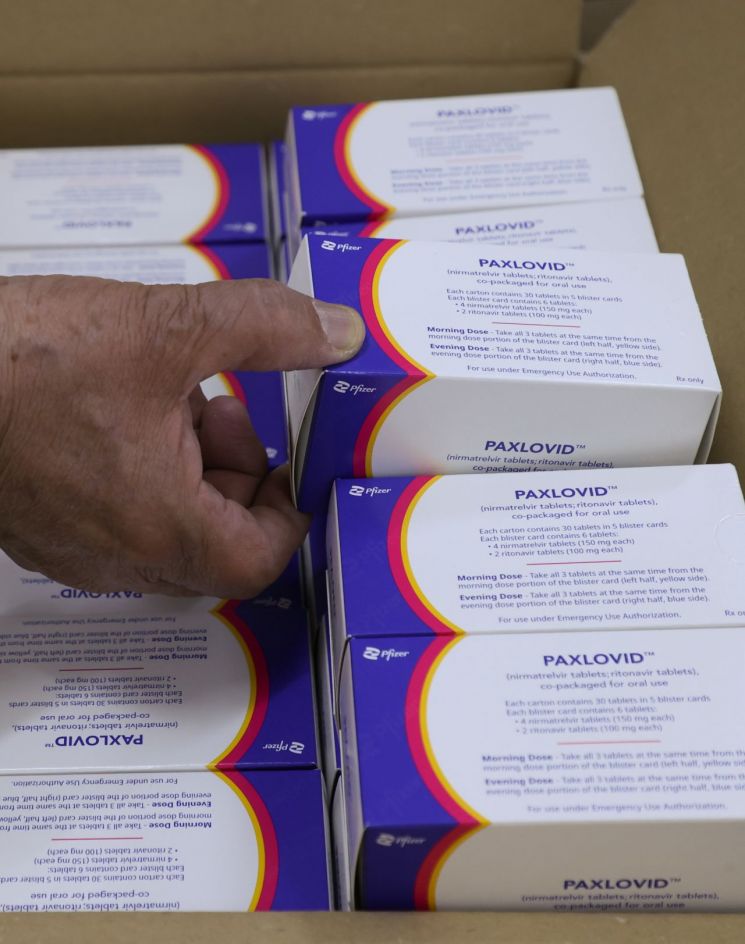
[Asia Economy Reporter Kim Young-won] Although the government advocates for ‘targeted quarantine,’ which focuses on rapid testing, treatment, and prescription for high-risk groups, the prescription rate of COVID-19 oral antiviral drugs compared to domestic confirmed cases remains low.
From the 28th of last month to the 4th of this month, a total of 25,732 prescriptions were made for oral COVID-19 treatments Paxlovid and Lagevrio. During the same period, with 625,004 confirmed cases, the prescription rate was approximately 4.12%, meaning only 4 out of every 100 confirmed patients received antiviral treatment. When limited to confirmed cases aged 60 and above, the prescription rate rises to 21.10%.
However, the prescription rate is relatively low compared to overseas. In the United States, Paxlovid prescriptions reached 1.26 million last month, with more than one-third of confirmed cases during that period receiving Paxlovid. The background for this includes creating an environment that allows rapid prescriptions, such as granting pharmacists the authority to prescribe Paxlovid starting last month.
Domestically, efforts have also been made to increase oral antiviral prescriptions. A ‘high-risk group fast track’ was established to enable high-risk groups such as the elderly and patients with underlying conditions to receive testing and antiviral prescriptions within a day, and the goal is to expand one-stop treatment institutions to 10,000. The number of pharmacies supplying antiviral drugs has also been expanded from about 1,000 to 2,000.
Nevertheless, the prescription rate for oral antivirals is not easily increasing, primarily due to the complexity of the drugs, which makes clinics reluctant to prescribe them. For Paxlovid, there are 23 contraindicated drugs distributed domestically, and among these, 5 cannot be administered with Paxlovid even if their use is stopped. In particular, ‘St. John’s Wort,’ one of the contraindicated components, is included in over-the-counter drugs and health supplements, making it difficult to verify even through DUR (Drug Utilization Review) services.
Jung Ki-seok, a member of the National Infectious Disease Crisis Response Advisory Committee, advised actively prescribing Lagevrio, which is relatively easier to prescribe. Jung said, “It is complicated for doctors to prescribe this complex drug (Paxlovid). They must take full responsibility if side effects occur or if it is prescribed incorrectly.” He added, “Neighboring Japan prescribes Lagevrio 70% of the time, and Hong Kong is similar.” Although Lagevrio is less effective than Paxlovid in preventing severe illness and death, it is better than not using any antiviral at all.
There are also suggestions that to expand Paxlovid prescriptions, high-risk patients such as those with underlying conditions should receive COVID-19 treatment and prescriptions at large hospitals they usually visit. Since these hospitals are well aware of the patient’s disease and medication history, it is easier to avoid contraindicated drugs when prescribing. Currently, Paxlovid prescriptions are not blocked at large hospitals, but home treatment patients are mostly connected to local clinics.
Professor Cheon Eun-mi of the Respiratory Medicine Department at Ewha Mokdong Hospital said, “Due to issues such as fees, tertiary general hospitals have not registered as respiratory treatment centers, so they mostly do not provide face-to-face treatment or prescription connections.” She added, “If one-stop treatment had started from university hospitals with abundant medication information, tertiary hospitals would have first gained experience in prescribing and shared that experience with private clinics, enabling prescriptions without fear.” She continued, “Even now, cooperation is needed so that tertiary general hospitals can fulfill their original roles.”
Jung also announced the results of the advisory committee meeting held the day before and urged improvements to the system to facilitate prescriptions and easy access to DUR at large and general hospitals.
© The Asia Business Daily(www.asiae.co.kr). All rights reserved.

















