Drowning in Water Hazard... Whether It Qualifies as a 'Public Facility' Is Key
"Management Responsibility vs User Negligence Must Be Clearly Examined"
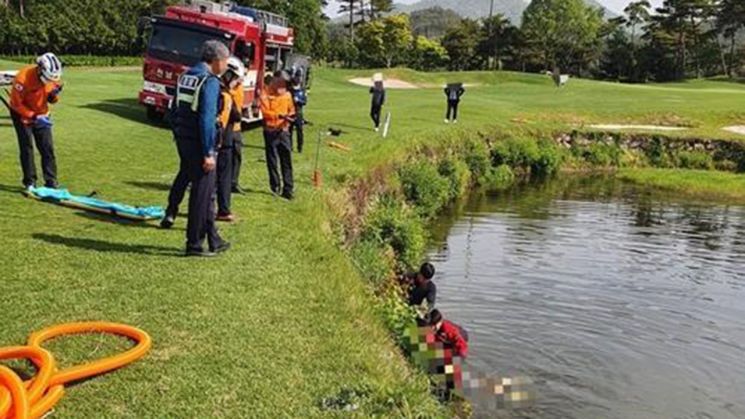 119 Rescue Team Rescuing a Golf Course Visitor Who Fell into a Pond (Photo by Suncheon Fire Station)
[Asia Economy Reporter Jang Hee-jun] If someone falls into a pond on a golf course while trying to retrieve a ball, is it the fault of the careless user, or the responsibility of the golf course for failing to prevent the accident? Recently, controversy has been spreading as the police announced their intention to consider applying the Serious Accidents Punishment Act to the golf course following the death of a golf course user who drowned in a water hazard.
According to the police on the 9th, in April, a woman in her 50s drowned in a water hazard with a depth of 3 to 4 meters at a golf course in Suncheon-si, Jeollanam-do. The Jeonnam Police Agency, which is investigating the case, booked caddie A, who assisted the game at the time of the accident, on charges of professional negligence causing death on the 7th of this month, and announced that it would review whether to apply the Serious Accidents Punishment Act to the golf course.
As the severity of punishment differs, attention is focused on whether the police’s policy will actually lead to the application of charges. In the past, when a fatal accident occurred at a golf course, the person responsible was charged with professional negligence causing death, which carried a penalty of imprisonment for up to five years or a fine of up to 20 million won. However, if prosecuted under the Serious Accidents Punishment Act, the punishment is much harsher, with imprisonment of one year or more or a fine of up to 1 billion won.
Can a golf course pond really be considered a ‘public use facility’?
The Serious Accidents Punishment Act, which came into effect in January this year, mainly strengthens criminal penalties for those responsible who neglect their duty to prevent risks in the event of serious accidents, including fatalities. To apply this law to the current accident, it must be determined whether it falls under the concept of a ‘serious civic accident,’ and the key issue will be whether the golf course can be classified as a ‘public use facility.’
A ‘public use facility’ refers to buildings or facilities used by many people that affect users’ health or public hygiene. The police are reviewing the application of the law based on the judgment that golf courses may also meet these conditions. However, this is controversial. Unlike the clubhouse, which clearly meets the conditions, it is somewhat ambiguous whether the field or the pond within it can be considered a building.
Heavy penalties under the law... What if the scope of application expands?
If the Serious Accidents Punishment Act is applied to this drowning accident, it will be the first case of a serious civic accident. The industry is concerned that if the law’s application expands to various incidents and accidents within golf courses, it will place a significant burden on golf course operations. Representative examples include frequent accidents such as being hit by a ball struck from behind or golf cart overturns, where responsibility is unclear.
From the perspective of the Serious Accidents Punishment Act, if accidents occur frequently not due to user mistakes but because of specific defects in course design, responsibility can be assigned. In the case of cart accidents, if caused by a caddie’s poor driving skills, it is unrelated, but if the driving course is unstable or there are curves or obstacles that significantly increase the risk of vehicle overturning, it may be considered a design or management defect.
Given this situation, golf courses are coming up with desperate measures to secure exemption reasons. Recently, a golf course in Gyeonggi-do is known to have distributed safety rule notices to users and obtained signatures confirming they have read them. However, since such ‘guidance’ level measures are unlikely to be recognized as fulfilling safety obligations, golf courses are expected to face deeper concerns about facility preparation and manpower reinforcement.
“Many controversies and significant ripple effects... Law application should be cautious”
Lawyer Yang Seung-chul of Haedam Law Firm pointed out, “Generally, ponds within golf courses serve functional and landscaping roles, so holding criminal liability by viewing this as intentional neglect of safety duties could be controversial.” He added, “While warning signs or fences can be installed around water hazards, considering applying the Serious Accidents Punishment Act simply because such measures were not taken raises questions about whether it aligns with the law’s legislative intent.”
Professor Jang Young-soo of Korea University Law School advised, “Although criminal cases rarely recognize strict liability, the Serious Accidents Punishment Act holds management and operation accountable rather than just actions, which has raised constitutional concerns. While it may be possible to interpret golf courses as public use facilities in drowning accidents, public opinion questioning the continuous expansion of the law’s scope should be considered, and it is necessary to carefully examine whether the golf course’s management was truly negligent.”
© The Asia Business Daily(www.asiae.co.kr). All rights reserved.

















