Selected Si-Gun Areas Promote Introduction Through 'Regulatory Sandbox' Applications
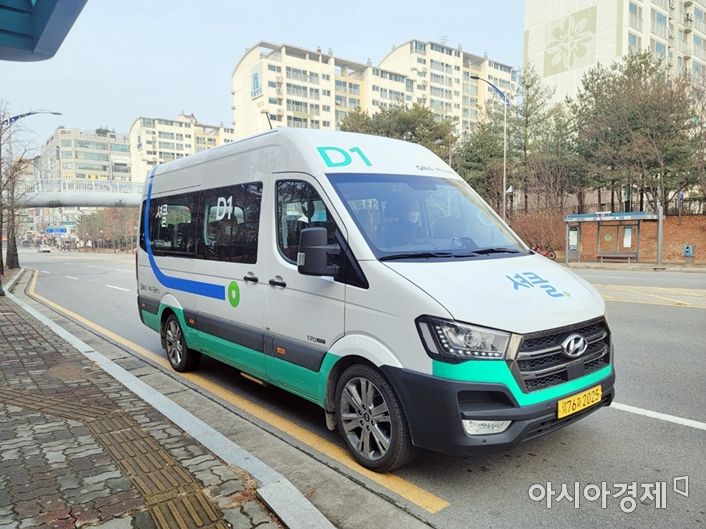
[Asia Economy Reporter Ra Young-cheol] Gyeonggi Province announced on the 9th that it will expand the new concept transportation service "DRT (Demand Responsive Transport, hereinafter DRT)," which flexibly transports passengers without fixed routes and predetermined schedules.
The characteristic of DRT is that it uses artificial intelligence (AI) technology to generate the optimal travel route in real time according to actual passenger demand.
The province is considering introducing DRT mainly in areas such as 2nd and 3rd phase new towns and rural fishing villages where existing transportation systems cannot meet transportation demand.
Earlier, since January, on-site inspections were conducted in cities and counties, and seven cities/counties (Suwon, Yangju, Goyang, Hanam, Pyeongtaek, Ansan, Hwaseong) that are actively interested in introduction were selected as preliminary target areas, and applications for regulatory sandbox for DRT operation were submitted.
According to the Passenger Transport Service Act, DRT business can only operate in rural areas or areas lacking public transportation. For new towns and other areas that do not fall under this category, special regulatory exemptions through regulatory sandbox applications are required.
The province plans to prioritize the introduction of DRT in the seven cities/counties that applied for the regulatory sandbox in the second half of the year once government (Ministry of Land, Infrastructure and Transport) approval is obtained.
Along with this, a demand survey for DRT project target areas will be conducted by the 19th for 31 cities and counties within the province. The main selection criteria are DRT operation suitability (transportation status, etc.), project promotion plans, and investment plans for project costs.
The province will select suitable areas for DRT operation among the cities and counties that expressed willingness to participate through a project target area review committee in the second half of the year and promote project expansion.
Park No-geuk, Director of the Transportation Bureau, said, "Currently, residents of Gyeonggi Province experience many inconveniences due to bus shortages not only for commuting to and from Seoul but also for local travel," adding, "We expect that through the expansion of the DRT project, residents will be able to easily and freely travel to their desired destinations."
© The Asia Business Daily(www.asiae.co.kr). All rights reserved.
![From Hostess to Organ Seller to High Society... The Grotesque Scam of a "Human Counterfeit" Shaking the Korean Psyche [Slate]](https://cwcontent.asiae.co.kr/asiaresize/183/2026021902243444107_1771435474.jpg)
















