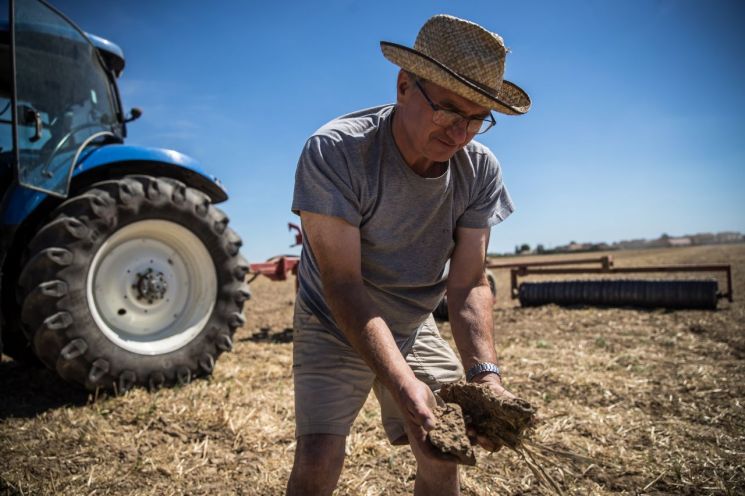
[Asia Economy Reporter Park Byung-hee] Europe is facing the worst drought crisis in history following an early heatwave this year. Water shortages are causing serious disruptions not only to drinking water but also to agriculture and livestock, logistics, and power generation.
On the 8th (local time), the British daily The Guardian reported that the entire Europe, including France, Spain, Italy, Germany, the Netherlands, Switzerland, and Norway, is facing a severe drought crisis, stating that "water shortages due to global warming are becoming the new normal."
According to the European Drought Observatory (EDO) under the European Union (EU), drought warnings were already issued for 45% of the EU area by mid-last month, with red alerts issued for 15% of the area.
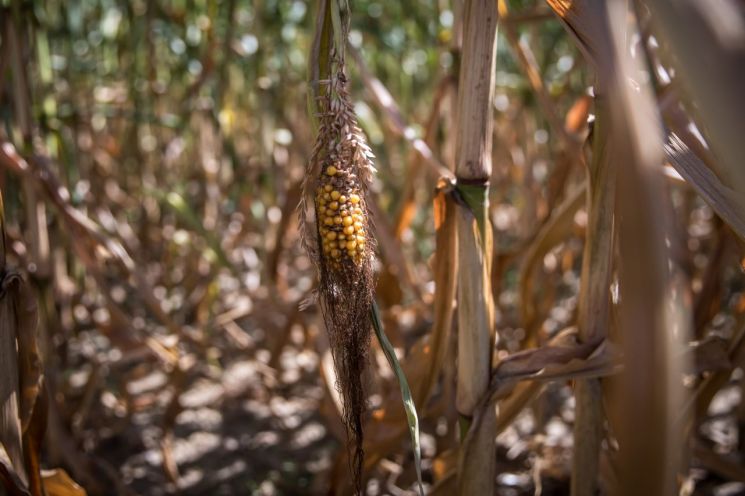
France is experiencing its worst drought crisis since records began in 1958. Last month's rainfall was 85% less than the average. Currently, water supply restrictions have been imposed in 93 out of 96 departments on mainland France. Due to the severe drought, France's grain production, as a major agricultural country, is also expected to be affected. The French Ministry of Agriculture expects this year's corn harvest to decrease by more than 18% compared to last year. Farmers and livestock producers have warned of severe milk shortages this fall and winter due to feed shortages.
Spain's water storage capacity has dropped to a record low of 40%. The Spanish government stated that rainfall over the past three months was less than half of the average, calling it the worst drought in 60 years.
The flow of the Po River, Italy's longest river, has dropped to about 10% of the average, and the water level is about 2 meters lower than usual. The Italian government declared a state of emergency in five northern provinces experiencing severe drought early last month and began distributing drinking water. The northern region of Italy has seen no continuous rainfall since November last year. Rice production in the Po River region, which accounts for 40% of Italy's agricultural output, is also expected to be severely affected. Italian farmers have warned that crop yields could decrease by up to 60%. The northern region of Italy has seen no continuous rainfall since November last year.
The water level of the Rhine River in Germany has fallen to a level lower than during the severe drought crisis in 2018. In 2018, severe drought caused maritime logistics via the Rhine River to be suspended for 132 days, dealing a serious blow to the European economy. The Rhine River is a major transport route for crude oil and coal to Belgium and the Netherlands. Currently, ships are transporting only about 25% of their usual cargo to avoid the risk of sinking.
In Switzerland, severe drought is expected to reduce cheese and milk production. The Dutch government officially declared a water shortage last week and urged citizens to refrain from buying new cars and not to fill swimming pools completely. The Belgian Meteorological Service announced that July this year was the driest July since 1885.
Norway has decided to limit electricity exports to Europe as the water shortage for hydropower generation worsens due to severe drought. Terje Aasland, Minister of Petroleum and Energy, said that if water levels for hydropower remain low, domestic power supply will be prioritized, and electricity exports to Europe will be restricted.
According to Norwegian water authorities, water levels in the southern region, the center of Norway's hydropower exports, are the lowest since 1996. The current water level is only 49.3% of storage capacity, significantly lower than the average of 74.4%.
© The Asia Business Daily(www.asiae.co.kr). All rights reserved.


















