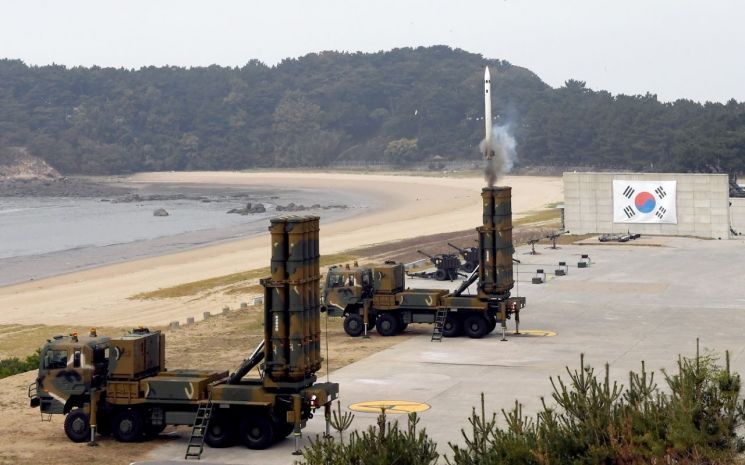
[Asia Economy Yang Nak-gyu, Military Specialist Reporter] As countries around the world are upgrading their weapon systems due to the Ukraine crisis, defense stocks are benefiting. Recently, with the Polish government signing a Framework Agreement for the export of FA-50 light attack aircraft, K2 tanks, and K9 self-propelled howitzers, it is becoming certain that South Korea’s defense exports will enter the global top 5. Some predict that Polish exports will boost defense sales in the mid to long term and significantly improve stock price trends.
Defense companies that achieved export success to Poland have been rising from their lows over the past three months. Korea Aerospace Industries (KAI) rose about 30%, Hyundai Rotem about 46%, and LIG Nex1 about 35%.
The most notable company is undoubtedly LIG Nex1. LIG Nex1 announced that its operating profit for the first half of 2022 (January to June) was provisionally estimated at 97.7 billion KRW, a 134.8% increase compared to the same period last year. Sales during the same period increased by 16.1% to 917.4 billion KRW.
The defense industry is focusing on LIG Nex1’s next-generation growth businesses. These include the Korean Positioning System (KPS) development project, which involves ultra-precise synthetic aperture radar (SAR) mounted on satellites, as well as military satellite communication terminals, electro-optical (EO), and infrared (IR) sensors.
Our military plans to invest 16 trillion KRW in space development for defense over the next 10 years. Through this, five large reconnaissance satellites will be introduced as part of the 425 project to monitor North Korean nuclear missiles, along with micro reconnaissance satellites and KPS satellites, known as the “Korean GPS,” to be gradually deployed by the 2030s. Especially, since the Korea-US summit agreed to strengthen cooperation in space fields including KPS, the KPS development project is expected to gain momentum.
The KPS control system will be operated separately by civilian and military sectors to prevent interruptions during satellite operation. The civilian satellite control center will be established at Cheongju Airport, while the military satellite control center will be set up at the Air Force Operations Command’s Space Operations Squadron. Additionally, the military will possess four antenna stations and six monitoring stations.
Development of cargo drones is also accelerating. The company is exploring market entry into the future urban air mobility (UAM PAV, Urban Air Mobility Personal Air Vehicle) sector. Once the drone system capable of transporting high-weight cargo of about 200 kg based on hydrogen energy is completed by 2025, commercialization linked with UAM and application as military transport drones for the Army, Navy, Air Force, and Marine Corps are expected.
Overseas order marketing activities are also being strengthened. In July, LIG Nex1 showcased the 2.75-inch guided rocket “Bigung” at RIMPAC, the world’s largest maritime joint exercise hosted by the United States, attracting attention from naval officials of various forces. Going forward, the company plans to enhance the status of K-defense in the Asian region through international defense exhibitions held in Indonesia, Thailand, and other countries.
An LIG Nex1 official said, “We will continue to secure new growth engines through expanding future and new businesses and pioneering overseas markets.”
© The Asia Business Daily(www.asiae.co.kr). All rights reserved.

















