Heavy Rain Mainly in Central Region from the 8th
'High-Voltage Batteries Over 300V'
Safety Devices Activate Even if Water Enters
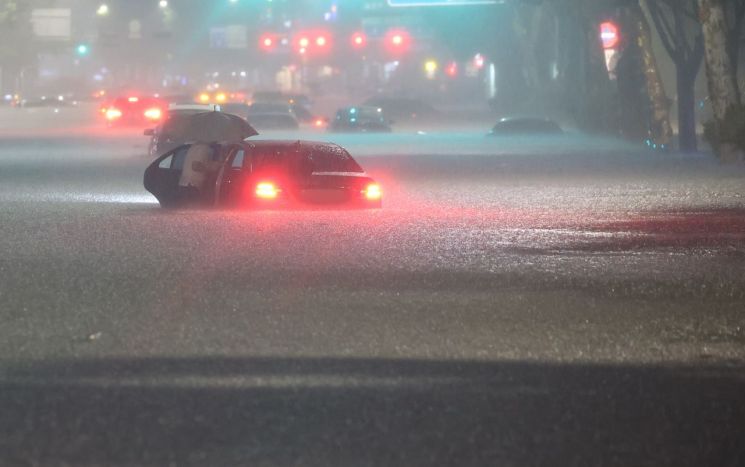 On the night of the 8th, a driver is evacuating after a vehicle was submerged on a road near Daechi Station in Gangnam-gu, Seoul.
 [Image source=Yonhap News]
[Asia Economy Reporter Kim Jung-wan] Overnight, the Seoul metropolitan area experienced 'record-breaking heavy rain,' drawing attention to the operability of electric vehicles (EVs). Since EVs operate with high-voltage batteries, concerns have arisen about the risk of electric shock and whether they can be driven in flooded conditions. Conventional vehicles, unlike EVs, are designed with waterproofing measures during manufacturing to prevent flood damage. Therefore, they can pass through water approximately 50cm deep without stalling.
Experts emphasize that while the possibility of electric shock in EVs is minimal and they can be operated even during heavy rain, it is safer to use public transportation whenever possible. This is because unpredictable problems may occur in situations where vehicles could be submerged.
According to local governments on the 9th, around 8 p.m. on the previous day (the 8th), heavy rain caused sewage to backflow near the Gangnam Station intersection, flooding roads and lanes. Repeated flooding incidents have increased anxiety among drivers of electric vehicles and hybrid cars that use high-voltage systems.
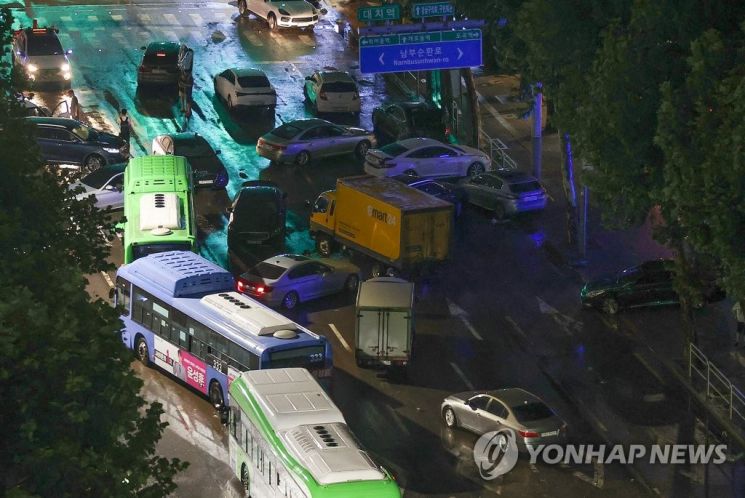 Cars that were submerged on the road near Daechi Station in Gangnam-gu, Seoul, on the morning of the 9th after heavy rain are parked. [Image source=Yonhap News]
◆ Vehicle Inoperability Detected by Sensors... Use 'Public Transportation' During Heavy Rain
Experts stress that even if EV batteries are exposed to rain, the likelihood of the driver receiving an electric shock is almost nonexistent. According to the industry, EV batteries are housed in special packs with enhanced waterproofing. If a short circuit occurs, an automatic cutoff function activates, and if the vehicle is submerged, flood sensors operate to isolate the battery from water.
Furthermore, even if moisture enters the battery causing abnormalities, various power components work interdependently, so if a problem arises in the battery, safety devices immediately activate to prevent vehicle malfunction. For example, EV batteries have moisture detection sensors that automatically shut off power when water seeps in, preventing electric shock situations in advance.
However, blindly trusting safety devices is risky. Industry insiders advise that since EVs have more than twice the number of electrical components compared to internal combustion engine vehicles, it is best to avoid flooded areas despite the presence of double or triple safety measures.
In summary, when considering EV operability during flooding caused by heavy rain, the consensus is that EVs can be driven unless their sensors indicate a problem. However, the possibility of accidents cannot be completely ruled out. This is why experts recommend using public transportation such as buses or subways during heavy rain, for both EVs and conventional vehicles.
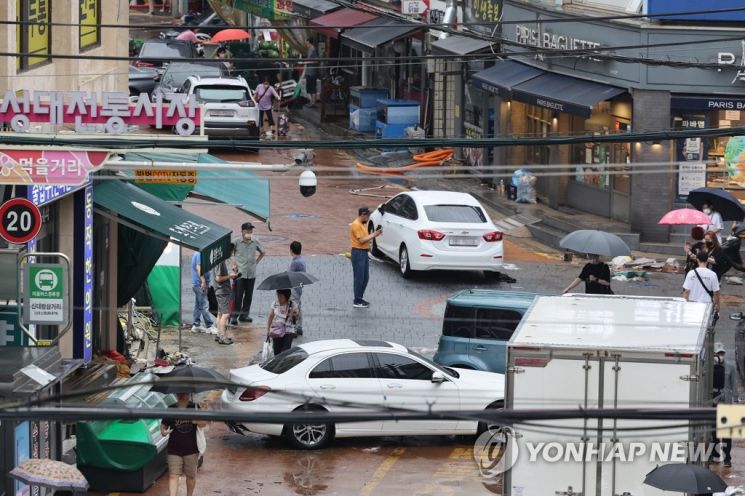 On the morning of the 9th, cars submerged by the overnight heavy rain are tangled and stopped on the road near Sindebang Samgeori in Dongjak-gu, Seoul.
 [Image source=Yonhap News]
◆ Charging EVs During Heavy Rain Raises Risk of Short Circuits
Meanwhile, caution is also necessary when charging EVs outdoors on rainy days. EVs are designed with waterproof charging ports and various shock protection features, so charging outdoors in the rain generally poses little risk. However, if there is no canopy (cover), water can accumulate inside the charging gun, increasing the risk of short circuits.
Even if chargers and charging inlets are made of insulating materials, rainwater ingress can lead to risks of explosion or electric shock. Therefore, during heavy rain, indoor charging stations should be used.
If an EV is struck by lightning while charging, do not start the vehicle and have it repaired immediately. EVs are fundamentally equipped with multiple protective fuses to handle overcurrent, designed so that lightning strikes travel along the vehicle’s surface to the ground. However, lightning strikes during charging may cause component damage.
Meanwhile, heavy rain is expected to continue from the central regions to Jeonbuk and Gyeongbuk for the time being. According to the Korea Meteorological Administration, expected rainfall by the 10th is 100-250mm in the Seoul metropolitan area, inland Gangwon, Gangwon mountains, northern Chungcheong, and northwestern inland Gyeongbuk; 50-150mm in eastern Gangwon, southern Chungcheong, northern Gyeongbuk (excluding northwestern inland), and the five western islands; and 20-80mm in Jeonbuk, Ulleungdo, Dokdo, and southern Gyeongbuk (on the 10th). Areas such as southern Gyeonggi, southern inland Gangwon, southern Gangwon mountains, and northern Chungcheong are expected to receive very heavy rainfall exceeding 350mm.
© The Asia Business Daily(www.asiae.co.kr). All rights reserved.



















