Hankyungyeon Announces 'Improvement Measures for Inheritance Tax System of Public Interest Corporations to Revitalize Corporate Succession'
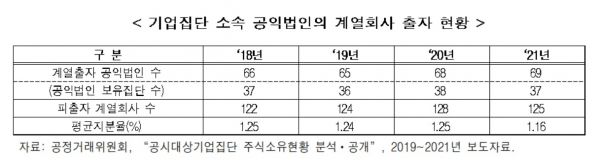 Status of affiliate company investments by public interest corporations belonging to corporate groups.
 [Photo by Korea Economic Research Institute]
[Asia Economy Reporter Han Ye-ju] A call has been made to ease regulations on stock contributions to public interest corporations to alleviate the contraction of corporate activities caused by the 'punitive inheritance tax.'
On the 9th, the Korea Economic Research Institute (KERI) stated in its report titled "Improvement Measures for the Inheritance Tax System on Public Interest Corporations to Revitalize Corporate Succession" that easing regulations on public interest corporations would promote donations as well as activate corporate succession.
According to the Fair Trade Commission, from 2018 to last year, the number of public interest corporations affiliated with publicly disclosed business groups has remained stagnant, and the average shareholding ratio of affiliated companies in public interest corporations has actually decreased. KERI expressed concern that the strengthening of stock restriction regulations on public interest corporations is causing the activities of business group public interest corporations to shrink.
According to the "2021 World Giving Index" published by the international charity organization CAF, South Korea's donation participation index scored 22 points, ranking 110th out of 114 surveyed countries, placing it in the lowest group. The proportion of legacy donations among total donations is also only 0.5%, which is very low compared to other advanced countries (United States 9%, United Kingdom 33%).
With the recent emphasis on ESG (Environmental, Social, and Governance) management, it has become important for companies to identify and solve social issues faced by local communities or the nation through public interest foundations. However, KERI pointed out that in Korea, stock restrictions on public interest corporations make it difficult for companies to play a leading role.
Researcher Lim Dong-won of KERI stated, "It is necessary to increase public interest activities in our society, but donations, which are the source of funding, are insufficient, so the current regulation-oriented system should be eased to promote donations." He added, "The reduction in activities of business group public interest corporations could lead to a reduction in essential public interest projects, and from the perspective that society is the beneficiary of public interest realization, a reduction in public interest projects would translate into social costs."
KERI emphasized that unlike major countries where management rights can be defended or succeeded through various methods such as dual-class voting rights, issuance of veto shares, and stock contributions to public interest foundations, Korea restricts or prohibits these institutional devices, making smooth management succession difficult. In particular, for sustainable growth of the Korean economy, large corporations need to continue expanding investments and growth, but currently, only succession support for small and medium-sized enterprises is provided, not for large corporations, resulting in significant corporate succession costs.
Researcher Lim said, "Overseas large corporations can reduce inheritance tax burdens and maintain management rights through legal systems during management succession," and added, "Considering that Korea lacks management defense measures and effectively blocks control by public interest corporations, it is necessary to reconsider whether the current system is desirable compared to other countries."
Along with this, KERI stressed that more focus should be placed on how public interest activities are carried out with the contributed stocks rather than on the issue of stock contributions to public interest corporations. In particular, since public interest corporations related to mutual investment restriction business groups have better financial conditions than general public interest corporations, easing stock restriction regulations is necessary to increase expenditures on public interest projects. The current inheritance tax system exempts inheritance and gift taxes only on 5% for public interest corporations related to mutual investment restriction business groups, but this ratio should be raised to 20% for all public interest corporations, as in the United States.
Researcher Lim stated, "If an appropriate burden is imposed institutionally during the corporate succession process, it can stimulate entrepreneurs' motivation and invigorate the overall economy," and mentioned, "If, as in the Wallenberg case, active public interest activities by public interest corporations are realized as a counterbalance to corporate succession, public interest corporations act as substitutes for public interest projects that the government should carry out with taxes, so tax support for them can secure legitimacy."
© The Asia Business Daily(www.asiae.co.kr). All rights reserved.
![Clutching a Stolen Dior Bag, Saying "I Hate Being Poor but Real"... The Grotesque Con of a "Human Knockoff" [Slate]](https://cwcontent.asiae.co.kr/asiaresize/183/2026021902243444107_1771435474.jpg)
















