Movie 'Hansan' Features Korean Subtitles
Director Kim Han-min: "A Bold Attempt After Much Deliberation"
Content Consumers Accustomed to OTTs Offering Korean Subtitles
Legislation Needed to Expand Accessibility Rights for the Hearing Impaired
 Large electronic billboard poster of 'Hansan: Rising Dragon' starring Park Hae-il and Byun Yo-han. The photo was taken on the 1st at a movie theater in Seoul featuring the film's promotional materials. [Image source=Yonhap News]
[Asia Economy Intern Reporter Kim Gun-chan] Korean movies and dramas are featuring Hangul subtitles. This is analyzed as a result of an increasing number of content consumers becoming accustomed to Hangul subtitles due to the spread of OTT (Over The Top ? services providing various videos such as movies and dramas over the internet). There are also voices calling for more active production of Hangul subtitles as a means to guarantee content accessibility for the hearing impaired.
'Hansan: Rising Dragon,' which was released on the 27th of last month and surpassed 4.5 million cumulative viewers, succeeded at the box office by unusually including Hangul subtitles for Korean dialogue in a theatrical film. Subtitles appear during the late part of the movie in the naval battle scenes of the Joseon navy and the land battle scenes of the militia. The line "Fire!" spoken by actor Park Hae-il, who plays Admiral Yi Sun-shin, appears at the bottom of the screen just like conventional subtitles.
Director Kim Han-min, who produced Hansan, explained in a media interview that the Hangul subtitles were "a courageous attempt after much deliberation," adding, "We had no choice but to use subtitles to faithfully convey the essence and vividly express the intensity of the war."
Audiences responded positively to this fresh attempt to handle Korean dialogue with Hangul subtitles. Kim, a university student who watched Hansan at a theater last weekend, said, "Usually, when watching Korean movies, I often have trouble hearing the dialogue clearly. This time, even though the battle scene sounds were loud, the subtitles at the bottom allowed me to fully understand the characters' lines and the situation." Online movie communities also shared comments such as, "It passed by so smoothly without any sense of alienation, which was nice," and "I don’t like full subtitles, but I think partial subtitles are necessary where the dialogue is hard to hear."
Experts analyze that audiences likely felt the effect of the Hangul subtitles. Cultural critic Jung Deok-hyun said about the audience reactions, "Although subtitles can be an element that breaks immersion, the director had a reason to use them," and explained, "There was an actual effect from the subtitles, which is why many viewers responded positively." Cultural critic Kim Heon-sik evaluated, "Subtitles are a consideration for fans and audiences," adding, "Although the kind and communicative approach through subtitles came later compared to other genres, it is welcome."
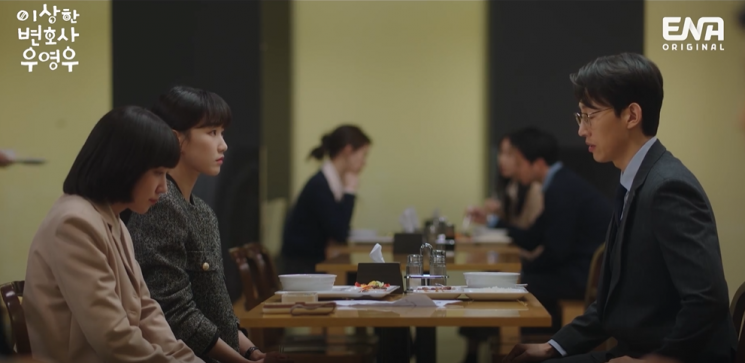 Closed captions are used in "Extraordinary Attorney Woo," which not only display Woo Young-woo's dialogue but also various sounds occurring in the scene, such as the sound of a door closing, in Korean subtitles.
 Photo by ENA capture
Until now, it was rare for standard Korean dialogue in movies or dramas to be accompanied by Hangul subtitles. Only in cases such as the movie 'Mogadishu' released last year, 'Steel Rain 2: Summit' released in 2020, and the tvN drama 'Our Blues' aired this year, were Hangul subtitles provided for North Korean dialects or Jeju dialect lines.
It is analyzed that audiences, accustomed to Hangul subtitles provided by OTT platforms, are responding positively to the breaking of the unwritten rule in the film and drama industry by the appearance of Hangul subtitles. Currently, most OTT platforms support Hangul subtitle services, although the number of contents provided varies.
Netflix provides Hangul subtitles for most of its content. According to the Korea Blind Union, as of the 8th, Netflix offers a total of 130 types (1,327 episodes) of audio description programs. Especially for original content produced domestically, Netflix provides 'closed captions' that display all sounds as subtitles. For example, in the popular drama 'Extraordinary Attorney Woo,' not only Woo Young-woo’s dialogue but also various sounds occurring in the scene, such as a door closing, are rendered as Hangul subtitles.
Domestic OTT providers such as Wavve and Watcha are also increasing the number of contents with Hangul subtitles. Watcha currently offers Hangul subtitles for about 240 titles, and Wavve has increased the number of contents with added Hangul subtitles to 12.
Cultural critic Jung Deok-hyun emphasized the phenomenon of content consumers becoming accustomed to Hangul subtitles, saying, "As video content consumption itself becomes globalized, the 'one-inch barrier' mentioned by director Bong Joon-ho is breaking down," and added, "Subtitles did not feel alien to consumers."
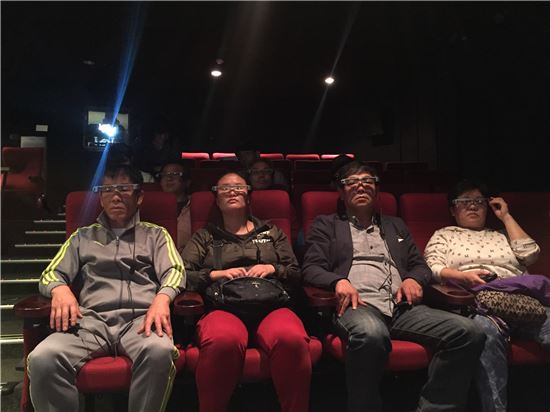 Deaf and hard-of-hearing individuals are watching a movie in a theater while wearing glasses that provide subtitle services. Photo by Jangaeukwonikmunje Yeonguso
Hangul subtitle services in the film and OTT industries are not simply provided for viewer convenience. They are also related to guaranteeing content accessibility for the hearing impaired.
Regarding Hangul subtitle services for the hearing impaired, the OTT industry’s situation is relatively better, but the film industry still has a long way to go. Kim Cheol-hwan, an activist from Barrier Removal, said, "Hangul subtitles are produced through support from the Film Development Fund," adding, "The budget is limited, so public funds alone have limitations."
Kim suggested, "Currently, there is no legislation requiring film production companies to create Hangul subtitles," and proposed, "Policies should be developed to make it mandatory to produce Hangul subtitles during the film production process as part of the production."
In this regard, according to the '2022 National Assembly Audit Issue Analysis' report published by the National Assembly Legislative Research Office on the 2nd, 'Activation of Barrier-Free Services on Domestic OTT' was selected as one of the issues for the Korea Communications Commission’s national audit. The Legislative Research Office analyzed that there is a need for measures to support part of the purchase costs for closed captions on OTT for the disabled and to establish effective guidelines for expanding barrier-free content.
© The Asia Business Daily(www.asiae.co.kr). All rights reserved.


















