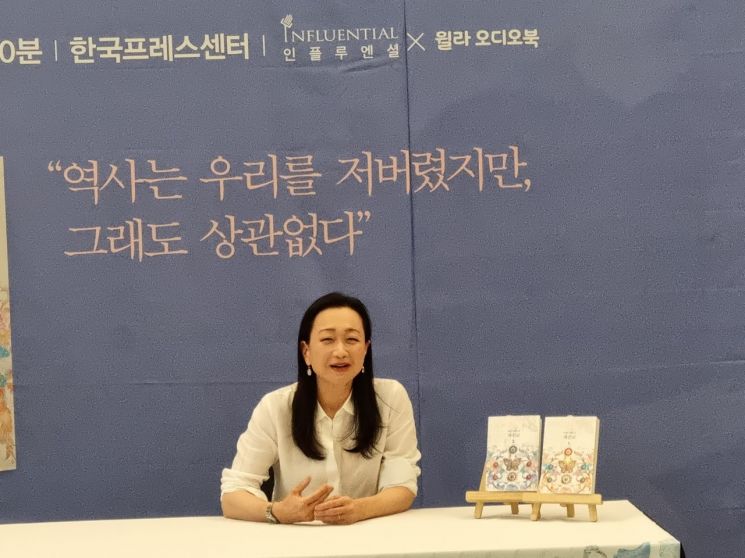
[Asia Economy Reporter Seo Mideum] “I wish all readers of my book were Korean.”
At the press conference for the revised edition of Pachinko held at the Seoul Press Center on the 8th, author Min Jin Lee said this. Just as readers immerse themselves in the world of a work when reading a book, she hopes readers worldwide will be captivated by Korea. When signing books, she writes “we are powerful family” for this very reason. She said, “Although we are not related by blood, we are connected,” and added, “I believe there is nothing we cannot accomplish when it becomes ‘we’ instead of ‘I.’”
She was a girl who loved writing as a child but did not dream of becoming a writer. In the 1990s, it was considered “absurd and far-fetched” for Korean American women to write novels. So she graduated from law school and chose the path of a lawyer. “I lived a very busy life.” Then she faced a turning point in her life, which was a liver disease. Upon hearing from a doctor that “you can get liver cancer in your 20s or 30s,” she began writing. “Because I wanted to do something meaningful.”
The inspiration came from a missionary lecture she attended while skipping classes during her freshman year at university. A white missionary told a story about a Korean Japanese boy, which was shocking. The boy, a parishioner, had committed suicide by jumping from an apartment, and it turned out he had been bullied at school. His graduation album contained messages like “Go back to where you came from,” “You smell like kimchi,” and “Die die die.” “The story of the deceased boy stayed in my mind for a long time.”
That’s how Pachinko was written. In fact, the currently published Pachinko is a completely different version from the original. Why? “Because it was too boring.” Even her husband said, “It’s too dull to read.” Eventually, she rewrote everything except for one chapter. Originally, Solomon was the protagonist, but since he was “too kind and had too comfortable a life” to be the main character of such a long narrative, she changed the protagonist.
Regarding the recent attention to works by Korean American women writers, she cited the influence of the “Hallyu” wave. The Korean government has made great efforts to export soft culture, and content creators have produced good works, forming the “Hallyu” phenomenon. She said, “I think a lot of attention has been drawn as works by Korean American women writers accumulated.” However, she explained, “There is still a lack of interest and support,” and “more writers need to achieve great success.”
The sequel is titled American Hagwon. She said it would be translated as “Hagwon” rather than “American Academy” in English, explaining, “You cannot understand Koreans without understanding hagwon.” The novel deals with the educational zeal of Koreans spread all over the world. She explained, “There are words borrowed directly from foreign languages, like ‘Burberry coat.’ Similarly, the term ‘hagwon’ should be borrowed by foreigners as well.”
The author puts great effort into translation. “I thought every expression was very important.” This is also why she signed a contract for the revised edition with the publisher Influential. She said, “It was important that the carefully crafted expressions be translated while preserving the original storytelling. Writing a work is a resistant, revolutionary, and risky act, and I needed a publisher who would understand that. Influential allowed me to control that process.”
Regarding the attention her work receives both domestically and internationally, she explained, “I liked 19th-century American and European literature. So I wrote in an omniscient narrator perspective. Also, I deal with racism, class discrimination, cultural imperialism, and colonialism. The tools used in 19th-century English literature are close to American and European styles, so I think that’s why.”
She continued, “At first, I was worried because many Koreans didn’t read it. Now, many like it and say things like ‘Now I understand my mother,’ or ‘I can talk with my father,’ which is very rewarding,” wiping away tears.
The novel Pachinko is a global bestseller depicting the story of a Korean family in Japan over four generations. Since its first edition in the United States in 2017, it became a bestseller and has been translated and published in 33 countries worldwide. In Korea, after its 2017 publication, it was reissued as a revised edition in April with a new publisher. Currently, only volume 1 is on sale, and volume 2 is undergoing translation and is scheduled for publication in August. On the 9th at 2 p.m., Min Jin Lee will hold a signing event at Kyobo Bookstore Gwanghwamun Branch, and on the 10th, a book talk at Sejong University Daeyang Hall.
© The Asia Business Daily(www.asiae.co.kr). All rights reserved.
![Clutching a Stolen Dior Bag, Saying "I Hate Being Poor but Real"... The Grotesque Con of a "Human Knockoff" [Slate]](https://cwcontent.asiae.co.kr/asiaresize/183/2026021902243444107_1771435474.jpg)
















