"Min Hyung-bae's Party Withdrawal Was Requested by the Party"... Lee Expresses Support for Rejoining
"Rejoining Possible After One Year" Also Faces Opposition
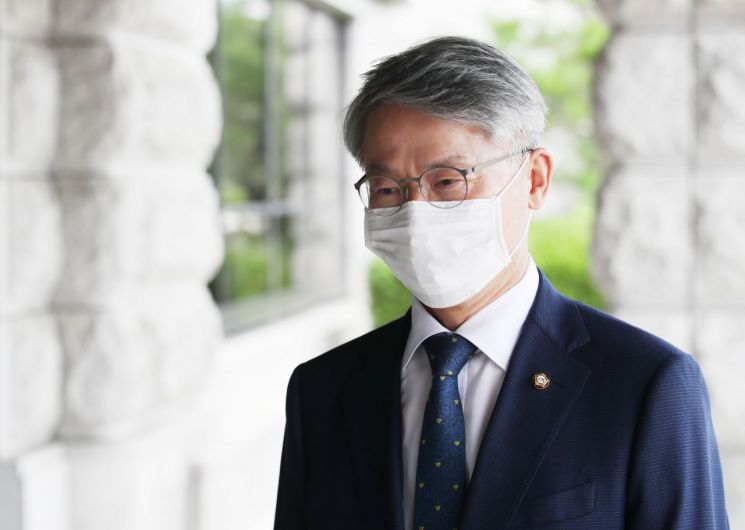 Independent lawmaker Min Hyung-bae is attending the public hearing on the 'Complete Prosecution Reform' held at the Constitutional Court in Jongno-gu, Seoul, on the 12th of last month. Photo by Yonhap News
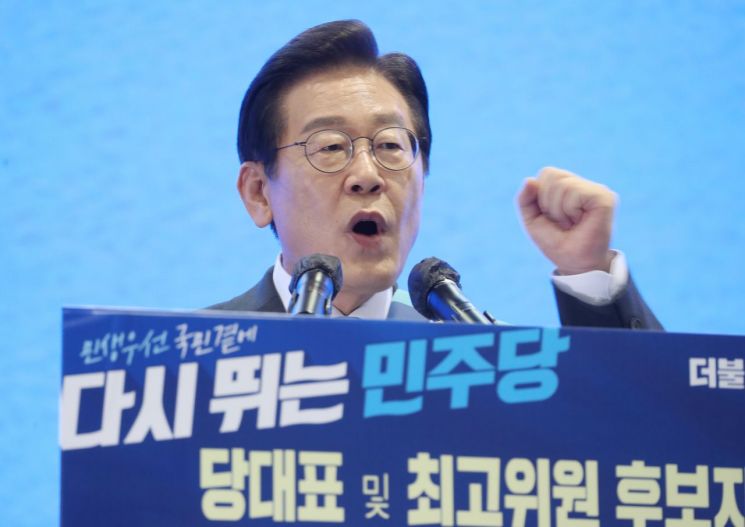
[Asia Economy Reporter Kang Juhee] Lee Jae-myung, a member of the Democratic Party of Korea, is solidifying his dominant position by securing over 70% of the votes in the first party representative primary of the party convention. As Lee's likelihood of winning becomes prominent, the issue of independent lawmaker Min Hyung-bae's reinstatement is expected to emerge as a key point. Min sparked controversy over a so-called 'fake resignation' during the passage of the 'complete removal of prosecution investigation rights' (Geomsu Wanbak) bill.
Among the candidates for party representative, Lee was the only one to express a positive stance regarding Min's reinstatement. At a party representative candidate invitation debate on the 3rd, Lee said, "(Opinions on Min's resignation) are quite divided, but party members seem to view it as a sacrifice, while many supporters of the ruling party see it as a trick," "From the party's perspective, it was done because the party needed it and requested it." He added, "If it is something the party must take responsibility for, the party should apologize or take appropriate measures; it is not right to place all the responsibility on an individual," and "If I become party representative, I will gather consensus and make a reasonable decision."
Min resigned from the Democratic Party in April during the process of the 'Geomsu Wanbak' bill passing through the National Assembly's Legislation and Judiciary Committee's agenda adjustment meeting and participated as a member representing a non-negotiating group. The adjustment meeting consisted of six members (three from the Democratic Party, two from the People Power Party, and one from the non-negotiating group), and if four or more members agreed, the bill could be submitted to the full committee. At that time, Min's resignation created a 4-to-2 split, enabling the bill's passage.
While Min strongly opposed the People Power Party's criticism of his resignation as fake, he recently expressed a desire to be reinstated. This has led to criticism that he has effectively admitted to the 'fake resignation.' Although Min currently holds an independent status, he has acted like a Democratic Party lawmaker, participating in election campaigns for Democratic candidates during the June 1 local elections.
However, there is considerable opposition within the Democratic Party to Min's reinstatement. The forced passage of the Geomsu Wanbak bill is considered one of the reasons for the Democratic Party's defeat in the June 1 local elections, raising concerns that hastily allowing Min's return could provoke a backlash from public sentiment. In a recent radio interview, lawmaker Park Yong-jin said, "According to the party constitution and regulations, reinstatement is only possible one year after resignation. The party regulations are promises to party members as well as to the public," and "This issue must be handled based on principles."
There is also concern that criticism claiming "the Democratic Party has not changed" could arise following consecutive defeats in the presidential and local elections. With the atmosphere favoring Lee's likely election, the generational change movement centered on the 97 Group (those who entered university in the 1990s and born in the 1970s) is struggling to gain momentum. Furthermore, if Min's reinstatement is pursued, the party may be perceived as lacking reflection on the causes of electoral defeat.
Professor Lee Jun-han of Incheon National University's Department of Political Science and Diplomacy advised, "In a situation where there is public opposition to Lee becoming party representative after losing the presidential election, Min's reinstatement issue could be a significant variable," adding, "Decisions should be made considering the party's principles and public sentiment."
© The Asia Business Daily(www.asiae.co.kr). All rights reserved.


















