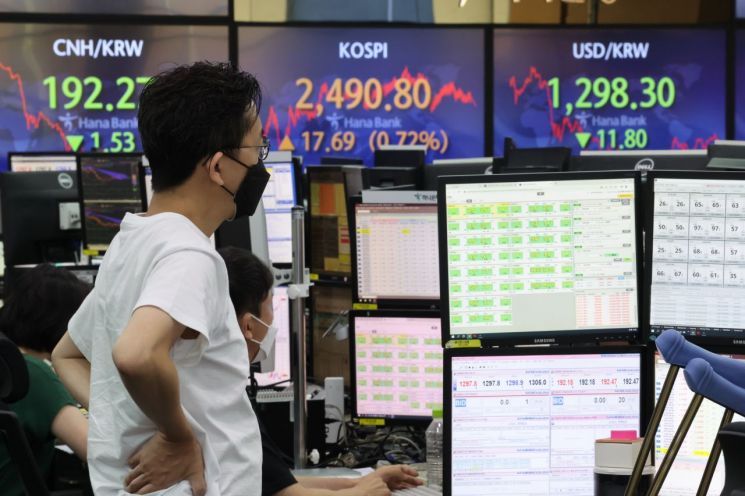
[Asia Economy Reporter Lee Seon-ae] Individual investors' funds are moving from the stock market to the bond market. As major central banks tighten monetary policies and economic uncertainties increase, a reverse money move is occurring where investors are withdrawing from the high-risk stock market and shifting to safe assets.
According to the Korea Financial Investment Association (KOFIA) on the 7th, individual investors have net purchased bonds worth 3.5116 trillion KRW in the over-the-counter bond market over the past month (July 4 to August 4). By bond type, other financial bonds excluding banks accounted for the largest net purchases at 1.355 trillion KRW, followed by corporate bonds at 1.3042 trillion KRW. Next were government bonds (403.2 billion KRW), bank bonds (224.8 billion KRW), and special bonds (144.6 billion KRW). Since the beginning of the year, the net bond purchases by individual investors total 8.6668 trillion KRW, 2.7 times the 3.2032 trillion KRW recorded in the same period last year.
Monthly net bond purchases by individuals have steadily increased this year: 328.3 billion KRW in January, 466.3 billion KRW in February, 650.6 billion KRW in March, 1.068 trillion KRW in April, 1.288 trillion KRW in May, 1.298 trillion KRW in June, and 2.9977 trillion KRW in July.
On the other hand, funds have flowed out of the bearish stock market. Over the past month, individual investors net sold stocks worth 1.2189 trillion KRW in the KOSPI market. After the KOSPI dropped to the 2,270 level intraday in early July and then gradually rebounded to settle around 2,400, many investors viewed this as a selling opportunity and disposed of their stocks. The stocks with the largest net sales were LG Energy Solution (521.5 billion KRW), Samsung Electronics (278.1 billion KRW), Hyundai Motor (248.3 billion KRW), Hyundai Mobis (201.3 billion KRW), and Celltrion (197.9 billion KRW).
During this period, individual investors net purchased 544.6 billion KRW worth of stocks in the KOSDAQ market, but combined with the KOSPI, there was a net selling dominance of 674.3 billion KRW in the domestic stock market.
Bonds are safe assets that provide principal and interest if held until maturity, as long as the issuer?whether a country, public institution, or company?does not default. They offer relatively stable returns even when market volatility is high. Bond prices and interest rates move inversely; when interest rates rise, investors can buy at a low price and sell when rates fall to realize capital gains.
Bond yields have risen sharply this year. Based on the final bid yield from KOFIA, the yield on AA- rated 3-year unsecured corporate bonds surged to around 4.4% annually in mid-June. Since then, the rapid rise in yields has eased, recently falling to around 4.0%, but compared to 2.415% at the end of last year, yields remain considerably high. In particular, yields on high-quality corporate bonds have consecutively entered the 4% range, attracting strong buying interest.
© The Asia Business Daily(www.asiae.co.kr). All rights reserved.

















