Correction Measures for Illegal Priority and Special Hiring Collective Agreements
Lee Jeong-sik "Employment Succession Clauses Cause Youth Frustration"
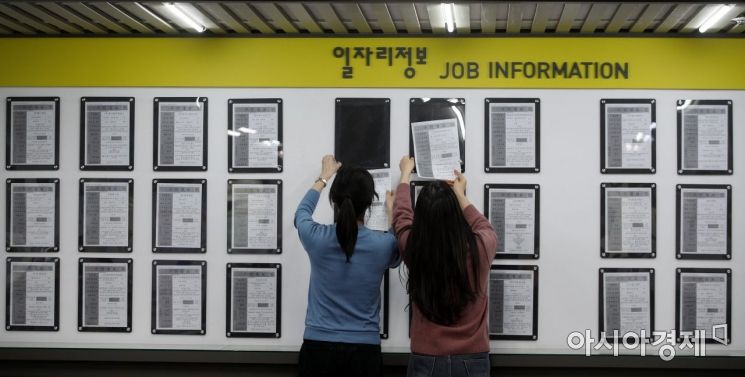 Employees at the Seoul Western Employment Support Center are updating job vacancy information on the job information bulletin board. Photo by Hyunmin Kim kimhyun81@
##Company A prioritizes hiring the children of retirees or long-term employees if they meet the hiring criteria. Additionally, when recruiting new employees, one child of an employee who meets the qualifications is given priority in hiring.
##Company B grants additional points in the selection process to the children of current employees and those recommended by employees during recruitment. Furthermore, the company gives special additional points and priority hiring to the direct children of retirees upon request during new recruitment.
The Ministry of Employment and Labor announced on the 7th that it found 63 collective agreements containing such illegal preferential or special hiring provisions after investigating collective agreements at workplaces with 100 or more employees, and plans to take corrective action.
This corrective action aims to ensure fair hiring opportunities so that young people are not unfairly discriminated against from the entry stage of the labor market, and it is one of the Yoon Suk-yeol administration’s national tasks.
While labor and management can autonomously conclude collective agreements, if the concluded agreements violate laws, administrative authorities can order their correction.
The Ministry of Employment and Labor judged that companies’ preferential or special hiring provisions discriminate against job seekers or other union members without reasonable grounds, violating Article 11, Paragraph 1 of the Constitution (right to equality), Article 7, Paragraph 1 of the Framework Act on Employment Policy (equal guarantee of employment opportunities), and Article 103 of the Civil Act (acts against public order).
The types of illegal preferential or special hiring provisions confirmed through this investigation by the Ministry of Employment and Labor include ▲hiring of retirees, long-term employees, employees with non-work-related illnesses, and employees’ immediate family members (58 cases), ▲hiring of labor union or employee-recommended candidates (5 cases), among others.
The proportion of collective agreements containing illegal preferential or special hiring provisions was higher in workplaces with fewer than 300 employees at 47.6% (30 cases) and in workplaces affiliated with the Korean Confederation of Trade Unions at 68.3% (43 cases).
The Ministry of Employment and Labor will issue correction orders through the Labor Relations Commission for illegal collective agreements and strictly take judicial measures according to the law if correction orders are not complied with. It will also strengthen negotiation guidance for labor and management to prevent illegal content from being included in collective agreements in the future.
Minister of Employment and Labor Lee Jeong-sik stated, "So-called 'employment inheritance provisions' discriminate against job seekers and other union members without reasonable grounds," adding, "They are especially unfair acts that discourage our youth who are taking their first steps into the labor market."
He continued, "We will continue to guide labor and management to prevent unreasonable collective agreements from being concluded, and when illegal collective agreements are identified, we will ensure fairness in hiring opportunities through correction orders and other measures."
© The Asia Business Daily(www.asiae.co.kr). All rights reserved.

















