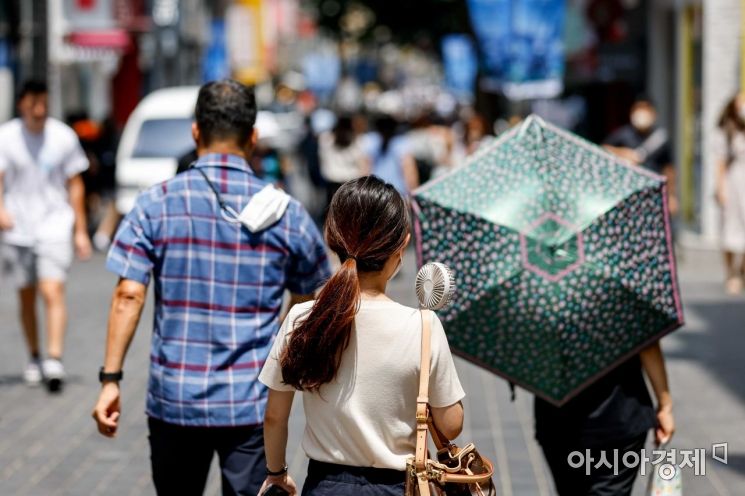
 On the 28th, as the daytime temperature in Seoul rose to 34 degrees Celsius, continuing the scorching heat, a citizen in Myeongdong, Jung-gu, Seoul, is cooling off using a handheld fan. Photo by Kang Jin-hyung aymsdream@
[Asia Economy Sejong=Reporter Dongwoo Lee] As the peak electricity demand for this summer is expected to reach its highest point next week, the power industry has begun preparations to secure a stable supply.
According to the Ministry of Trade, Industry and Energy on the 6th, the maximum electricity demand is expected to reach around 94.4GW next week due to employees returning from vacation and the scorching heat. Compared to last summer's peak demand of 89.1GW and reserve capacity of 8.9GW (reserve rate 9.9%), power supply and demand management is necessary to prepare for abnormal weather conditions.
The government announced that it will mobilize all supply capabilities during peak electricity demand periods to secure an additional 9.2GW of reserve power and ensure stable supply and demand. The government is encouraging the industry to implement sequential shutdowns of air conditioners and stagger summer vacations, while mobilizing all efforts including commissioning of new facilities in the public sector.
Minister Lee Chang-yang of the Ministry of Trade, Industry and Energy also visited the Wide-area System Operation Center of Korea Electric Power Corporation’s Seoul Headquarters in Jung-gu, Seoul on the 4th to inspect the summer power supply and demand situation and urged stable operation.
Meanwhile, as electricity demand increases, Korea Electric Power Corporation’s financial burden is also expected to grow. According to the Korea Power Exchange, as of the 5th of this month, the integrated SMP averaged 202.7 KRW per kWh, which is more than 50 KRW higher than the same period last month.
The price of liquefied natural gas (LNG), which affects SMP price determination, soared due to the aftermath of the Russia-Ukraine war, causing the LNG calorific unit price to rise by 39.6% month-on-month per Gcal. KEPCO is analyzed to incur a loss of about 30 KRW per kWh when selling electricity due to the increase in power purchase costs.
© The Asia Business Daily(www.asiae.co.kr). All rights reserved.
![Clutching a Stolen Dior Bag, Saying "I Hate Being Poor but Real"... The Grotesque Con of a "Human Knockoff" [Slate]](https://cwcontent.asiae.co.kr/asiaresize/183/2026021902243444107_1771435474.jpg)
















