Galbitang Up 12.6%... Jajangmyeon, Chicken, Samgyeopsal, Gimbap, Ramyeon, and Tteokbokki Also Rise Over 10%
High Inflation Rapidly Increases Food and Dining Expenses for Common People
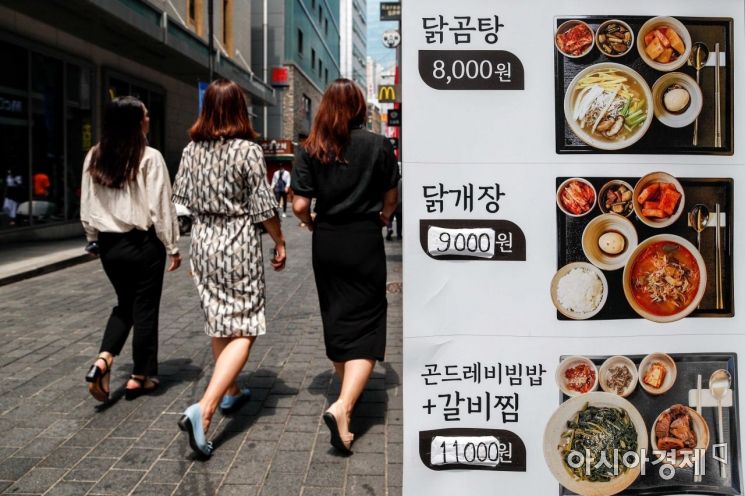 On the 28th, as the cost of dining out has recently surged, the burden of lunch expenses on office workers has increased. A restaurant sign in Seoul shows updated prices. Photo by Jinhyung Kang aymsdream@
[Asia Economy Sejong=Reporter Kwon Haeyoung] Last month, the prices of all 39 items that make up dining-out expenses rose, marking the largest increase in dining-out costs in nearly 30 years.
According to Statistics Korea on the 6th, the dining-out price index in July 2022 was 111.39, up 8.4% compared to the same month last year. This was the largest increase in 29 years and 9 months since October 1992 (8.8%).
Prices of all 39 dining-out items tracked by Statistics Korea rose. The price of Galbitang (beef short rib soup) surged 12.6% compared to a year ago, followed by Jajangmyeon (11.9%), chicken (11.4%), dosirak (lunchbox) (11.3%), and samgyeopsal (pork belly) (11.2%).
Prices of snack bar menus, mainly favored by students with light wallets, also jumped significantly. Gimbap (11.1%), ramyeon (10.5%), and tteokbokki (10.5%) all recorded double-digit growth rates. Pizza (8.5%) and hamburgers (3.7%) also saw price increases.
After work, even enjoying samgyeopsal with a glass of soju has become burdensome. Prices of samgyeopsal (11.2%), dwaejigalbi (pork ribs) (10.4%), and beef (8.8%) all rose simultaneously, and prices of alcoholic beverages such as beer (7.7%), soju (6.8%), and Makgeolli (5.6%) also increased.
The cost of meals at workplace cafeterias rose by 4.4%, which was about half the rate of increase in dining-out prices.
It is not only dining-out prices that have risen. Among the total 151 food items excluding dining-out, including agricultural, livestock, fishery products, and processed foods tracked by Statistics Korea, prices of 132 items (87.4%) increased compared to a year ago, with an average increase of 12.0%.
As living costs centered on food prices surge like this, the pain felt by low-income and vulnerable groups is also growing. Food expenses are items that are difficult to reduce consumption of even when prices rise, so they inevitably translate into a burden on ordinary people. Due to high inflation, the lives of ordinary people are becoming more difficult to the extent that they worry about their immediate food and living expenses.
According to Statistics Korea, households in the bottom 20% income bracket spent 357,754 won, which is 42.2% of their average monthly disposable income (847,039 won) in the first quarter of this year, on food purchases and dining-out expenses. This means spending about 12,000 won per day and 4,000 won per meal on food expenses.
© The Asia Business Daily(www.asiae.co.kr). All rights reserved.
![Clutching a Stolen Dior Bag, Saying "I Hate Being Poor but Real"... The Grotesque Con of a "Human Knockoff" [Slate]](https://cwcontent.asiae.co.kr/asiaresize/183/2026021902243444107_1771435474.jpg)
















