AI Machine Learning and More: Samsung Electronics Launches SW Solutions and Semantic SSD After World's First Development Last Year
SK Hynix Also Releases DDR5 DRAM-Based Samples
[Asia Economy Reporter Moon Chaeseok] The core of Samsung Electronics and SK Hynix's 'super-gap management' is strong technological capability. The next battlefield they have turned their eyes to is the next-generation interface CXL (Compute Express Link) memory semiconductor field, which implements terabyte (TB)-level capacity. They are accelerating the development of new products in preparation for the increasing demand from various industries such as artificial intelligence (AI) and machine learning (ML).
According to the semiconductor industry on the 6th, both companies are recognized as world-class CXL memory semiconductor companies. There is a common view that Samsung is leading and SK is chasing. The best achievement in this field was the birth of the world's first CXL DRAM semiconductor, the 'CXL Memory Expander,' developed by Samsung on May 11 last year. Exactly one year later, on May 10, they created a 512-gigabyte (GB) CXL DRAM, reducing data latency to one-fifth of the previous level.
Moreover, thanks to the 'CXL Memory Semantic SSD' solution unveiled at the US Flash Memory Summit (FMS) held on the 3rd, Samsung is moving one step ahead. This product improves response speed by 20 times compared to existing SSDs in AI, ML, and other fields, designed to be used in areas that utilize a large amount of 'small-sized' data such as AI and ML.
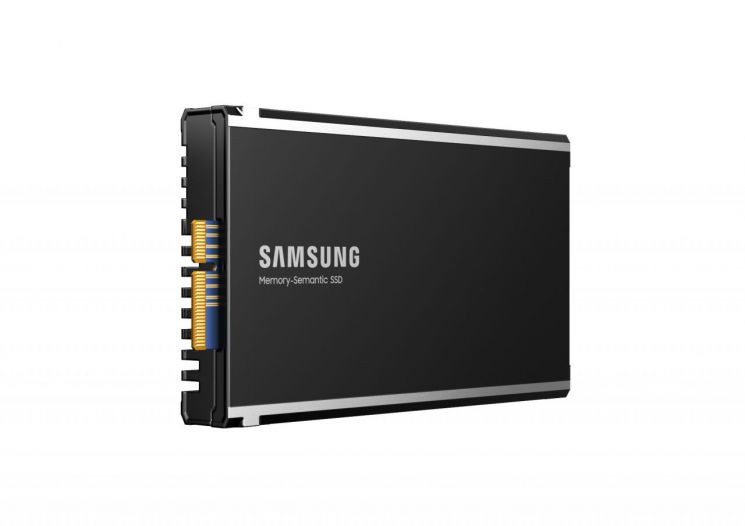 Samsung Electronics unveiled the Compute Express Link (CXL)-based 'Memory Semantic SSD (Solid State Drive)' on the 3rd. (Photo by Samsung Electronics)
SK Hynix is also in pursuit. On the 1st, they entered the 'CXL super-gap' competition by releasing a DDR5 (Double Data Rate 5) DRAM-based CXL memory sample. They plan to leverage the 'versatility' of CXL, which is used in central processing units (CPU), graphics processing units (GPU), accelerators, and memory of various information technology (IT) devices, to secure customers and profitability.
The industry evaluates the 'speed race' between the two companies as a meaningful achievement that aligns with the IT market's focus on maximizing memory semiconductor efficiency. According to the industry, before the integration at the end of last year, there was a competition for memory efficiency between the CXL Consortium and the GEN-Z Consortium. The CXL Consortium was classified as Intel-affiliated, while the GEN-Z Consortium was non-Intel affiliated. Both were organizations formed by global companies to enhance performance such as capacity and processing speed of memory semiconductors.
After the integration into the CXL Consortium at the end of last year, CXL emerged as the industry's sole standard, with Samsung and SK pushing forward. Currently, the CXL Consortium includes major semiconductor companies such as Samsung Electronics, SK Hynix, Intel, Micron, Nvidia, AMD, Qualcomm, and big tech companies like Google and Microsoft. In particular, SK Hynix is reported to have actively participated from the early days of the CXL Consortium's establishment.
The next-generation memory interconnect standard was finalized as CXL at the end of last year, and the industry expects the adoption speed of CXL memory semiconductors by customers to accelerate. Demand for the new CXL interface is expected to arise, and the supply and demand for server DRAM for data centers will continue to increase.
© The Asia Business Daily(www.asiae.co.kr). All rights reserved.

















