Health Data Also Poses Security Risks
Avoid Requests and Collection Whenever Possible
Remote Medical Care Premature Before Stakeholder Agreement
Hospitals Should Be Supported in Their Desired Tasks
Users Familiar with Kakao
Should Be Enabled to Experience Health Management
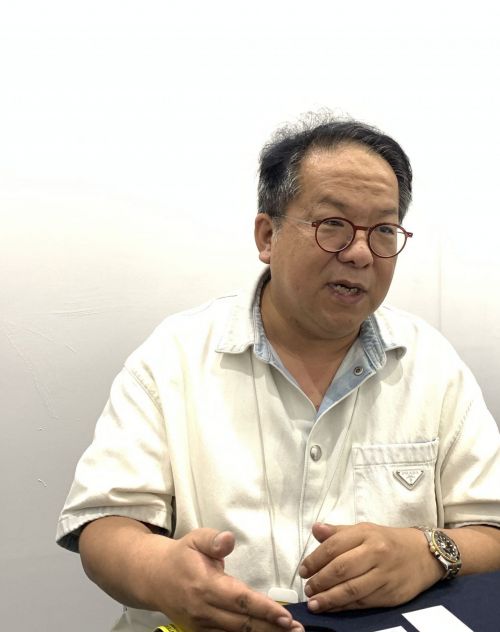
[Asia Economy Reporter Lee Chun-hee] "We are not people who produce data. We have no intention of becoming data operators. Our goal is to be an ‘enabler’ who does not collect data but enables its effective use."
Hwang Hee, CEO of Kakao Healthcare, gave this answer on the afternoon of the 4th during an interview with Asia Economy at the BioPlus-Interphex Korea 2022 (BIX 2022) event held in Gangnam-gu, Seoul, in response to a question about the future direction of business development. CEO Hwang explained, "Enablers and operators are different stories," adding, "Since it is generally difficult to understand, I wanted to explain it when given a deep interview opportunity." While actively clarifying various misunderstandings arising from growing interest in Kakao Healthcare, he also revealed the company’s future vision.
CEO Hwang emphasized that this direction can also solve security issues, which are one of the risks in digital healthcare. He said, "No matter how well prepared, it is difficult to prevent accidents 100%," and added, "Since risks can arise if data is directly collected or held, we try to avoid requesting or collecting data as much as possible." Medical information and other data remain on end devices directly connected to patients, such as smartphones, and the service structure reads the data only when necessary. CEO Hwang said, "Of course, development is difficult and costly," but he is confident that "if it can reduce concerns about collecting data for other purposes, it is the right approach."
He also firmly drew a line regarding some expectations that Kakao Healthcare would enter telemedicine. CEO Hwang said, "As the CEO of Kakao Healthcare, I am not interested in telemedicine," and stated that considering the current situation in Korea and Kakao, there is neither a possibility nor a plan to enter telemedicine. He explained that it is premature as the five stakeholders?doctors, hospitals, pharmacists, government, platform companies, and patients?have not reached an agreement. He added, "Digital healthcare is not about replacing hospitals but helping with what hospitals want to do but cannot," and "there are many things that can be done at both the front and back ends of the medical field, so I believe there are roles to play even without dealing with telemedicine."
CEO Hwang, who described healthcare as "fundamentally an unfair service," raised his voice saying, "The greatest value of digital healthcare is to improve medical accessibility and solve medical inequality." He explained that although Korea is evaluated as having high medical accessibility through the National Health Insurance, there is still a significant gap in accessibility between regions, and Kakao Healthcare aims to contribute to solving such problems.
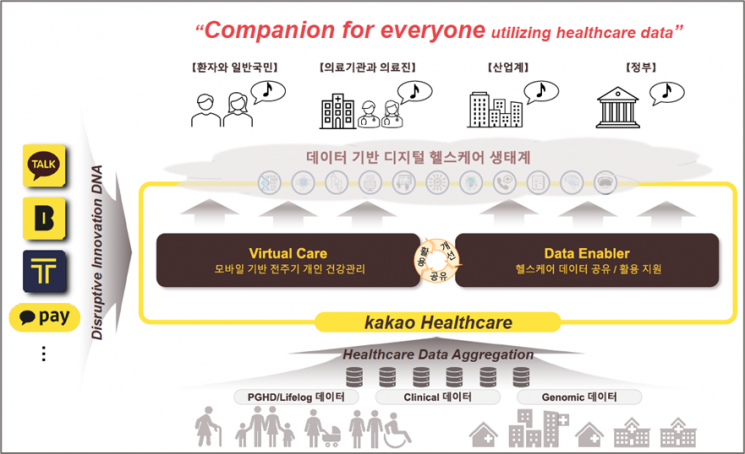
Regarding specific business areas, he was reserved, saying, "We are continuously discussing internally," but provided clues to glimpse them. CEO Hwang said, "From an individual’s perspective, the service they want is important, not what Kakao does," and added, "We need to process data such as hospital visits and lifestyle habits well to provide ‘personalized services’ tailored to each person." Furthermore, he said, "The ultimate goal is to provide health management services where users familiar with Kakao can have a similar user experience."
Regarding the platform and business model (BM), he said, "The most effective means to deliver services to patients is mobile," and announced, "We will provide services so that patients can access them anytime and anywhere as long as they have internet connection." Along with this, he added, "Kakao’s growth formula was to attract many people who need data or mobile services," and explained, "We need to lay the foundation through this; it is difficult to succeed if we move with intentions such as monetization or BM from the start."
He also shared plans to continue active collaboration with startups. CEO Hwang said, "Services needed in digital healthcare vary for each individual, so one company cannot develop everything," and added, "Since there are already well-made services, rather than going into competition, partnering with them allows us to quickly bring good services, which is more beneficial."
© The Asia Business Daily(www.asiae.co.kr). All rights reserved.
![Clutching a Stolen Dior Bag, Saying "I Hate Being Poor but Real"... The Grotesque Con of a "Human Knockoff" [Slate]](https://cwcontent.asiae.co.kr/asiaresize/183/2026021902243444107_1771435474.jpg)

















