[Asia Economy Reporter Lee Seon-ae] Investors have mixed feelings about 'Tesla' and 'Hyundai Motor,' the representative automobile stocks in the US and Korean stock markets. Recently, foreign investors investing in domestic stocks have been diligently buying Hyundai Motor with confidence in its upward momentum, while domestic investors investing in foreign stocks have been aggressively selling Tesla to recover losses and ease anxiety.
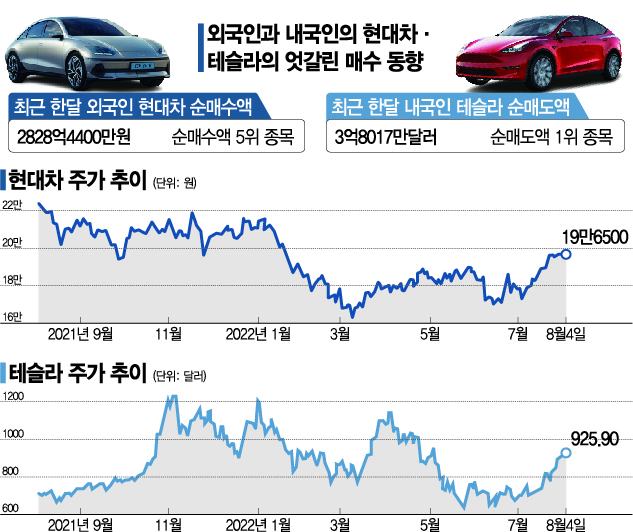
According to the Korea Exchange on the 5th, foreigners have recently continued a net buying streak of Hyundai Motor. The net purchase amount over the past month reached 282.844 billion KRW. It also ranked among the top 5 net purchase stocks by foreigners. This net buying trend is interpreted as stemming from confidence that the stock price will maintain a relatively favorable trend in the second half of the year. The securities industry is also supporting further stock price increases by raising target prices. Recently, NH Investment & Securities raised Hyundai Motor's target price from 240,000 KRW to 260,000 KRW, followed by Hyundai Motor Securities at 300,000 KRW and Yuanta Securities at 290,000 KRW.
In the second quarter, Hyundai Motor also set a record high quarterly performance, firing a celebratory salvo. Sales amounted to 35.9999 trillion KRW, an 18.7% increase compared to the same period last year. The improvement in the sales mix centered on Genesis and SUVs, reduction in incentives, and exchange rate effects offset the impact of the overall volume decline, resulting in increased sales. Operating profit was 2.9798 trillion KRW, up 58.0% from the same period last year. Consequently, the stock price is trending upward. After a sluggish start to the year, the stock price is on the verge of reclaiming 200,000 KRW. It closed at 196,500 KRW the previous day and rose to 197,500 KRW after the market opened, raising expectations for reclaiming 200,000 KRW.
July sales performance is also strong. Domestic sales were 56,305 units, exports 269,694 units, totaling 326,000 units sold globally. This is a 4.0% increase compared to the same period last year. Sales, which had suffered due to semiconductor shortages, returned to an upward trend after four months. With the won-dollar exchange rate surpassing 1,300 KRW and the dollar remaining strong, the expansion of exports is also viewed positively by the market. Researcher Cho Su-hong of NH Investment & Securities explained, "Compared to the past, incentives (promotion costs) have significantly decreased, and the improvement in operating rates during the production recovery process is expected to positively impact profitability." Researcher Lee Sang-hyun of IBK Investment & Securities said, "Hyundai Motor's profit margin has significantly increased thanks to the rising exchange rate and the increased proportion of high-spec product sales," adding, "Considering the shortage of automobile inventory and still pending customer orders, favorable performance is expected in the second half, and the stock price is likely to show a positive trend."
Domestic investors began selling Tesla from last month. The overseas stock investors known as 'Seohak Gaemi' switched to net selling on a monthly basis for the first time since August 2019, offloading about 3.68 million USD worth of US stocks last month. The stock most sold was Tesla, with net sales amounting to 184.84 million USD. The net sales amount over the past month was 378.5 million USD, ranking first among net sold stocks. As the stock price, which had plunged to the 600 USD range earlier this year, rebounded to the 900 USD level, it is interpreted that investors kept selling to recover losses. Tesla's stock price fell 47.6% from 1,199.78 USD in early January to 628.16 USD in May. Afterwards, the stock price rebounded, recovering to 700 USD in late June and rising to 891.45 USD by the end of July. On the 4th, it recovered further to 925.90 USD. Nevertheless, if held since the beginning of the year, it is still in the loss zone.
Additionally, as the stock price rebounded recently due to the favorable effect of a stock split, the desire to realize profits using this opportunity was also significant. Concerns about the disappearance of the stock split effect and the possibility of the stock price plummeting again due to US-China trade conflicts also played a role. Researcher Heo Jae-hwan of Yuji Investment & Securities evaluated, "(Seohak Gaemi investors) have lowered their expectations for a trend rise and are selling to realize profits and reduce losses."
Meanwhile, opinions on Tesla's future stock price outlook are divided. According to financial information provider TipRanks, among 31 analysts, 18 recommended buying Tesla. Six were neutral, and seven recommended selling.
Gary Black, co-founder of Future Fund Active ETF (FFND), raised Tesla's target price from 1,400 USD to 1,600 USD. He judged that Tesla's earnings per share (EPS) next year would reach 26 USD, significantly exceeding Wall Street's current forecast of 17 USD. On the other hand, Citigroup issued a sell recommendation, lowering the target price to 424 USD, about half of the current level. The reason is that Tesla's sales are significantly lower compared to other companies that achieved Tesla's current market capitalization. In fact, companies of similar size to Tesla recorded an average quarterly sales of 25 billion USD, while Tesla's sales in the second quarter of this year were only 16.9 billion USD.
© The Asia Business Daily(www.asiae.co.kr). All rights reserved.
!["The Woman Who Threw Herself into the Water Clutching a Stolen Dior Bag"...A Grotesque Success Story That Shakes the Korean Psyche [Slate]](https://cwcontent.asiae.co.kr/asiaresize/183/2026021902243444107_1771435474.jpg)
















