Equipment Construction Scheduled for Completion in June Next Year
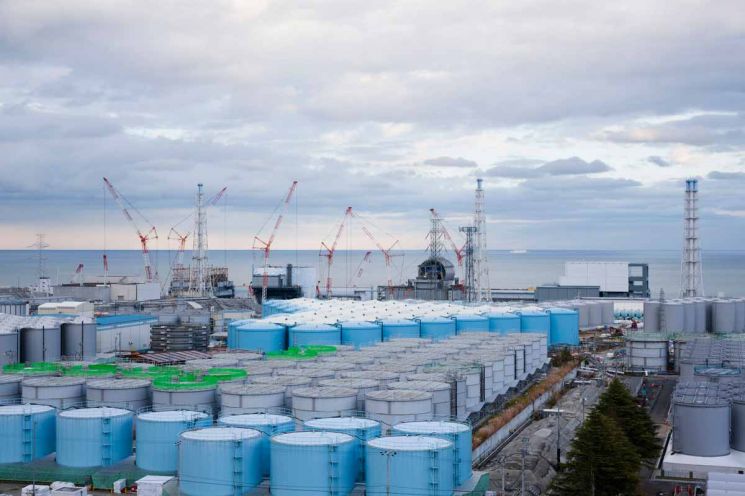
[Asia Economy Reporter Yoon Seul-gi] As the Japanese government announced plans to discharge contaminated water from the Fukushima Daiichi Nuclear Power Plant into the ocean, there are projections that the originally planned timeline of next spring could be delayed by about two months to sometime after next summer.
On the 4th, major Japanese media outlets including Nihon Keizai Shimbun (Nikkei) reported that Tokyo Electric Power Company (TEPCO), the operator of Fukushima Daiichi Nuclear Power Plant, has begun construction work on facilities such as an underwater tunnel necessary for the contaminated water discharge. TEPCO also released a schedule indicating that the construction will be completed by June next year.
TEPCO plans to carry out excavation of the underwater tunnel extending to the sea about 1 km from the nuclear plant site, and installation of pipelines connecting the storage tanks to the underwater tunnel. A TEPCO official told the media, "There are factors such as typhoons and other weather conditions, as well as changes in marine conditions."
Earlier, in April last year, the Japanese government announced that considering the time when the contaminated water storage tanks would be full, they would start diluting the contaminated water with seawater and discharge it into the sea in front of Fukushima Daiichi Nuclear Power Plant from next spring. However, due to construction delays, the discharge timing is expected to be about two months later than originally planned.
Nikkei reported, "The amount of contaminated water generated is decreasing, and the time when the storage tanks will be full is expected to be next fall," adding, "Even if the ocean discharge does not start in spring next year, the situation of overflowing contaminated water can be avoided."
Since the hydrogen explosion accident caused by the Great East Japan Earthquake on March 11, 2011, about 130 to 150 tons of contaminated water containing radioactive materials, including groundwater and rainwater, are generated daily at Fukushima Daiichi Nuclear Power Plant. TEPCO purifies this water using the Advanced Liquid Processing System (ALPS) and stores it in tanks on the plant site. However, TEPCO stated that since the storage tanks are full and there is no more space, they plan to dilute the contaminated water to about 1/40th of its concentration and discharge it into the seabed.
The problem is that even after purification with ALPS, the radioactive substance tritium (a radioactive isotope of hydrogen) contained in the contaminated water cannot be removed. Because of this, Japan’s decision to discharge the contaminated water has faced criticism not only from neighboring countries but also from Japanese fishermen’s groups. On the 23rd of last month, China’s state-run media Global Times pointed out, "TEPCO claims that ALPS can remove 62 types of radioactive substances, but tritium is difficult to separate from water," and warned, "1.3 million tons of contaminated water will be discharged into the ocean."
It also criticized, "The actual performance of ALPS is not as effective as Japan claims, and continuous exposure to tritium can lead to DNA damage in humans. As of March 2020, about 70% of the radioactive contaminated water treated by this system exceeded discharge standards."
Global Times expressed concern, stating, "If the contaminated water is discharged into the ocean, radioactive materials will reach most of the Pacific Ocean within 57 days," and warned, "This will negatively affect not only the area near Fukushima but also the marine ecosystems of neighboring countries."
Japanese fishermen’s organizations are also opposing the decision to discharge the contaminated water, anticipating damage to fisheries. The Japan Federation of Fisheries Cooperative Associations adopted a resolution at its regular general meeting held last month, stating, "Our firm opposition to the ocean discharge of ALPS-treated water, which cannot gain the understanding of fisheries workers nationwide and the public, remains unchanged."
© The Asia Business Daily(www.asiae.co.kr). All rights reserved.

















