Ministry of Science and ICT: "Weather is good, launch expected as scheduled on the morning of the 5th"
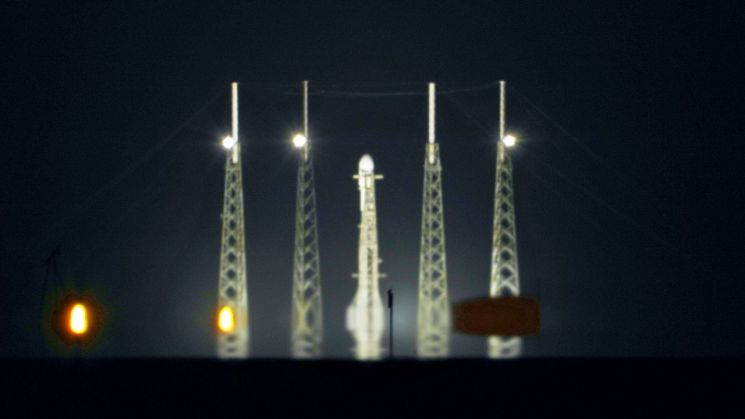 The United States SpaceX Falcon 9 carrying South Korea's first lunar probe, Danuri, successfully stood upright at Launch Pad 40 of the U.S. Space Force Base in Cape Canaveral, Florida, around 10:15 PM on the 3rd (local time). Photo by Joint Press Corps.
[Asia Economy Reporter Kim Bong-su] The Ministry of Science and ICT announced that South Korea's first lunar probe, 'Danuri,' was erected at Launch Pad 40 of the U.S. Space Force base in Cape Canaveral, Florida, around 11:15 a.m. (Korean time) on the 4th, entering the final inspection and countdown preparation procedures.
Danuri is loaded in the payload fairing of SpaceX's Falcon 9 launch vehicle. It is scheduled to launch at 8:08 a.m. (Korean time) the next day.
The Ministry of Science and ICT expects favorable weather conditions over the launch site on the scheduled day based on U.S. military weather observations, and since no abnormalities have been found in various inspections so far, the launch is expected to proceed as planned on the morning of the 5th. The launch was originally scheduled for the morning of the 3rd but was postponed by two days due to a sensor failure in the first stage engine of the Falcon 9 rocket.
After launch, Danuri will begin a long journey by orbiting the Lagrange point using the ballistic lunar transfer (BLT) method for four and a half months to enter lunar orbit. It will enter lunar orbit at the end of December and orbit 12 times a day at an altitude of 100 km, conducting various scientific experiments and collecting data on the lunar surface. In particular, the permanently shadowed region camera (ShadowCam) developed by NASA is tasked with confirming the presence of water and searching for a foothold for humanity's lunar exploration. High-resolution cameras, wide-field polarization cameras, magnetometers, and gamma-ray detectors developed with domestic technology will investigate the composition, geological formation processes, and resource distribution of the lunar surface. Additionally, space internet equipment is attached to conduct research for establishing international space communication standards, including streaming BTS's music videos.
© The Asia Business Daily(www.asiae.co.kr). All rights reserved.

















