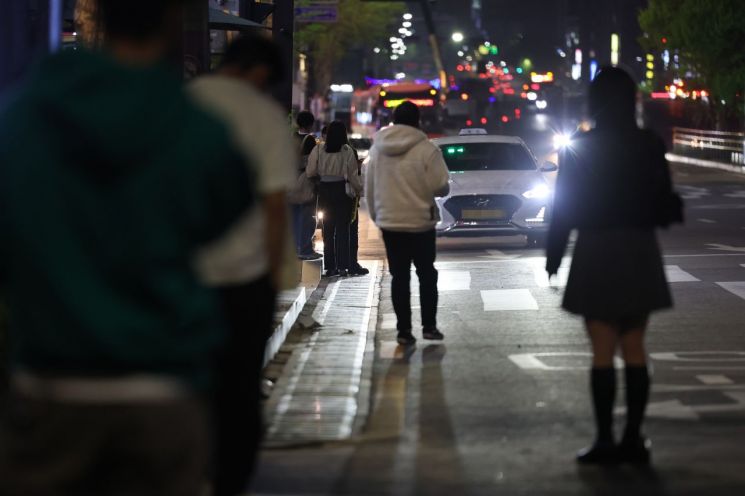
[Asia Economy Reporter Kang Nahum] The necessity of the ‘Smart Call System,’ a feature that allows passengers to get taxis faster by paying extra, is being raised again. This is because the late-night taxi crisis has not been resolved since social distancing measures were effectively lifted. The government is also considering introducing the Smart Call System alongside the dynamic fare system.
According to industry sources on the 3rd, the Ministry of Land, Infrastructure and Transport recently announced plans during the presidential briefing to implement ▲Smart Call System ▲nighttime dynamic fare system ▲lifting restrictions on private taxis ▲expanding ride-sharing services.
Among these, the Smart Call System is an AI dispatch system that increases the success rate of taxi calls, previously implemented by Kakao Mobility as a fare policy. Last year, Kakao Mobility diversified the taxi call fees, which were previously a flat rate of 1,000 KRW (2,000 KRW at night), under the name ‘Smart Call,’ raising the maximum fee to 5,000 KRW. However, the service was discontinued due to strong public backlash claiming ‘Kakao is raising taxi fares that even the government does not raise.’
In just one year, the situation has reversed rapidly, with the government taking the initiative to bring back the Smart Call System. This is because the late-night taxi crisis shows no signs of easing. Due to a shortage of regular taxis during late-night peak hours, citizens have no choice but to use premium taxis that cost two to three times more, but even premium taxis are scarce and difficult to use.
With the introduction of the Smart Call System, it is expected to attract drivers who left for the delivery industry during the COVID-19 pandemic back to the taxi industry and incentivize drivers who prefer daytime shifts to work late-night hours as well.
The industry is rushing to apply the dynamic fare system, considered a preliminary step to the Smart Call System. Uti recently revised its franchise terms to allow call fees ranging from 0 KRW to 3,000 KRW to be paid to affiliated taxis depending on supply and user demand. This is a concept similar to Kakao Mobility’s ‘KakaoT Blue,’ which charges users between 0 and 3,000 KRW. Uti plans to pay all revenue generated from dynamic call fees to taxi drivers by the end of this year. A Uti representative said, “Taxi drivers can earn a bit more during high-demand times, and users can have a higher success rate of getting a ride. This is also to resolve the recent taxi crisis and improve taxi drivers’ working conditions.”
Some companies have already introduced the Smart Call System. Konatus, the operator of Banban Taxi and Ribbon Taxi, recently launched ‘Rocket Call.’ This service allows passengers to pay an additional call fee of 1,000 to 3,000 KRW to get a taxi dispatched quickly, with the entire call fee given as an incentive to the taxi driver. The difference from Kakao Mobility’s Smart Call is that the full call fee is paid as an incentive to the driver. Kakao Mobility, facing performance improvement pressure amid recent sale issues, is also rumored to possibly revive the Smart Call System.
The increasing burden on consumers remains a challenge to be addressed. On the 1st, Kim Byungwook, a member of the Democratic Party of Korea, pointed out at the National Assembly Land, Infrastructure and Transport Committee meeting, “While there may be demands for taxi fare increases due to rising oil prices, taxi fare hikes require social consensus,” adding, “Applying a uniform ‘Smart Call Fee’ of over 3,000 KRW could increase the public’s burden amid already severe inflationary pressures.”
© The Asia Business Daily(www.asiae.co.kr). All rights reserved.

















