US Passes Semiconductor Industry Promotion Act; Inflation Reduction Act Expected Next Month
Korean Automakers and Battery Companies in US Anticipate Trickle-Down Effects
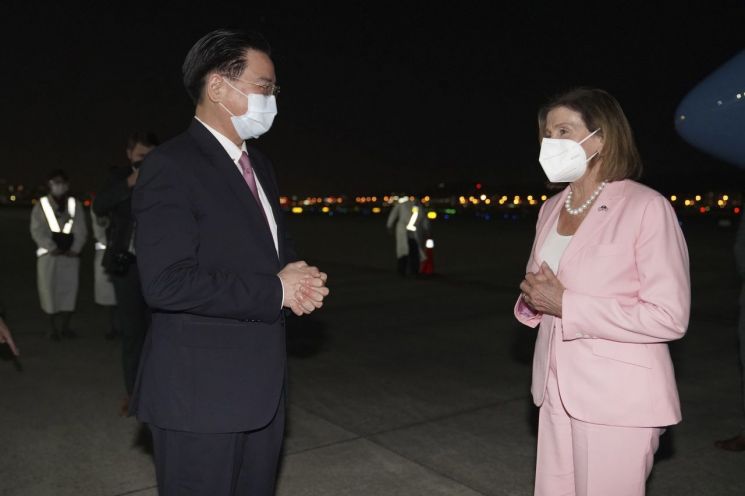
[Asia Economy Reporter Kwon Jae-hee] As Nancy Pelosi, the third in the U.S. presidential line of succession and Speaker of the U.S. House of Representatives, insisted on visiting Taiwan, escalating U.S.-China tensions, related beneficiary sectors such as semiconductors, secondary batteries, and finished car industries are emerging in the domestic stock market. This is due to expectations that the U.S. will pass a series of bills tightening restrictions on China.
According to the Korea Exchange on the 3rd, the stocks most purchased by foreigners over the past week were LG Energy Solution (469.8 billion KRW), Samsung SDI (119.6 billion KRW), Hanwha Solutions (107.1 billion KRW), Hyundai Motor (97.8 billion KRW), and Samsung Electronics (98.2 billion KRW), in that order. The buying spree by foreigners appears to be driven by the anticipation that domestic secondary battery, semiconductor, and finished car companies will benefit from the U.S.-China conflict.
The Semiconductor Industry Promotion Act, which is awaiting only President Biden's signature in the U.S., and the Inflation Reduction Act expected to pass next month include provisions aimed at isolating China from the global supply chain. The U.S. Senate's Semiconductor Industry Promotion Act, which supports the U.S. semiconductor industry with a total of $52 billion (approximately 68 trillion KRW) from an energy and economic security perspective, is a representative example. This bill includes support measures for companies establishing semiconductor manufacturing plants in the U.S. Samsung Electronics, which is building a new foundry plant locally, and SK Hynix, which is considering new investments in the U.S., will benefit from the enactment of this bill. However, the fact that both companies also operate semiconductor plants in China is expected to be a burden.
The U.S. Inflation Reduction Act, expected to pass as early as next month, is also seen as targeting China. This bill includes tax credits of $7,500 (approximately 9.84 million KRW) for electric vehicle buyers and $4,000 for used electric vehicle buyers. Starting in 2024, to receive half of the electric vehicle subsidy, $3,750, the battery must contain at least 40% of raw materials mined in the U.S. or countries with which the U.S. has free trade agreements (FTA). As a result, Korean finished car manufacturers Hyundai Motor and Kia, as well as battery producers and battery material companies, will benefit from the trickle-down effect. This is because China's biggest battery competitor, CATL, and Chinese battery material companies are expected to be excluded from subsidy eligibility. Hyundai Motor and Kia are expected to see increased local sales. Additionally, this law includes Tesla and General Motors (GM), which were previously excluded from tax credit eligibility, allowing companies like LG Energy Solution and LG Chem, which count them as clients, to also benefit from the trickle-down effect.
Yoo Ji-woong, a researcher at Daol Investment & Securities, said, "The U.S. Inflation Reduction Act will act as a positive momentum for Hyundai Motor, Kia, and battery cell companies planning to localize production in the U.S."
© The Asia Business Daily(www.asiae.co.kr). All rights reserved.
![Clutching a Stolen Dior Bag, Saying "I Hate Being Poor but Real"... The Grotesque Con of a "Human Knockoff" [Slate]](https://cwcontent.asiae.co.kr/asiaresize/183/2026021902243444107_1771435474.jpg)
















