Foreign Currency Asset Management Income, Increase in Foreign Currency Deposits at Financial Institutions
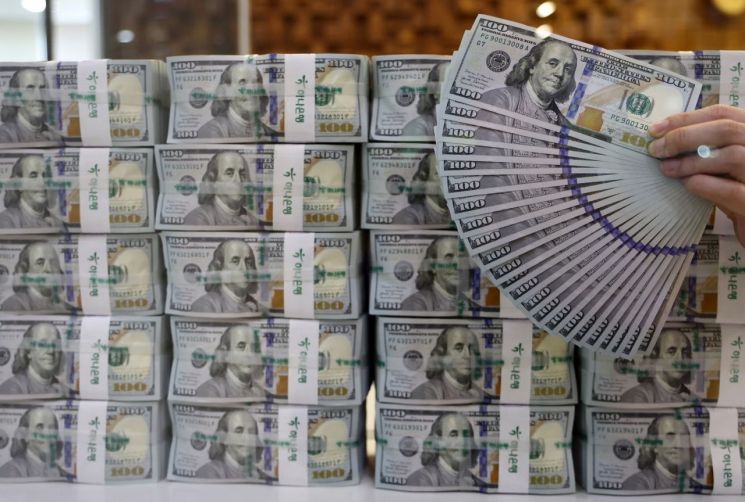
South Korea's foreign exchange reserves increased by 330 million dollars in one month, marking a return to growth after five months. This is interpreted as a result of an increase in foreign currency deposits at financial institutions and a decrease in foreign exchange reserves used to defend the exchange rate.
According to the 'End of July Foreign Exchange Reserves' statistics released by the Bank of Korea on the 3rd, South Korea's foreign exchange reserves stood at 438.61 billion dollars, an increase of 330 million dollars compared to the end of the previous month.
The foreign exchange reserves had recorded 461.766 billion dollars in February, then decreased for four consecutive months to 438.28 billion dollars in June, but returned to a slight increase last month.
The Bank of Korea explained the increase in foreign exchange reserves as "despite a decrease in the dollar conversion amount of other currency foreign assets, it was due to an increase in foreign asset management income and foreign currency deposits at financial institutions."
To calculate the size of foreign exchange reserves, the Bank of Korea converts other foreign currency assets such as euros, pounds, and yen into dollars at the end of each month. Last month, the dollar strengthened, causing the dollar conversion value of other foreign currency assets to relatively decrease.
However, last month, foreign currency deposits and other factors increased more than the reduced foreign exchange reserves, resulting in an overall increase. The slight stabilization of the won-dollar exchange rate also appears to have influenced the reduction in foreign exchange reserves used by the foreign exchange authorities to defend the won's value.
As of the end of last month, foreign exchange reserves consisted of securities at 391.85 billion dollars (89.3%), deposits at 23.2 billion dollars (5.3%), International Monetary Fund (IMF) Special Drawing Rights (SDR) at 14.39 billion dollars (3.3%), gold at 4.79 billion dollars (1.1%), and IMF positions at 4.37 billion dollars (1.0%).
Securities decreased by 3.42 billion dollars in one month, while deposits increased by 3.98 billion dollars.
As of the end of June, South Korea's foreign exchange reserves maintained the 9th largest position globally, unchanged from the previous month.
China had the largest reserves at 3.0713 trillion dollars despite a decrease of 56.5 billion dollars in one month, followed by Japan at 1.3571 trillion dollars. Next were Switzerland (962.5 billion dollars), India (589.2 billion dollars), Russia (584.1 billion dollars), Taiwan (549.0 billion dollars), Saudi Arabia (466.4 billion dollars), and Hong Kong (447.2 billion dollars).
© The Asia Business Daily(www.asiae.co.kr). All rights reserved.
![Clutching a Stolen Dior Bag, Saying "I Hate Being Poor but Real"... The Grotesque Con of a "Human Knockoff" [Slate]](https://cwcontent.asiae.co.kr/asiaresize/183/2026021902243444107_1771435474.jpg)
















