Exporting SMEs in Crisis Face Greater Challenges in Second Half
Ministry of SMEs Opens Risk Response TF to Discuss Support
#Domestic small and medium-sized enterprise R, which exports golf equipment to Japan, has recently been operating without 'margins.' Although exports have increased, delays in Japanese shipping since the spread of COVID-19 forced the use of air freight, causing logistics costs to triple. On top of this, the depreciation of the yen further worsened profitability. The rise in logistics costs and exchange rate instability are unlikely to normalize in the short term, making the outlook for the second half of the year even bleaker. For R, the record-high export volume of small and medium enterprises in the first half of this year is merely a hollow achievement.
#Automotive electronic parts manufacturer C is facing disruptions from production to export due to the inability to procure key semiconductor materials used in major products. Previously, supply was secured within two weeks at most, but due to the explosive demand for semiconductors and the Ukraine crisis, it now takes six months to a year. Moreover, as global companies have started stockpiling semiconductor parts, small and medium enterprises are in an even more difficult position. Prices of key parts have risen 10 to 20 times compared to pre-COVID-19 levels, making it hard to bear the cost burden. As this situation continues, delays in delivery have caused existing overseas customers to drop off, the company lamented.
Domestic export small and medium enterprises are being driven into crisis. Although small and medium enterprise exports recorded an all-time high in the first half of this year, global supply chain instability and exchange rate volatility have intensified due to the Ukraine crisis and China's stringent COVID-19 lockdown policies. Voices from the field indicate that export conditions are worsening to the point where it is difficult to foresee even a short distance ahead in the second half of the year.
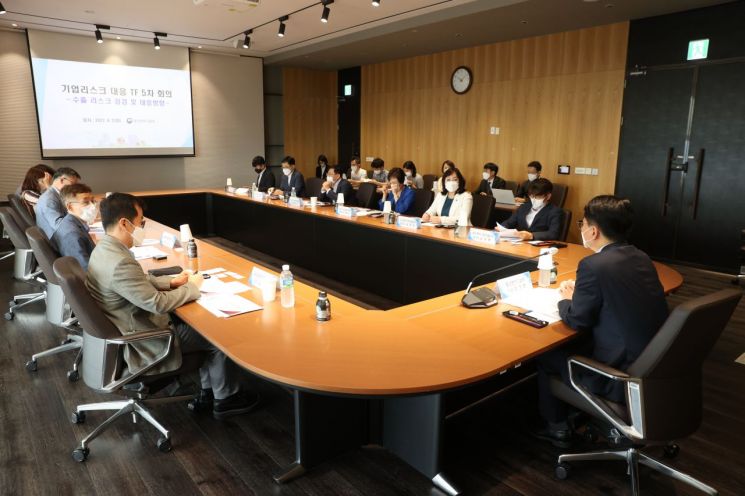 On the 2nd, the 5th meeting of the Corporate Risk Response TF on the theme of exports is being held at the Korea International Trade Association in Gangnam, Seoul.
On the 2nd, the Ministry of SMEs and Startups (MSS) held a 'Corporate Risk Response Task Force' at the Korea International Trade Association, reflecting the industry's concerns and sense of crisis. The task force discussed the economic impact of the recent triple crisis of high inflation, high interest rates, and high exchange rates on small and medium enterprise exports, as well as future response directions.
The cause of the dark clouds hanging over export small and medium enterprises, which recorded good performance until the first half, can be found in the ongoing logistics difficulties and rising raw material prices eroding corporate profitability. In fact, a survey conducted by the Korea Federation of SMEs in June found that the majority of companies cited rising raw material prices (72.2%) and logistics difficulties such as lack of shipping space and containers (44.3%) as export risks. Choo Moon-gap, head of the Economic Policy Division at the Korea Federation of SMEs, explained, "Although Korea's SME export volume has set a record high, the sustained high level of raw material prices has led to a trade deficit, increasing external risk factors."
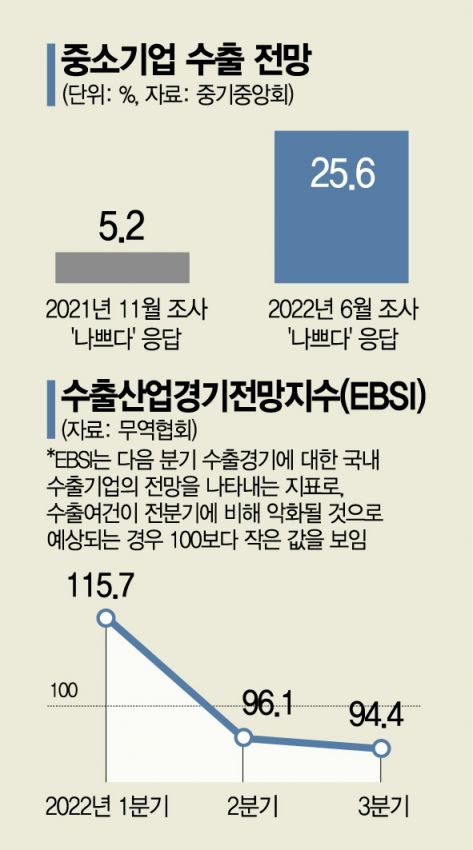
The problem is that this worsening export situation, combined with the complex crisis of high inflation and high interest rates, is expected to further exacerbate the difficulties of export small and medium enterprises in the second half of the year. This is why the Export Business Survey Index (EBSI), which reflects domestic companies' outlook on quarterly export conditions, recorded a lower figure of 94.4 in the third quarter of this year compared to 96.1 in the second quarter. In the Korea Federation of SMEs' survey, one in four export small and medium enterprises (25.6%) predicted a 'bad' export outlook for the second half of the year.
Industry insiders agree that government policies that resonate with the realities of export small and medium enterprises, such as easing raw material procurement costs and expanding budgets for logistics support, are necessary. Cho Joo-hyun, Vice Minister of MSS, said, "Even in difficult economic conditions, the most urgent task is to quickly and accurately grasp policy demands from the field so that small and medium enterprises can actively engage in export activities and to establish a response system for timely support."
© The Asia Business Daily(www.asiae.co.kr). All rights reserved.


















