Inflation Exceeds 6% with 2-3 Months of Increase Before Stabilizing
Raising Base Interest Rate by 0.25%p Each Time is Advisable
Stagflation Assessment to be Made After Reviewing October Data
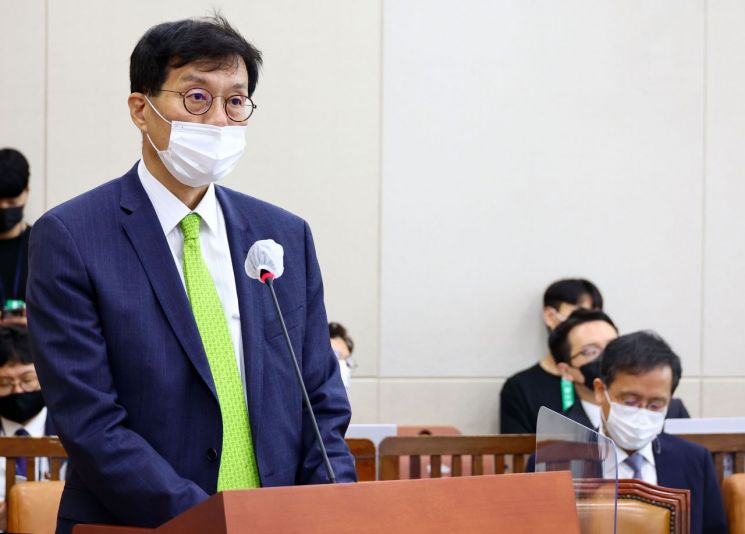 Lee Chang-yong, Governor of the Bank of Korea, is reporting on business at the Planning and Finance Committee plenary meeting held at the National Assembly in Yeouido, Seoul, on the 1st. [Image source=Yonhap News]
Lee Chang-yong, Governor of the Bank of Korea, said that the inflationary trend is expected to continue for another 2 to 3 months before stabilizing, but he did not rule out the possibility of an additional 'big step (a 0.50 percentage point increase in the base interest rate)' if the outlook deviates from expectations.
At the Planning and Finance Committee plenary session held at the National Assembly in Yeouido, Seoul, on the 1st, Governor Lee stated, "If there are no changes in overseas factors such as oil prices, the consumer price inflation rate is expected to exceed 6% and continue for 2 to 3 months before gradually stabilizing."
He added, "If this trend is maintained, I think it is desirable to raise the base interest rate by 0.25 percentage points each time to ease the inflationary trend."
However, Governor Lee left room for flexibility by saying, "If inflation deviates from the expected trend, we will decide the magnitude and extent of the rate hike after reviewing the data at that time," and "We cannot exclude the possibility of a big step."
In response to People Power Party lawmaker Kim Young-sun's concern that a sharp increase in the base interest rate could excessively increase the interest burden on ordinary citizens, Governor Lee countered that stabilizing inflation first is important.
He said, "If we fail to curb the inflationary trend, the real income of the people will fall further, and trying to control inflation later will involve greater costs. Therefore, although it is a grim decision, I believe it is macroscopically important to break the inflationary sentiment through interest rate hikes."
He continued, "When the inflation rate reaches 6 to 7%, the acceleration intensifies," and emphasized again, "Once it exceeds 6%, much greater costs may be involved. Unfortunately, from a macro perspective, we have no choice but to maintain the interest rate hike stance until the inflationary trend is curbed."
Regarding the possibility of stagflation, where economic recession and inflation occur simultaneously, he explained, "The Bank of Korea projected the economic growth rate for the second quarter at about 0.3%, but in reality, consumption increased much more, resulting in 0.7%. The domestic economy has not deteriorated significantly yet."
He added, "Considering the current situation, we are still monitoring the possibility that next year's economic growth rate will fall below 2%. In that sense, it is a bit early to definitively say it is stagflation. We think we need to review overseas data around October to make a judgment."
© The Asia Business Daily(www.asiae.co.kr). All rights reserved.
![Clutching a Stolen Dior Bag, Saying "I Hate Being Poor but Real"... The Grotesque Con of a "Human Knockoff" [Slate]](https://cwcontent.asiae.co.kr/asiaresize/183/2026021902243444107_1771435474.jpg)
















