Bank of Korea Reports to National Assembly's Finance Committee
Inflation Expected to Rise Over 4.5% This Year
Low Likelihood of Foreign Capital Outflow
Need to Prepare for Risks in Non-Bank Financial Institutions
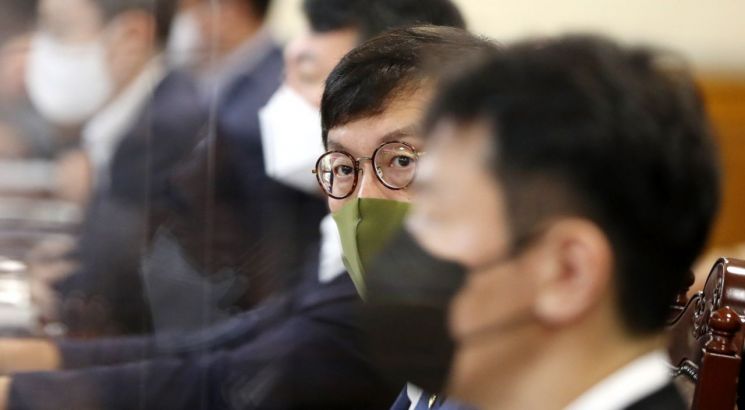 Bank of Korea Governor Lee Chang-yong is attentively listening to the remarks of Deputy Prime Minister and Minister of Economy and Finance Choo Kyung-ho at the emergency macroeconomic and financial meeting held at the Bankers' Hall in Jung-gu, Seoul, on the morning of the 28th.
 [Photo by Yonhap News]
The Bank of Korea stated that the consumer price inflation rate is expected to remain on a high upward trend for the time being and that it is appropriate to raise the base interest rate by 0.25 percentage points going forward.
In a business status report submitted to the National Assembly's Planning and Finance Committee on the 1st, the Bank of Korea explained, "if the future inflation and growth trajectory does not significantly deviate from the current forecasted path, it is judged appropriate to gradually raise the (base interest rate) by 0.25 percentage points at a time."
The Bank of Korea, continuing its base rate hike stance since August last year, raised the rate preemptively by 0.5 percentage points last month, explaining that "although downside risks to the economy have increased, the decision was made considering the expectation that growth will continue to exceed potential levels."
The Bank of Korea emphasized that while both upside risks to inflation and downside risks to growth have recently increased in the domestic economy, inflation risks remain greater at this point in time.
Consumer prices are expected to significantly exceed the May forecast level (4.5%) for the year, while this year's growth rate is expected to slightly fall short of the previous forecast (2.7%).
The Bank of Korea noted that although the U.S. Federal Reserve's giant step (a 0.75 percentage point increase in the base interest rate) has caused the Korea-U.S. base interest rates to invert, it currently judges that the possibility of a large-scale outflow of foreign investment in domestic securities is not high.
This is because a considerable portion of foreign investors' stock portfolio adjustments has already been made, and domestic bond yields relative to credit ratings remain favorable, so the pressure for capital outflow is not high.
Regarding the financial market situation, the Bank of Korea stated, "The domestic financial system is generally stable, but it is necessary to prepare for the possibility of increased risks among vulnerable borrowers and some non-bank financial institutions."
Although the financial vulnerability index, which shows medium- to long-term vulnerabilities within the financial system, has declined since the second half of last year, it remains at a high level compared to the long-term average, and the financial distress index is also on the rise, recently entering a cautionary stage.
The Bank of Korea emphasized, "Attention should be paid to the possibility that the debt repayment ability of vulnerable household and corporate borrowers weakens and that the funding and operational conditions of non-bank financial institutions become unstable," adding, "Under cooperation among policy authorities, measures to strengthen support for vulnerable borrowers and improve debt structures must be devised."
© The Asia Business Daily(www.asiae.co.kr). All rights reserved.
![Clutching a Stolen Dior Bag, Saying "I Hate Being Poor but Real"... The Grotesque Con of a "Human Knockoff" [Slate]](https://cwcontent.asiae.co.kr/asiaresize/183/2026021902243444107_1771435474.jpg)











