High Inflation Era... Delivery Fee Burden
Saving by Reducing Dining Out and Using Convenience Store Lunchboxes
Riders Also Selling Delivery Motorcycles Used
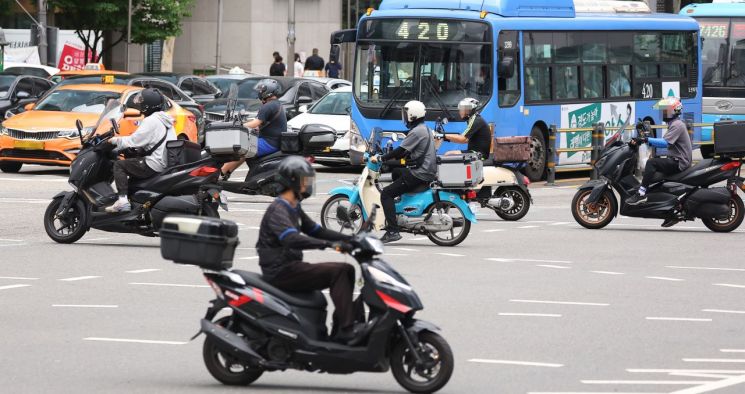 More users are leaving delivery applications due to increased delivery fees. The photo shows a motorcycle passing through an intersection in downtown Seoul on June 28.
 [Image source=Yonhap News]
[Asia Economy Reporter Yoon Seul-gi] #. Last weekend, A, a worker in their 20s, who tried to order dessert using a delivery application (app), gave up due to the "high delivery fee." A said, "There is already a minimum order amount, so the delivery fee was burdensome," adding, "The food cost was 10,000 won, but the delivery fee was 4,000 won, so it was hard to make the payment right away."
As prices soar, the number of delivery app users is decreasing. Some delivery workers are even putting their motorcycles up for sale as secondhand items, indicating that the delivery service, which prospered during the spread of COVID-19, is now shaking. Some view this as a result of the economic downturn leading to reduced dining out, suggesting that such a situation may continue.
According to recent big data analysis solution Mobile Index, the monthly active users (MAU) of major delivery apps Baedal Minjok, Yogiyo, and Coupang Eats have decreased. Baedal Minjok's MAU dropped by 740,000 from 20.73 million in January to 19.99 million in June, while Yogiyo and Coupang Eats also saw sharp declines of 1.46 million (8.92 million → 7.46 million) and 2.2 million (6.58 million → 4.38 million) respectively during the same period.
The delivery industry was a representative sector that benefited from COVID-19. Previously, the government implemented social distancing to prevent the spread of COVID-19 and actively encouraged the use of delivery and takeout services, which increased delivery demand and caused delivery fees to skyrocket. In some areas, when weather, time, and regional surcharges were added to the basic delivery fee, the delivery cost per order exceeded 10,000 won. In response, consumers devised self-help measures such as "delivery pooling" (sharing delivery fees among people living nearby) to cope with the "delivery fee bomb."
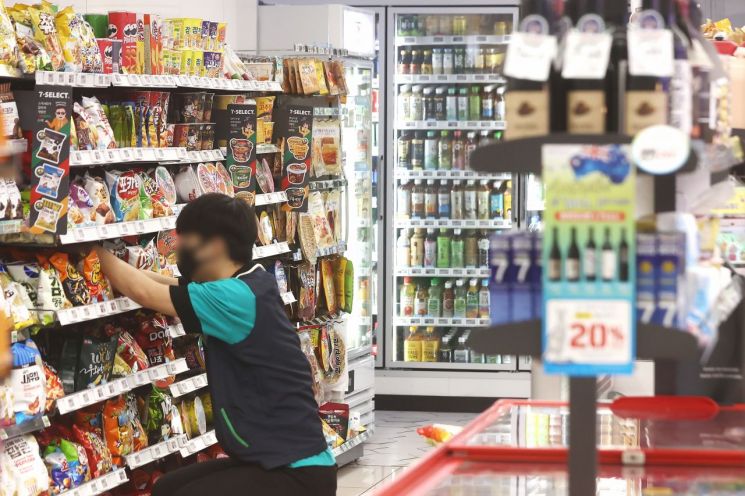 Due to the steep rise in prices, some office workers are relying on convenience store lunch boxes for their meals. The photo shows an employee working at a convenience store in Seoul on the 6th. Photo by Yonhap News.
◆ Soaring dining-out prices... meals solved at convenience stores
However, as high-intensity quarantine policies have been lifted and full-scale daily life recovery has begun, a gloomy atmosphere is detected in the delivery industry. The delivery fees consumers have to bear have become a major complaint, and with the ongoing high inflation, the number of consumers using delivery services is decreasing.
According to the National Statistical Portal (KOSIS) of Statistics Korea on the 1st, the dining-out price index for the first half of this year (January to June) rose 6.7% compared to the previous year's cumulative figure. The year-on-year cumulative change rate compares the average price level from January to June this year with the same period last year. By item, the price of samgyeopsal, a representative affordable dining-out menu, increased by 7.4%.
Prices for beef (8.5%) and pork ribs (7.9%) consumed as dining-out also rose, while jajangmyeon prices soared 9.1% in the first half of the year, jjamppong by 8.2%, and tangsuyuk by 6.1%. Summer health menus such as samgyetang (4.4%) and naengmyeon (7.6%) also saw price increases. This is why more people are either picking up food themselves to reduce delivery fees or deleting delivery apps altogether.
Given this situation, some people are solving meals at convenience stores. According to Emart24, sales of lunch boxes and baked bread increased by 48% and 39% respectively from June to the 26th of last month compared to the same period last year. Lunch box sales increased by 68% in office districts, and also rose by 54% and 42% in single-residence and academy districts respectively. According to GS25, lunch box sales from the 1st to the 7th of last month increased by 49.8% compared to the same period last year. The number of people purchasing lunch box containers and airtight containers related to lunch boxes on online shopping malls has also increased.
Kim, a company employee in their 40s, said, "Recently, I had dinner with a convenience store lunch box and cup noodles, which seems to be the most economical option in this high-price era," adding, "I don't even think about ordering delivery anymore."
Meanwhile, as demand for delivery services decreases, the secondhand market is flooded with delivery motorcycles. On an online secondhand motorcycle trading community, many motorcycles under 125cc, mainly used by delivery workers, have been listed one after another. Since the lifting of social distancing, listings surged, with about 4,770 motorcycle sale posts recorded in June, marking a record high. This is interpreted as many riders quitting the delivery business and leaving the industry altogether.
© The Asia Business Daily(www.asiae.co.kr). All rights reserved.

![Clutching a Stolen Dior Bag, Saying "I Hate Being Poor but Real"... The Grotesque Con of a "Human Knockoff" [Slate]](https://cwcontent.asiae.co.kr/asiaresize/183/2026021902243444107_1771435474.jpg)
















