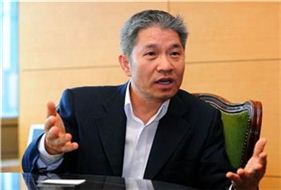
 Kang Bang-cheon, Chairman of Asset Plus Asset Management
[Asia Economy Reporter Hwang Sumi] Recently, allegations of nominee investments involving prominent figures in the financial sector have surfaced. Following John Lee, former CEO of Meritz Asset Management who led the Donghak Ant Movement, Kang Bangcheon, chairman of Asset Plus Asset Management and known as Korea's first-generation fund manager, is also reportedly facing disciplinary procedures by financial authorities over allegations of nominee investments.
According to the financial investment industry on the 31st, Chairman Kang is under suspicion of nominee investments by financial authorities. This comes just one month after John Lee, another value investment expert, resigned from his CEO position amid similar allegations.
Chairman Kang gained attention after launching Asset Plus Asset Management in 2008 and pioneering direct fund sales in the industry. He is famous for earning 15.6 billion KRW from an initial seed money of 100 million KRW in just 1 year and 10 months through value investing during the IMF (International Monetary Fund) crisis.
Additionally, in 2013, he was the only Korean included alongside Warren Buffett, Peter Lynch, and others in the book "99 Great Investors of the World," published in Sweden. Kang is also known as the inspiration for the fund manager character Yoon Jung-hak, portrayed by actor Yoo Ah-in in the film "Default," which deals with the Asian financial crisis.
However, it has recently been confirmed that Kang was investigated by the Financial Supervisory Service (FSS) over allegations of nominee investments. The FSS revealed that during a regular inspection of Asset Plus Asset Management conducted from last year through the first half of this year, they detected signs of proprietary trading by Chairman Kang.
Proprietary trading refers to securities firms buying and selling securities with their own funds to generate profits. This is distinct from agency trading, where trades are executed on behalf of clients. Traders must prioritize agency trades received from clients. When entrusted with trading transactions by clients, traders are prevented from prioritizing trades in which they have a direct interest to generate profits.
According to the FSS, Chairman Kang is suspected of lending his funds to the shared office company Wonderplus and trading stocks under the corporate name for several years. Wonderplus is known to have Kang as the largest shareholder and his daughter as the second-largest shareholder. The FSS views this as nominee investment and proprietary trading.
The FSS explained that they did not classify it as proprietary trading merely because funds were lent to the office company, but identified specific circumstances indicating it was not a simple loan. The investigation into Chairman Kang has concluded, and disciplinary procedures are underway. The FSS plans to submit a disciplinary proposal to the Financial Services Commission in the second half of the year.
In response, Chairman Kang admitted to lending the funds but denied that it constituted proprietary trading or grounds for sanctions. He stated that he lent the funds to Wonderplus at an annual interest rate of 4.6% and reported all interest income to the National Tax Service.
He also argued that profits and losses belong to the corporation, not to him personally. Kang said, "Interpreting a legitimate loan as proprietary trading simply because I am the major shareholder is excessive," adding, "The corporation and I have a borrower-lender relationship, and even as a 100% major shareholder, I cannot claim all the company's assets." However, the FSS reportedly judged that since Kang is the major shareholder, the profits and losses ultimately accrue to him.
Meanwhile, the impact of these allegations on the financial investment industry is expected to be significant. Previously, John Lee also stepped down amid illegal investment allegations from financial authorities.
John Lee is known as the pioneer of the "Korea Fund," the world's first fund investing in Korean companies from New York's Wall Street. Notably, as an investor with a clear investment philosophy, he led the Donghak Ant Movement, marking a milestone in the history of Korea's capital markets.
However, in May, John Lee was investigated by the FSS following reports that Meritz Asset Management invested fund money in a company where his wife is a shareholder. Although Lee denied any illegality, the controversy persisted, and he ultimately resigned on the 28th of last month, just ten days after the nominee investment allegations surfaced.
Additionally, Chairman Kang unexpectedly announced his retirement on the 29th. According to Asset Plus Asset Management, Kang will resign from his positions as registered director and chairman at the extraordinary board meeting and shareholders' meeting scheduled for August. This marks 23 years since he founded Asset Plus Investment Advisory, the predecessor of Asset Plus Asset Management, in 1999.
© The Asia Business Daily(www.asiae.co.kr). All rights reserved.
![User Who Sold Erroneously Deposited Bitcoins to Repay Debt and Fund Entertainment... What Did the Supreme Court Decide in 2021? [Legal Issue Check]](https://cwcontent.asiae.co.kr/asiaresize/183/2026020910431234020_1770601391.png)















