Government Prepares 'Measures to Enhance Accessibility and Strengthen Benefit Management'
Concurrent Benefit Evaluation and Drug Price Negotiation... Introduction of Various Risk-Sharing Systems
Patient Groups Demand Swift Benefit Implementation System
Pharmaceutical Companies Also Requested for Post-Evaluation, Post-Payment, and Installment Systems
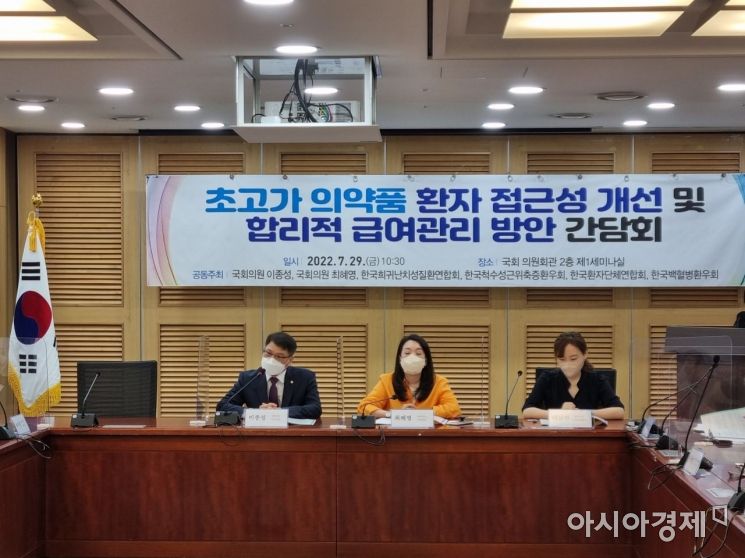 On the morning of the 29th, a meeting on "Improving Patient Access to Ultra-High-Cost Drugs and Rational Benefit Management Measures" was held at the National Assembly Members' Office Building, jointly hosted by Lee Jong-seong of the People Power Party, Choi Hye-young of the Democratic Party of Korea, the Korea Rare and Intractable Disease Association, the Korea Spinal Muscular Atrophy Patients Association, the Korea Patient Organization Federation, and the Korea Leukemia Patients Association.
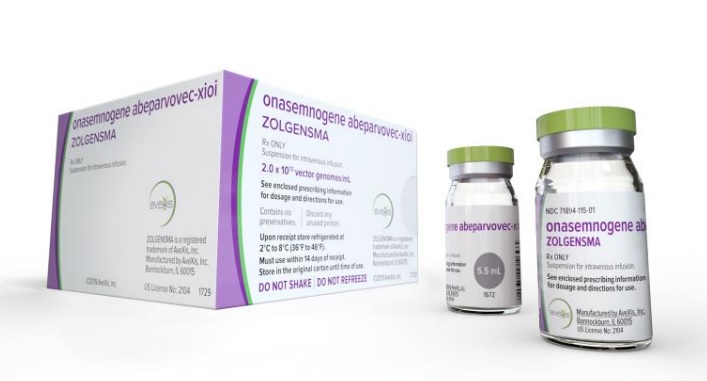
[Asia Economy Reporter Lee Chun-hee] As the National Health Insurance coverage for ultra-expensive treatments such as the 360 million KRW leukemia treatment 'Kymriah' and the 2 billion KRW spinal muscular atrophy (SMA) treatment 'Zolgensma' continues, concerns about the financial soundness of the health insurance system are also growing. While the government has announced plans to establish various insurance measures for ultra-expensive treatments, patient groups have raised their voices, calling for faster insurance listing and practical supplementary measures to share the suffering of patients.
On the morning of the 29th, a meeting on "Improving Patient Access to Ultra-High-Cost Drugs and Rational Benefit Management Measures" was held at the National Assembly Members' Office Building, jointly hosted by Lee Jong-sung of the People Power Party, Choi Hye-young of the Democratic Party, the Korea Rare and Intractable Disease Association, the Korea Spinal Muscular Atrophy Patients Association, the Korea Patient Organization Federation, and the Korea Leukemia Patient Association.
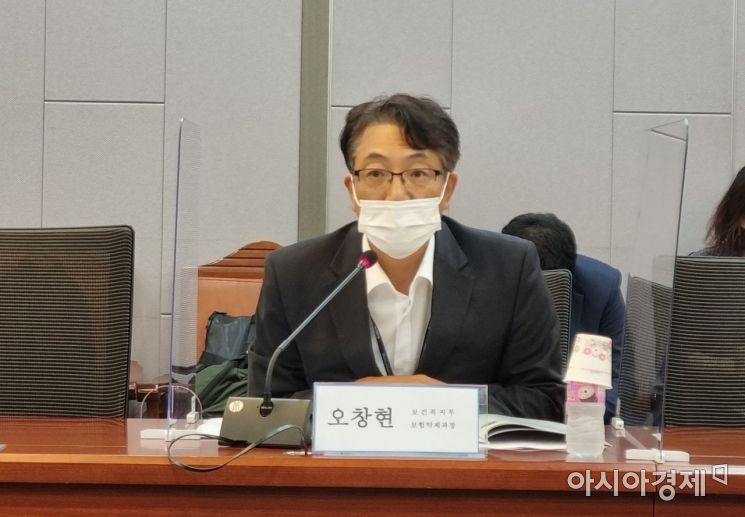
At the meeting, Oh Chang-hyun, head of the Insurance and Drug Division at the Ministry of Health and Welfare, the relevant ministry, explained in his presentation on "Measures to Enhance Patient Access to High-Cost Severe Disease Treatments and Strengthen Benefit Management" that since social discussions were triggered by Kymriah and Zolgensma, they are preparing improvement plans to enhance patient access while strengthening monitoring of treatment effectiveness and safety, and benefit management. This involves accelerating the so-called 'fast-track listing' process as much as possible while establishing multiple safety measures throughout.
Regarding patient access, a 'parallel pilot project' is being promoted to complete all benefit listing procedures within a maximum of 120 days by simultaneously conducting the Health Insurance Review and Assessment Service's benefit evaluation and the Health Insurance Corporation's price negotiations at the same time as the Ministry of Food and Drug Safety's product approval application. Yumi-young, head of the Drug Management Office at the Health Insurance Review and Assessment Service, explained that the parallel implementation of benefit evaluation and price negotiations after the MFDS completes safety and efficacy review, which can be considered a preliminary stage of the pilot project, "could be implemented in the second half of the year."
To ensure financial soundness and treatment effectiveness, systems such as performance-based risk-sharing agreements currently applied to Kymriah and Zolgensma, post-management systems for high-cost drugs, review of discontinuation criteria after drug use, and improvements to the volume-price linkage system are planned to be implemented.
Additionally, for high-cost new drugs, benefit administration will be conducted through prior approval by the Health Insurance Review and Assessment Service's Medical Review and Evaluation Committee. The exemption system for economic evaluations will be limited to drugs for 'small patient populations' to strengthen cost-effectiveness assessments, and measures to enhance price transparency through price comparisons with the Advanced 7 countries (A7) will be promoted.
Patient groups partially agreed with these measures but also voiced the need for improvements. They emphasized that while new drugs should be administered to patients quickly, more practical system improvements are necessary to reduce their burden. They demanded the prompt implementation of the government's proposed parallel pilot project for approval application-benefit evaluation-price negotiation, and stressed that ▲ rare drugs and rare disease treatments should be managed in an integrated manner ▲ rare diseases with treatments should be included in newborn screening ▲ life-critical new drugs should be supplied free of charge to low-income groups.
In particular, there was a strong call for faster insurance listing due to the excessively long time from when new drugs apply for approval domestically to when insurance coverage is achieved. Lee Bo-yeon, who lost her son, the late Cha Eun-chan, who suffered from pediatric acute leukemia after missing the opportunity for Kymriah treatment, said, "While Eun-chan was waiting for Kymriah, the difficulty was not only the cost but also the long time until actual use." She appealed, "There is mention of a pilot project to conduct benefit evaluation and price negotiation in parallel, but I hope it will be accelerated more dramatically so that the drug can be used quickly, and that measures to allow drug use during the gap period will also be found and prepared."
In fact, even in the case of Zolgensma, which was recently covered by insurance, parents of patients posted appeals on internet communities that if insurance coverage was not achieved by July, their children would miss the age limit and be unable to receive treatment. Regarding this, Oh explained, "The original age limit for Zolgensma administration is 12 months, but to provide treatment opportunities, transitional measures have been created so that about seven children can receive treatment opportunities," adding, "Administrative procedures include transitional measures for children born up to July 2020."
However, he added that such measures are inevitably limited, saying, "If this period is exceeded, it will not align with the MFDS approval details and will be difficult to accept at the Health Insurance Policy Deliberation Committee." The MFDS currently states about Zolgensma, "Experience in patients aged 2 years or older or weighing 13.5 kg or more is limited," and "Safety and efficacy of Zolgensma in such patients have not been established."
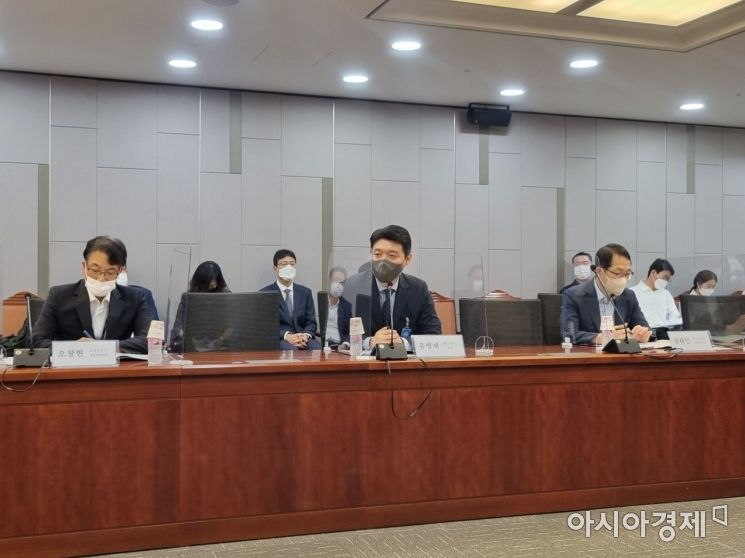 On the morning of the 29th, Yoo Byung-jae, CEO of Korea Novartis, is speaking at a meeting held at the National Assembly Members' Office Building on "Improving Patient Accessibility to Ultra-High-Cost Drugs and Rational Benefit Management Measures."
Patient groups issued strong demands not only to the government, the Health Insurance Corporation, and the Health Insurance Review and Assessment Service but also to pharmaceutical companies. They called for pharmaceutical companies to take the lead in early administration by sharing patients' immediate burdens even before insurance coverage is achieved if they are confident in the drug's efficacy. Specifically, they appealed for ▲ pre-treatment, post-evaluation, and post-payment for high-cost drugs ▲ establishment of installment payment systems for non-covered drug costs.
Moon Jong-min, director of the SMN Patients Association, said, "Post-evaluation and post-payment may seem selfish and idealistic, but if the drug is effective, pharmaceutical companies should invest and proceed first so that treatment can be received while negotiating with the Health Insurance Review and Assessment Service and the Health Insurance Corporation," adding, "The installment payment system is also idealistic, but I hope pharmaceutical companies invest and open it."
Yu Byung-jae, CEO of Korea Novartis, explained, "Once safety and efficacy are secured, a shortened period for quick access should be created," and added, "As a concept of pre-investment, pharmaceutical companies provide drugs free of charge to clinical trial participants, so we intend to encourage more patient participation in Korea."
© The Asia Business Daily(www.asiae.co.kr). All rights reserved.
!["The Woman Who Threw Herself into the Water Clutching a Stolen Dior Bag"...A Grotesque Success Story That Shakes the Korean Psyche [Slate]](https://cwcontent.asiae.co.kr/asiaresize/183/2026021902243444107_1771435474.jpg)


















