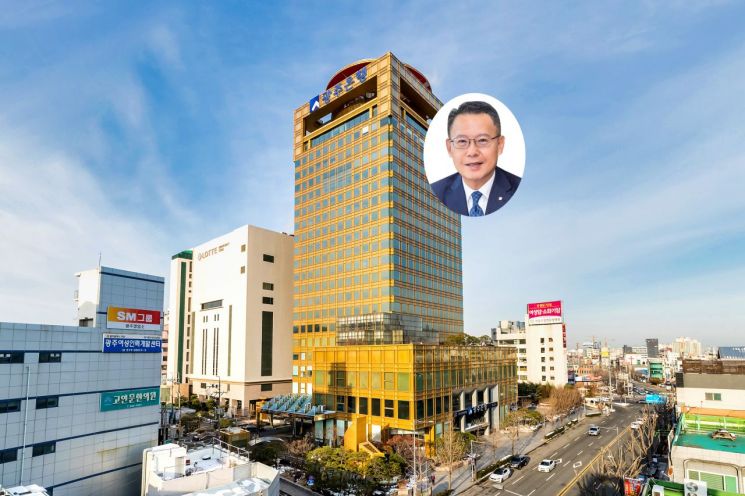
[Asia Economy Honam Reporting Headquarters Reporter Park Jin-hyung] Gwangju Bank announced on the 29th that its net profit for the first half of this year reached a record high of 122.9 billion KRW (separate basis).
This represents an 18.5% increase compared to the net profit of 103.7 billion KRW in the first half of the previous year, and the operating profit for the first half reached 163.4 billion KRW (137.9 billion KRW in the same period last year).
Both the non-performing loan ratio and delinquency ratio stand at 0.29%, maintaining the highest level of asset soundness in the banking sector. The BIS capital adequacy ratio is 15.30%, and the common equity tier 1 capital ratio is 14.47%, with all related ratios being managed stably.
This achievement, following last year's record net profit of 196.5 billion KRW, is seen as the result of Gwangju Bank President Song Jong-wook’s emphasis on coexistence with the region and companionship with local residents, realizing ‘pursuit of value beyond profit’ through community-based management and inclusive finance, expanding the business base, and promoting solid internal management.
President Song Jong-wook of Gwangju Bank stated, “Although challenging management conditions are expected in the second half due to the first-ever big step rate hike, digitalization of finance, and sluggish economy, we will do our best to fulfill the role of Gwangju and Jeonnam’s representative bank by practicing community-based management, customer-centered field management, inclusive finance based on customer value and social responsibility, and strengthening social contribution activities. Along with community-based management, we will proactively respond to changes in the digital financial environment, enhance digital communication with customers, and secure digital financial competitiveness to become a sustainable 100-year bank.”
Considering the significant increase in household and corporate debt during the COVID-19 crisis response and the recent big step (0.5% point base rate hike) by the Bank of Korea, which has increased the repayment burden on financially vulnerable groups such as low-credit borrowers, Gwangju Bank has proactively introduced specific interest rate reduction measures for local middle and low-income earners and small business owners. These include ▲a 2.0%p reduction in inclusive finance loan interest rates to support low-income finance ▲up to 1.0%p reduction when extending the maturity of loans secured by credit guarantee foundation guarantees ▲up to 1.0%p reduction in interest rates for personal business loans exceeding 7.0% interest when extending maturity. Additionally, the bank plans to devise and implement various additional measures to support local middle and low-income earners and small business owners.
Furthermore, at the 2022 second half management strategy meeting, Gwangju Bank set the following key strategies to focus on in the second half: ▲strengthening sales capabilities in response to the changing business environment due to rising interest rates ▲enhancing management efficiency based on channel optimization strategy and cost management ▲expanding future revenue base through strengthening digital competitiveness ▲strengthening asset soundness management.
In the first half of 2022, Gwangju Bank achieved remarkable management results that solidified its status as the representative bank of Gwangju and Jeonnam, including ▲ranking first in the regional bank category for five consecutive years in the ‘Korea Industrial Brand Power (K-BPI)’ ▲ranking first in the small and medium-sized group of the 2021 relational finance excellent banks selected by the Financial Supervisory Service ▲receiving the ‘Excellent’ grade in the 2021 regional reinvestment evaluation by the Financial Services Commission and Financial Supervisory Service ▲ranking first among small banks in the 2021 second half technology finance performance evaluation (TECH evaluation) by the Financial Services Commission ▲achieving a grand slam by serving as the dedicated bank for the Gwangju Metropolitan City treasury and the five districts of Gwangsan, Dong, Seo, Nam, and Buk in Gwangju ▲securing all treasuries in the Jeonnam city areas (Gwangyang, Naju, Mokpo, Suncheon, Yeosu) ▲being the first in Gwangju and Jeonnam to join the Red Cross 1 billion KRW donation club, supporting local small and medium enterprises, small business owners, and middle and low-income earners.
Regarding this, there has been positive feedback that Gwangju Bank, as the regional representative bank, has taken the lead in empathizing with and addressing community issues, and that social contribution activities and financial support carried out in the process have led to warm exchanges with local residents.
In fact, President Song Jong-wook frequently visits local small and medium enterprises to listen directly to their difficulties and carefully considers practical financial support measures. He also emphasizes field-centered management to employees, aiming to minimize damage to the local economy and ensure timely financial support for local small and medium enterprises, small business owners, and middle and low-income earners through systematic community-based management.
Additionally, the bank provides prompt financial support when needed by local self-employed individuals and small business owners. Since 2018, it has made special contributions totaling 7.11 billion KRW to the Gwangju Credit Guarantee Foundation and 4.7 billion KRW to the Jeonnam Credit Guarantee Foundation. This year alone, it signed a special guarantee business agreement with Gwangsan, Dong, Seo, and Buk districts of Gwangju Metropolitan City to make a special contribution of 250 million KRW and support a total of 7.575 billion KRW in special guarantee loans for small business owners.
Accordingly, as of the end of June 2022, the financial support provided by Gwangju Bank to self-employed individuals and small business owners affected by COVID-19 amounted to 30,897 cases and 1.3943 trillion KRW.
Gwangju Bank’s ESG management, which participates in solving problems in various fields such as the local economy, society, and culture, is also attracting attention. This includes issuing ESG bonds to support eco-friendly businesses and local small and medium enterprises and small business owners struggling due to COVID-19, coal phase-out and Green New Deal agreements, relay volunteer activities at Gwangju Stream, and selling inclusive financial products for self-employed individuals, small business owners, and middle and low-credit borrowers. The bank also donates more than 10% of its net profit back to the local community through various social contribution activities.
Having built a solid foundation through qualitative growth and structural improvement, Gwangju Bank plans to leap forward as a sustainable 100-year bank, not only as the representative bank of Gwangju and Jeonnam in 2022 but also as the leading regional bank with the highest profitability and soundness.
The bank will further deepen its existing focus on community-based management and inclusive finance practices, and accelerate efforts to strengthen digital financial competitiveness, which is actively underway through the complete overhaul of personal and corporate smart banking, full implementation of MyData, operation of a digital finance center dedicated to managing non-face-to-face customers, and upskilling of internal capabilities centered on digital and IT.
© The Asia Business Daily(www.asiae.co.kr). All rights reserved.
![User Who Sold Erroneously Deposited Bitcoins to Repay Debt and Fund Entertainment... What Did the Supreme Court Decide in 2021? [Legal Issue Check]](https://cwcontent.asiae.co.kr/asiaresize/183/2026020910431234020_1770601391.png)















