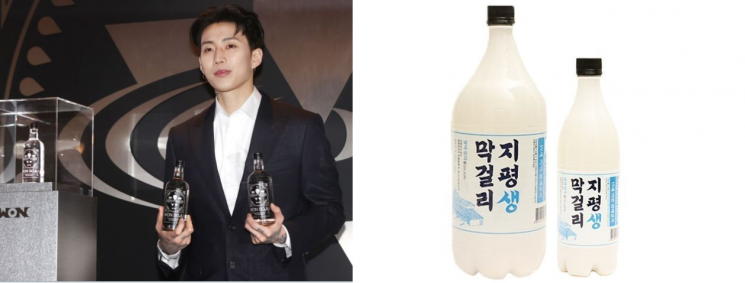
[Asia Economy Son Sunhee (Sejong)·Song Seungyun Reporter] The government has decided to revise related laws to redefine the 'traditional liquor regulations' triggered by singer Park Jaebeom's 'Wonsoju.' The current standards for traditional liquor specified in the law greatly differ from the general perception of consumers, and some makgeolli products such as Baekseju and Jipyeong Makgeolli are not recognized as traditional liquor unlike Wonsoju, raising issues of fairness.
According to the Ministry of Agriculture, Food and Rural Affairs on the 29th, a revision bill of the 'Act on the Promotion of Traditional Liquor Industry' focusing on separately classifying regional specialty liquors and including makgeolli in traditional liquors will be submitted to the regular National Assembly session in September. The goal is to amend it within this year.
Under the current Traditional Liquor Industry Act, regional specialty liquors made primarily from agricultural products produced locally, like Wonsoju, are classified as traditional liquors. However, some makgeolli products, even if following traditional manufacturing methods, have not been recognized as traditional liquors because they use imported agricultural products as ingredients or are not produced by 'agricultural corporations.' With the recent rise in interest in the Korean Wave, overseas demand for makgeolli is also increasing, but domestic laws are hindering online sales and exports in the related industry.
Accordingly, the government is considering separating regional traditional liquors entirely for separate promotion and including makgeolli and others as traditional liquors in the amendment. A Ministry of Agriculture, Food and Rural Affairs official explained, "There was a problem where regional specialty liquors were included as traditional liquors under the law, so some products that are not actually traditional liquors received benefits. We plan to separate the broad category of regional specialty liquors and include those like makgeolli, which did not receive benefits, as traditional liquors." In this regard, Jeong Hwang-geun, Minister of Agriculture, Food and Rural Affairs, visited Kooksoondang, a traditional liquor manufacturing and export company located in Hoengseong, Gangwon Province, the day before and said, "We will amend the Traditional Liquor Industry Act within this year in a way that the public can understand."
The alcoholic beverage industry, where some existing products like makgeolli were not recognized as traditional liquors due to not meeting legal requirements, welcomes this move. An industry official said, "This law revision will be an opportunity to grow the entire industry and dispel misunderstandings about traditional liquor," adding, "It seems desirable to keep regional specialty liquors as they are to protect small businesses and expand the recognition scope of traditional liquors."
The traditional liquor industry generally agrees with this direction but expresses concerns about the benefits that large companies might receive once classified as traditional liquors.
A representative of a traditional liquor manufacturing company said, "We had anticipated this situation since celebrities entered the industry and shook up the market," emphasizing, "We need to see how the law revision will proceed, but many agree with the current discussions in broad terms. However, the original intent to protect small businesses and foster the traditional liquor industry must not be compromised."
© The Asia Business Daily(www.asiae.co.kr). All rights reserved.

















