Average Debt Amount at Closure: 84.97 Million KRW
40% of Closed Businesses Have Restarted or Are Preparing to Restart
2022 First Half Survey on Business Closures of Guaranteed Support Companies
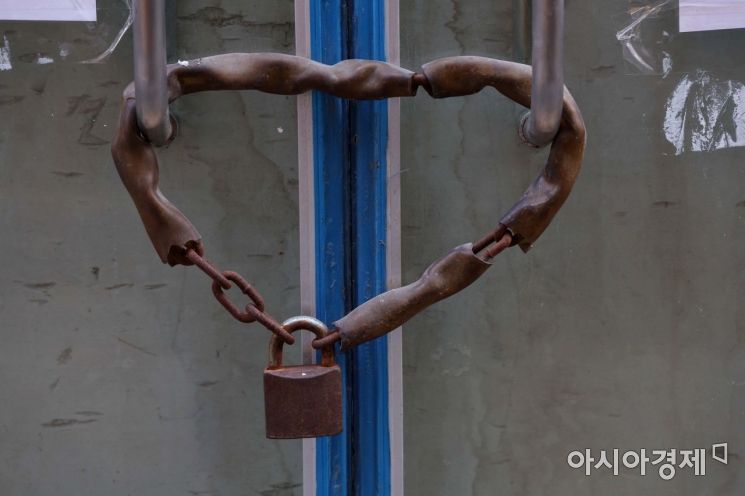 The door of a closed store in Myeongdong, Seoul is firmly locked. The padlock is rusted, showing how much time has passed. We hope the COVID-19 situation calms down soon so that small business owners and self-employed people can smile brightly again. Photo by Moon Honam munonam@
[Asia Economy Reporter Sim Nayoung] The era of 6.57 million self-employed people in South Korea. One out of every eight people in the country is self-employed. As the entry barrier is low, closures are also frequent, which is the rule in this neighborhood. Debt ranging from tens of millions to hundreds of millions of won is an unavoidable burden. What kind of circumstances lead self-employed people to decide to close their businesses? Will they be able to get back on their feet?
According to the '2022 First Half Closure Status Survey of Guaranteed Companies' by the Korea Credit Guarantee Fund Central Association (a telephone survey of 821 closed businesses conducted from April 21 to May 18), the average debt amount at the time of closure for self-employed people was 84.97 million won. The most common debt range was between 50 million and less than 70 million won (22.7%), followed by 100 million to less than 200 million won (20.7%). Those with debt over 200 million won accounted for 9.4%.
Kim Young-woo (32, pseudonym), who runs a Agujjim (spicy braised monkfish) restaurant in Daegu, is also joining the ranks of self-employed people quitting their businesses. He decided to close his store after using up the remaining packaging containers this month. He started the business with money saved from part-time jobs in his twenties and bank loans. Initially, he had a 30-pyeong (approx. 99 sqm) store with a proper dining area, but when COVID-19 hit and business declined, he moved to a 6-pyeong (approx. 20 sqm) place focusing only on delivery. Five months after moving, even the remaining deposit was used up to maintain the store, leaving him with 60 million won in debt.
Kim said, "They say young people endure hardships willingly, so I ran the business for four years, but sales declined, the economy worsened, and over time it felt like I was falling into a hellfire." He added, "After selling my car as a last resort, I got 13 million won, but after paying overdue ingredient costs, utilities, and rent, I only have 2 million won left."
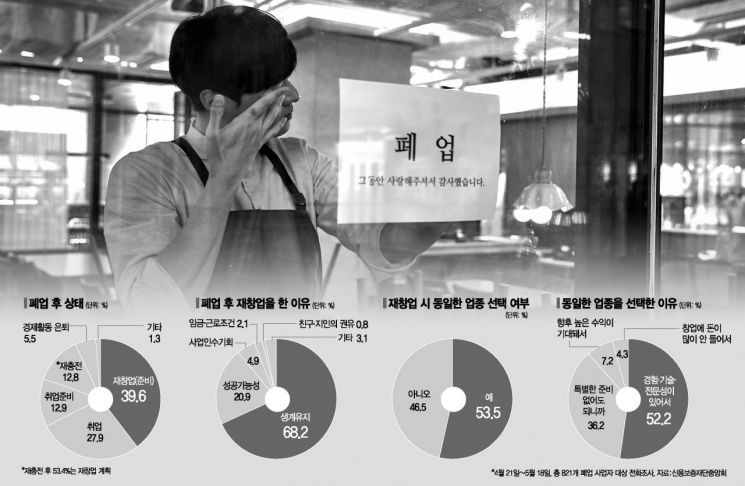
The most cited reason for closure was 'poor sales and profits' (73.8%). As expected, 93.3% of respondents said they were affected by COVID-19. The longest operating period among closed businesses was '10 years or more' (28.3%). This suggests that even self-employed people with relatively long business histories could not withstand the impact of COVID-19 restrictions on operating hours and eventually went out of business. Among the types of closed businesses, independent stores (74.1%) outnumbered franchise stores (25.9%), indicating that those who entered self-employment without headquarters support or know-how faced greater management difficulties.
Even if they decide to close, without money, they cannot. Various taxes, rent, ingredient costs, and demolition fees costing tens of thousands of won per pyeong make closure burdensome. As a result, the average closure cost for self-employed people was 19.89 million won. This is why 60.8% of respondents said they most needed support for closure costs such as restoration expenses.
The reality for those closing businesses is that they often cannot even properly collect the money owed to them before packing up. The top difficulty during closure was 'recovering key money' (31.4%). Park Kyung-jin (48, pseudonym), who put up her pork belly restaurant in Haeundae, Busan, for sale, initially tried to recover the full 25 million won key money she paid when starting the business, but after three months without a buyer, she drastically reduced it to 13 million won. Park sighed, "I am hurriedly trying to settle and handing over the store at a 'crazy key money' price. Even if I sell the equipment as used, I could get 6 million won, but with rising prices and a tough economy, no one wants to buy the store."
Among closed small business owners, 40% have either 'already restarted a business' (24.1%) or are 'preparing to do so' (15.5%). Among those who said they are 'recharging' (12.9%), 53.4% plan to 'restart a business' in the future. This means about half of closed small business owners are jumping into re-entrepreneurship. Only 5.5% said they have 'retired from economic activities.'
© The Asia Business Daily(www.asiae.co.kr). All rights reserved.
![Clutching a Stolen Dior Bag, Saying "I Hate Being Poor but Real"... The Grotesque Con of a "Human Knockoff" [Slate]](https://cwcontent.asiae.co.kr/asiaresize/183/2026021902243444107_1771435474.jpg)












