Purchased from the Overseas Korean Cultural Heritage Foundation's UK branch
"Additional investigation and research needed to identify the owner"
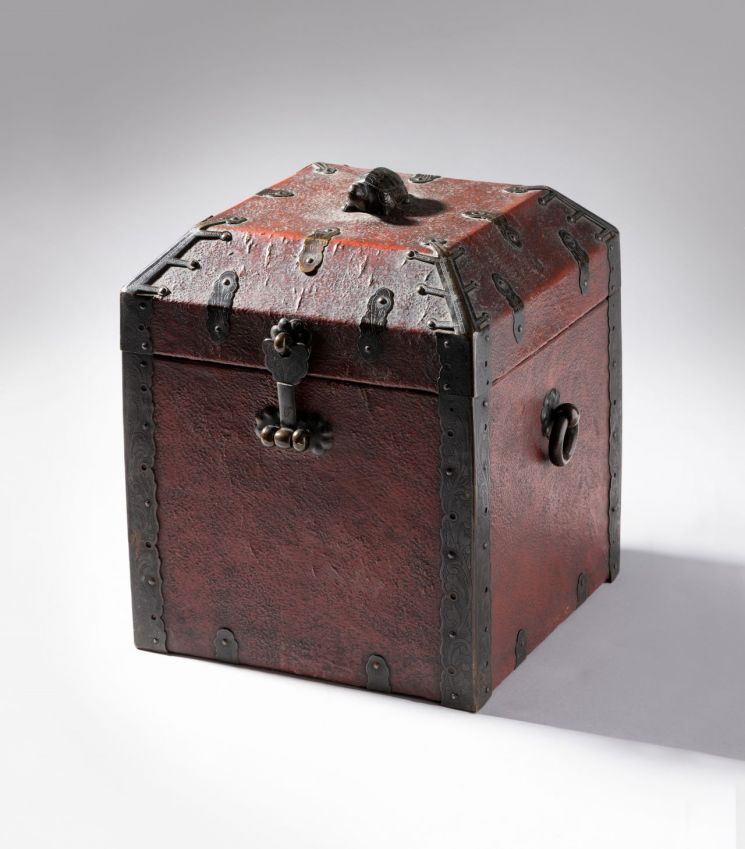
Eobo (御寶) is the royal seal of the king. It was kept in the Jongmyo Shrine or the Oegyujanggak in a container called Botong (寶筒) as the inner case and Borok (寶?) as the outer case. The two boxes were usually made together with the eobo, but sometimes older ones were repaired and reused. Therefore, it is difficult to determine the exact production date. This is even more so if the eobo, which serves as the source, is missing.
The Cultural Heritage Administration and the Overseas Korean Cultural Heritage Foundation revealed an unidentified Borok purchased from a British corporation on the 27th of last July. The acquisition was carried out after expert evaluation, direct inspection, and persuading the owner. A foundation official stated, "When we obtained the information, the British corporation was negotiating for sale," adding, "We closely cooperated with the Cultural Heritage Administration and repeatedly conveyed to the owner the necessity of returning it to Korea, which enabled us to bring it into the country." They also announced, "It will be exhibited next month to the public through the special exhibition 'The Journey of Cultural Heritage Outside the Country' at the National Palace Museum of Korea."
The Borok has a turtle-shaped handle at the center of the lid. The interior surface is coated with red lacquer, and the exterior is wrapped in leather. On top of that, a reddish color mixed slightly with yellow was painted. Its dimensions are 23 cm in width, 23 cm in length, and 27.5 cm in height. The lower part of the hinge on the back is long, and copper wire was used, suggesting it was made in the 19th century. The plain silk used inside is also characteristic of that period. A foundation official said, "Additional investigation and research are needed to clearly identify the owner."
The Borok is not a mass-produced item like a seal box. It was made according to royal ceremonies for kings and queens. It holds high value as it symbolizes the legitimacy and historicity of the Joseon royal family. The Borok was continuously produced as a single item for over 300 years during the Joseon Dynasty. Made from various materials such as metal, textiles, and leather, it is also regarded as a chronological resource to observe the stylistic and material changes and developments of court crafts.
Currently, the National Palace Museum of Korea manages 312 Borok and Inrok (印?) items transferred from Jongmyo Shrine. All were made after the 1600s. Inrok refers to boxes containing seals used by crown princes, crown princesses, and others.
This repatriation was made possible with sponsorship from Riot Games. Despite the uncertainty of success in acquisition, they have provided steady support since 2012. Previously acquired cultural properties include the 2013 'Seokgasamjondo,' the 2018 'Hyo myeong Sejabin Chekbong Jukchaek,' and in 2019, the 'Cheokamseonsaeng Munjip Chekpan,' 'Baekja Idonggungmyeong Sagakho,' and 'Junghwagungin,' among others.
© The Asia Business Daily(www.asiae.co.kr). All rights reserved.
!["The Woman Who Threw Herself into the Water Clutching a Stolen Dior Bag"...A Grotesque Success Story That Shakes the Korean Psyche [Slate]](https://cwcontent.asiae.co.kr/asiaresize/183/2026021902243444107_1771435474.jpg)
















