Yongsan Maintenance Depot Master Plan Unveiled
Seoul Designates Site as Minimal Location Regulation Zone... Skyscrapers Exceeding Legal Floor Area Ratio Cap of 1500% Planned
All Parcels Allowed Mixed-Use Development Including Office, Residential, and Commercial
Over 70% of Site for Non-Residential Use... 6,000 Housing Units to be Supplied
Total Project Cost Estimated at 12 Trillion KRW, 5 Trillion KRW Public Seed Money
"Project Expected to Complete Within 10-15 Years at Earliest"
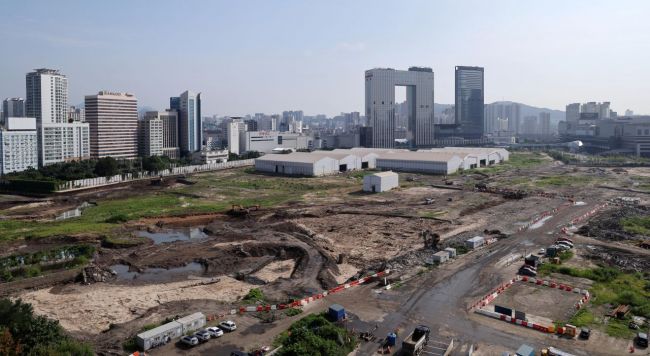 The site of the railway maintenance depot in Hangangno 3-ga, Yongsan-gu, Seoul, on the 26th. On this day, the Seoul Metropolitan Government will announce the development plan for the Yongsan International Business District. Photo by Hyunmin Kim kimhyun81@
[Asia Economy Reporters Kim Hyemin and Hwang Seoyul] The ‘last prime land’ in the heart of Seoul, Yongsan Maintenance Depot, will be developed into a high-density ‘live-work mixed-use’ international business district featuring supertall buildings.
On the morning of the 26th, Seoul Mayor Oh Se-hoon announced the ‘Yongsan International Business District Development Plan’ at Seoul City Hall. He stated, "It is a geographically central area connecting downtown Seoul, Yeouido, and Gangnam with high potential, but it lost momentum for development over the past 10 years after previous projects were canceled," adding, "We will start before it’s too late," expressing his commitment to the development.
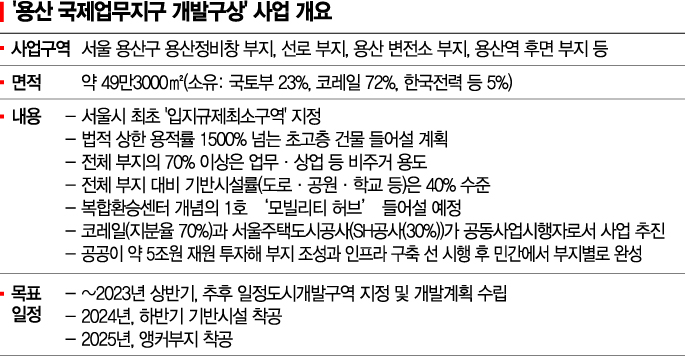
The Yongsan Maintenance Depot site, located in Hangang-ro 3-ga, Yongsan-gu, Seoul, is a vacant lot of approximately 493,000 square meters behind Yongsan Station. It is an open space twice the size of Yeouido Park and is called ‘golden land’ as it is the last large-scale available land in Seoul.
In 2007, during Mayor Oh Se-hoon’s previous term, Seoul included this site in the ‘Yongsan International Business District Project’ to develop it into the largest business hub in Northeast Asia. However, the project was ultimately canceled in 2013 due to the developer’s bankruptcy amid the global financial crisis. Later, the Moon Jae-in administration announced plans to supply about 10,000 housing units, but the plan was not pursued due to opposition from residents and others.
Accordingly, Seoul City, which holds the development permit rights, signed a business agreement (MOU) last May with Korail, which owns 72% of the entire site, to participate as a joint project implementer. After several working-level consultations and expert advice, they established a concrete vision and development direction for the ‘Yongsan International Business District Development Plan.’
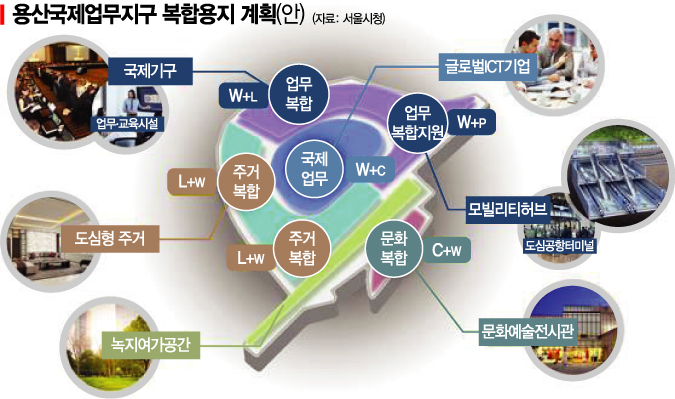
◆ Parks and green spaces among supertall skyscrapers... ‘Live-work mixed-use’ Asian Silicon Valley = Seoul City unveiled a plan to create a live-work mixed-use integrated international city where vast parks and green spaces spread among supertall skyscrapers, and all activities including jobs, housing, and culture can be addressed. The area will feature office spaces and convention (MICE) facilities, business hotels, and more, accommodating cutting-edge tech companies, research institutes, and international organizations.
To realize this, Seoul plans to divide the entire Yongsan Maintenance Depot site into several blocks, categorized into international business, mixed-use office, mixed-use residential, and mixed-use cultural zones. All blocks will allow multi-purpose mixed-use development, including office, residential, and commercial functions. This will abolish the existing zoning system divided into residential, public, and industrial areas and apply the ‘Beyond Zoning’ concept for the first time, enabling complex functional arrangements.
In particular, Seoul plans to designate the area as the city’s first ‘Minimum Location Regulation Zone’ to allow supertall buildings exceeding the legal maximum floor area ratio (FAR) of 1500%. This regulatory exemption means that the site will not be subject to location regulations based on zoning and other restrictions, and the permitted uses, FAR, and building heights will be separately determined. For comparison, New York’s Hudson Yards, similar to Yongsan International Business District, allows FAR up to 3300%.
The maximum FAR and number of floors will be specified during the development plan finalization process and confirmed as the private sector proceeds with the project. In past development attempts, Seoul permitted the construction of a landmark building up to 620 meters (about 150 floors) in the district’s center, taller than Jamsil’s Second Lotte World Tower (555m, 123 floors). In 2010, the developer proposed a plan to build a main tower up to 100 floors, flanked by landmark buildings of 72 and 69 floors respectively, totaling 67 high-rise buildings.
More than 70% of the entire site will be allocated for non-residential uses such as office and commercial purposes. The housing supply scale will vary depending on the unit sizes. A Seoul city official said, "If private sale apartments of about 30 pyeong (approx. 99 sqm) and rental apartments of about 20 pyeong (approx. 66 sqm) are mixed appropriately, about 6,000 housing units can be supplied." To secure public interest, 40% of the entire site will be developed as infrastructure such as roads, parks, and schools. Additionally, to address concerns about high-density development, height restrictions will be minimized, but guidelines will be provided to form a skyline considerate of surrounding areas.
◆ Ground level focused on greenery and pedestrians, vehicles underground... Creation of the first mobility hub = Seoul City will also create green ecological spaces throughout the area, securing more than 50% greenery at ground level. A north-south green axis will be established, connecting Bukhansan Mountain, downtown Seoul, Namsan, Yongsan Park, Yongsan International Business District, and the Han River.
The interior of the Yongsan International Business District will be connected through a three-dimensional pedestrian network linking ground, underground, and aerial pathways, extending to Yongsan Station. Buildings will be connected by aerial bridges and underground walkways.
Vehicles will run underground via an underground traffic system. The roads will feature a smart environment supporting autonomous driving, including Intelligent Transportation Systems (ITS) and Vehicle-to-Everything (V2X) communication systems. Moreover, the underground roads will connect to major arterial roads such as Gangbyeonbuk-ro and Hangang-daero, enhancing accessibility to downtown Seoul, Gangnam, and Incheon Airport. Particularly, a ‘Mobility Hub No. 1’ will be established on the site adjacent to Yongsan Station, serving as a public transport transfer point facilitating easy and convenient transfers among Urban Air Mobility (UAM), subway, and other transport modes.
Regarding UAM, a pilot route between Gimpo Airport and Yongsan International Business District will be operated in line with the commercialization of aircraft in 2025. This will enable passengers to land at Incheon or Gimpo Airport, take UAM to Yongsan, and transfer to the metropolitan area express railroad (GTX) or subway. The rail network includes five lines: Gyeongbu Line, Honam Line, Line 1, Line 4, and Gyeongui-Jungang Line, with three additional lines planned: GTX-B, Susaek-Gwangmyeong high-speed railroad, and Shinbundang Line.
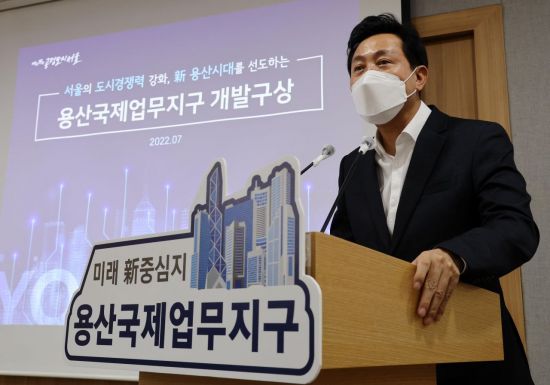 Seoul Mayor Oh Se-hoon is announcing the development blueprint "Yongsan International Business District Development Plan" for the area around the Yongsan Maintenance Depot at Seoul City Hall on the 26th. Photo by Kim Hyun-min kimhyun81@
◆ Total project cost 12 trillion KRW... 5 trillion KRW public seed money invested upfront = Seoul City, learning from the past failure of a mega private project led by a private financial vehicle (PFV), decided to proceed with phased and sequential development led by Seoul Housing and Communities Corporation (SH Corporation) and Korail.
First, the public sector will invest about 5 trillion KRW to prepare the site and build infrastructure, then sell the land parcels to private developers one by one for individual development and gradual completion. To ensure stable and continuous project progress, the establishment of a dedicated organization tentatively named Yongsan Development Agency is also under consideration. Additionally, Korail will own the site adjacent to Yongsan Station, construct buildings, and proceed with a pilot project to lease or sell the completed buildings.
Mayor Oh Se-hoon said, "The total project cost is expected to be about 12 trillion KRW," adding, "If we proceed swiftly aiming to start construction on the anchor site in 2025, we expect to complete the project within 10 to 15 years."
© The Asia Business Daily(www.asiae.co.kr). All rights reserved.
![Clutching a Stolen Dior Bag, Saying "I Hate Being Poor but Real"... The Grotesque Con of a "Human Knockoff" [Slate]](https://cwcontent.asiae.co.kr/asiaresize/183/2026021902243444107_1771435474.jpg)


















