Metaverse Platform Roblox, 150 Million Users
Majority Are 'Gen Z'... Targeting Future Customers
 Global companies are increasingly advertising through the world-renowned metaverse platform 'Roblox'. / Photo by Roblox, Hyundo Song, Asia Economy intern reporter
[Asia Economy Reporter Lim Juhyung, Intern Reporter Song Hyundo] Global conglomerates such as Samsung Electronics, Hyundai Motor Company, and Gucci are entering the 'metaverse platform' space. This is a marketing strategy aimed at becoming familiar with teenagers, who will be future consumers.
Samsung Electronics recently launched an experiential virtual space called 'Samsung Space Tycoon' on the world's largest metaverse platform, Roblox. This space features Samsung's home appliances and smartphones rendered in graphics. Earlier, in September last year, Hyundai Motor Company opened 'Hyundai Mobility Adventure' on Roblox and has been operating it since. Users who access Hyundai's virtual space can explore various Hyundai vehicles and enjoy simple mini racing games.
Roblox is a metaverse game platform launched in 2006 by American programmer David Baszucki. As of last year, it had 150 million monthly active users and 40 million daily active users on average. Roblox's characteristics include simple graphics reminiscent of LEGO toys and infinite scalability. Users can create their own experiential spaces within the Roblox platform through simple programming and invite other users to enjoy games together in those spaces.
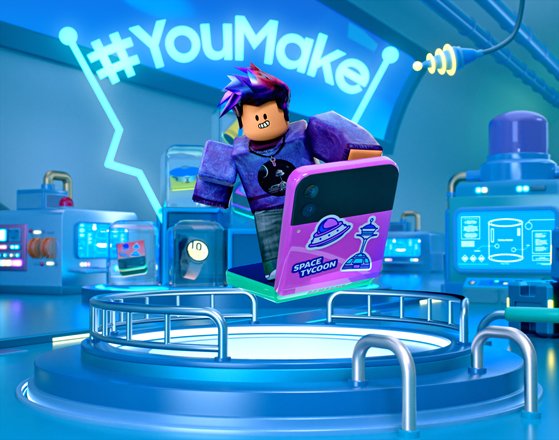
Global conglomerates are focusing on Roblox's potential as a marketing tool. Italian luxury brand Gucci and sports brand Nike also implemented product exhibition halls within the game space through brand partnership events with Roblox last year.
However, companies entering Roblox do not always attract users' attention. For example, the number of visitors to Samsung and Hyundai's virtual spaces averages between 500 and 2,500, which is low compared to Roblox's overall scale. Nevertheless, these companies' goal is to promote their brands to metaverse gamers, who are future consumers. According to official statistics from the developer, the majority of game developers and users within Roblox are teenagers. Among them, users aged 17 to 24 are the fastest-growing age group.
◆Metaverse Advertising That Failed with 'Second Life'... "Need to Increase Factors That Keep Consumers Visiting"
In fact, marketing using metaverse platforms is not new. Similar attempts were made in the early 2000s when high-speed internet became widespread. The game 'Second Life,' known as the origin of the metaverse, is a representative example.
Released in 2003, Second Life was a massive virtual city where users gathered to trade currency called 'Linden Dollars,' and real-world companies established branches and conducted advertising activities.
 Known as the first metaverse game, 'Second Life' attempted to establish branches of real-world companies in virtual spaces to conduct marketing activities. The photo shows the branch of the American computer equipment company 'Dell' created within the game. Photo by Online Community Capture
However, Second Life's popularity did not last long. After recording 36 million users in 2007, the number gradually declined to about 600,000 today.
The failure of Second Life is closely related to the level of IT technology development. In the early 2000s, PCs capable of handling vast 3D virtual spaces were not widespread, and server technology to support numerous simultaneous users was lacking. As a result, users who found it difficult to connect to the game gradually left Second Life.
Meanwhile, the emergence of social networking services (SNS) such as Facebook and Twitter accelerated the 'post-Second Life' phenomenon. Unlike Second Life, which required expensive computers to access, these SNS platforms were text-based and easily accessible to anyone. Consequently, companies shifted their advertising activities to focus on SNS.
Currently, metaverse platforms can run smoothly even on affordable entry-level PCs, and the development of related support equipment such as VR (virtual reality) goggles is actively underway. This is why there are expectations that the metaverse could become a new axis for corporate advertising. Experts predict that once metaverse advertising becomes widespread, it could surpass the effectiveness of general online advertising. Professor Eunhee Lee of Inha University's Department of Consumer Studies said, "Metaverse spaces, where users spend long periods like in games, have a definite advantage of exposing consumers to advertisements for much longer than general ads," adding, "However, to enhance advertising effectiveness within the metaverse, it is necessary to increase incentives for consumers to stay in one space, similar to reality."
© The Asia Business Daily(www.asiae.co.kr). All rights reserved.
![Clutching a Stolen Dior Bag, Saying "I Hate Being Poor but Real"... The Grotesque Con of a "Human Knockoff" [Slate]](https://cwcontent.asiae.co.kr/asiaresize/183/2026021902243444107_1771435474.jpg)













