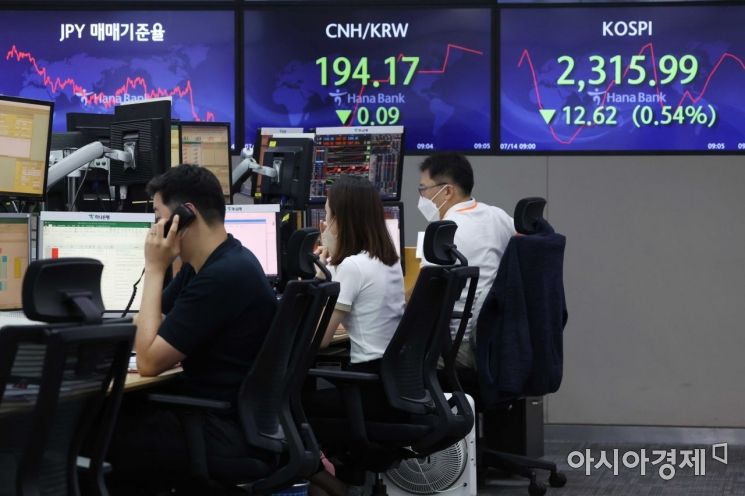
 On the 14th, dealers are working in the dealing room of Hana Bank in Euljiro, Seoul. On this day, the KOSPI index opened at 2316.41, down 12.20 points (0.52%) from the previous session. The won-dollar exchange rate started at 1306.5 won, down 0.4 won. Photo by Moon Honam munonam@
[Asia Economy Reporter Myunghwan Lee] Foreign investors are returning to the domestic stock market. After large-scale selling during the market downturn in the first half of this year, foreign investors have shown a buying trend this month, supporting the index. Securities firms advised paying attention to semiconductor, automobile, and secondary battery-related stocks, which are attracting demand from foreign investors.
On the 25th, the KOSPI closed higher, returning to the 2400 level despite the decline in the US stock market the previous day. The KOSPI closed higher due to the supply and demand from foreign and institutional investors, with foreign investors purchasing stocks worth 90 billion KRW. Considering that foreign trading generally follows the US stock market, this buying trend is somewhat unusual.
Looking at the trading trends of foreign investors over the past two weeks, their buying flow stands out. Among the 11 trading days from the 11th to the 25th, foreign investors were net buyers on 6 days. Considering that foreign investors were mostly sellers in the first half of this year, this indicates a strengthening buying trend. Out of 121 trading days in the first half of this year, foreign investors were net sellers on 81 days and net buyers on only 40 days.
The buying trend of foreign investors became prominent starting from the 14th. Foreign investors were net buyers for four consecutive trading days from the 14th, marking the third time this year they have recorded four consecutive days of net buying. Previously, foreign investors showed four consecutive days of buying in mid-February and late May.
The returning foreign investors mainly accumulated large-cap stocks such as semiconductors, automobiles, and secondary batteries. From the 11th to the 25th, Samsung Electronics and SK Hynix ranked first and second among the top net purchased stocks by foreign investors. Hyundai Motor took third place, and Kia, another automobile stock, ranked tenth. Secondary battery-related companies such as Samsung SDI (4th) and LG Energy Solution (6th) were also among the main stocks accumulated, along with telecommunications companies like KT (5th) and SK Telecom (7th), which appeared among the top net purchases.
Securities firms pointed out that foreign investors took the domestic market's weak trend as a buying opportunity. Yujun Choi, a researcher at Shinhan Financial Investment, analyzed, "The continued price decline may have provided an opportunity for long-term funds to increase their domestic stock holdings."
There was also advice to focus on the sectors where foreign investors' buying is concentrated. Researcher Choi said, "Considering the aspect of filling the supply gap, recent rebound momentum, and earnings, it is effective to approach secondary batteries among semiconductors, automobiles, and IT home appliances. As a defensive stock concept, it is also worth paying attention to the telecommunications sector, which has continued to attract inflows in July following the first half of the year."
© The Asia Business Daily(www.asiae.co.kr). All rights reserved.

![A Woman with 50 Million Won Debt Clutches a Stolen Dior Bag and Jumps... A Monster Is Born [Slate]](https://cwcontent.asiae.co.kr/asiaresize/183/2026021902243444107_1771435474.jpg)















