Most Netizens Watch Content Through Unauthorized Copies
K-Content Illegal Distribution Losses Near 550 Billion Won
 The popularity of Korean content such as dramas and webtoons is increasing, but damages caused by unauthorized reproduction and illegal viewing are also rapidly rising. / Photo by Song Hyundo, Asia Economy intern reporter
[Asia Economy Reporter Lim Ju-hyung, Intern Reporter Song Hyun-do] The popular drama "Extraordinary Attorney Woo" (Woo Young-woo) is gaining popularity in China as well. The platform airing Woo Young-woo is "Netflix," which is not officially available in China. Nevertheless, posts and reviews related to Woo Young-woo are flooding online communities within China.
The popularity of Woo Young-woo in China can be gauged by the number of posts on online communities and social networking services (SNS). On Douban, China's largest content review site, Woo Young-woo holds a rating of 9.3, with over 21,000 reviews. On Chinese SNS platforms like Weibo, positive comments such as "The best Korean drama I've ever seen" and "The actors' performances are outstanding" continue to pour in.
Content-specialized media have also highlighted the "Woo Young-woo phenomenon." The Chinese media outlet Sina reported that a fan page for Woo Young-woo, created by a Chinese netizen, has attracted over 30,000 followers, stating, "Woo Young-woo's popularity is extraordinary."
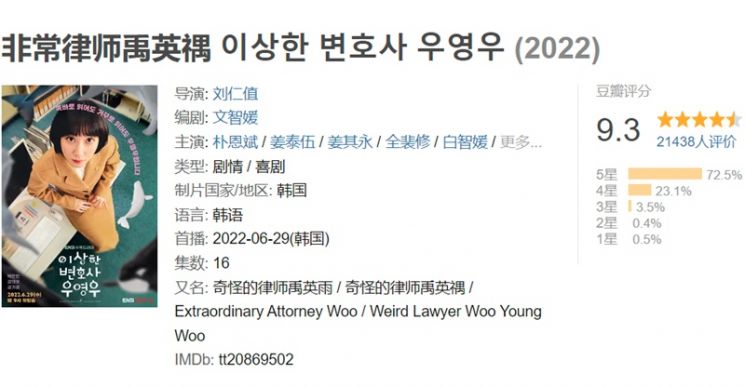 In China, the drama "Woo Young-woo" cannot be officially watched, but tens of thousands of user ratings have already been posted on review sites. / Photo by Douban, a Chinese review site capture
Woo Young-woo has been airing since the 29th of last month and is available for viewing overseas through the American streaming platform Netflix. However, Netflix is not officially provided in China. There are criticisms labeling Chinese netizens' viewing of video content as "pirate viewing." Professor Seo Kyung-deok of Sungshin Women's University wrote on Facebook on the 21st, "Pirate viewing is absurd enough, but on China's largest review site, (Chinese people) rate it among themselves," adding, "It's truly a situation where they secretly watch and do everything among themselves."
Chinese netizens appear to access banned imported content using P2P downloads, illegal streaming sites, and cloud services. They share illegally copied content files on P2P sites or public clouds with other netizens or evade investigations by setting up streaming sites with overseas addresses. On the 25th, entering "Woo Young-woo" on Baidu, China's largest portal site, yielded over 900,000 results. Among these were many streaming sites offering Korean dramas for free and numerous P2P files such as torrents.
◆The status of K-content has risen... but illegal copying damages are increasing much faster
 Since the 'Hanhanryeong' (Korean Wave ban), the import of Korean video and music content has been restricted in China, but Chinese netizens can easily access them through illegal streaming sites and P2P downloads. / Photo by Chinese portal 'Baidu' capture
The widespread issue of "illegal viewing of Korean content" in China is also confirmed by statistics. According to data compiled by the Korea Copyright Protection Agency on "Illegal distribution cases by country" from 2017 to last year, China accounted for 32.5% of the total cases, ranking first.
This is not a problem unique to China. Unauthorized copying of webtoon services provided by domestic IT companies such as Naver is rampant not only in Asian countries but also in English-speaking countries. According to data compiled by the content specialist company Conist, as of 2020, traffic to illegal Korean webtoon piracy sites totaled 33.6 billion views. According to data from the Korea Creative Content Agency in the same year, the annual cumulative damage from illegal content distribution reached 548.8 billion KRW, a 70% increase compared to the previous year. This far exceeded the growth rate of content export revenue (13.9%) during the same period.
 As of 2020, the cumulative views of illegal reproduction sites for webtoons and other content reached a total of 33.6 billion views. The photo shows an illegal webtoon distribution site that was shut down in 2018. / Photo by Yonhap News
Experts suggest that both the government and private sectors must strive to protect copyrights of domestic content businesses. Professor Lee Won-sang of the Department of Law at Chosun University stated, "There are not many cards the government can use to respond to China's illegal content copying, but a gesture to raise objections through official diplomatic channels is necessary so that China considers its national reputation."
© The Asia Business Daily(www.asiae.co.kr). All rights reserved.
![Clutching a Stolen Dior Bag, Saying "I Hate Being Poor but Real"... The Grotesque Con of a "Human Knockoff" [Slate]](https://cwcontent.asiae.co.kr/asiaresize/183/2026021902243444107_1771435474.jpg)


















