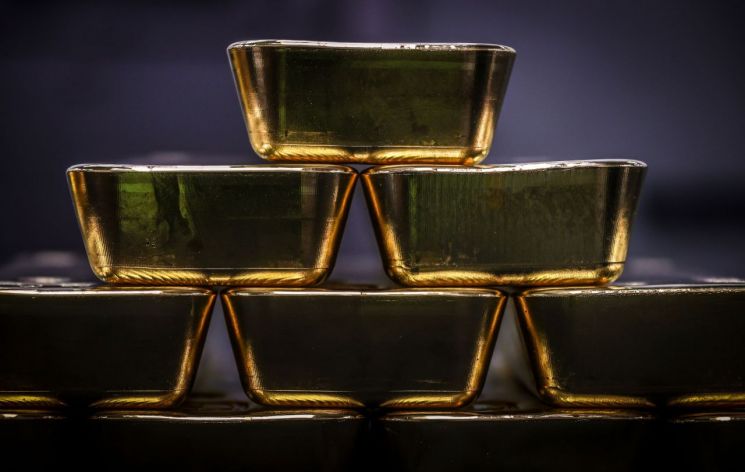
[Asia Economy New York=Special Correspondent Joselgina] The price of gold, a representative safe-haven asset, continues to struggle as it has fallen for four consecutive months amid soaring inflation and recession concerns.
According to the Wall Street Journal (WSJ) on the 24th (local time), gold futures, based on the most actively traded contract month, are currently trading at $1,727.40 per ounce, down 4.4% ($79.90) since July began. At this pace, the monthly gold price is expected to decline for the fourth consecutive month, marking the longest downward streak since November 2020.
WSJ reported, "Many investors expected gold to protect their portfolios from inflation, but gold prices have fallen 5.5% so far this year."
This is a consequence of the Federal Reserve's (Fed) aggressive tightening measures to reduce inflation. Rising Treasury yields and a strong dollar have acted as negative factors for gold. Since gold is traded internationally in dollars, a strong dollar typically leads to a decline in gold prices. Additionally, the rise in U.S. Treasury yields lowers the relative asset value of gold.
Andrew Lekas, Head of Bonds, Currencies, and Commodities at ETF investment firm Old Mission, conveyed the sentiment, saying, "People are thinking, 'If gold does not function as an inflation hedge, why should I hold gold?'"
Stocks related to gold are also falling. The VanEck Gold Miners ETF dropped 7.2% in July alone. During the same period, gold mining companies Barrick Gold and Newmont, listed on the New York Stock Exchange, slid 13% and 14%, respectively. Considering that the S&P 500 index, composed of large-cap stocks, rebounded 4.7% this month, these are notably poor performances.
Recently, Swiss investment bank UBS lowered its gold futures price forecast for the first half of next year from $1,700 to $1,650 per ounce. Shannon Saccocia, Chief Investment Officer (CIO) at SVB Private, said, "Inflation has peaked, but the dollar remains strong," adding, "This means a meaningful recovery in gold prices by the end of the year is unlikely." He also noted that the $1,700 per ounce level could break down.
However, some analyses suggest that if the Fed slows the pace of rate hikes, it could curb the rise in Treasury yields and the strength of the dollar, potentially leading to a rebound in gold prices. Gold is considered relatively stable compared to stocks and bonds in terms of portfolio diversification and other aspects.
© The Asia Business Daily(www.asiae.co.kr). All rights reserved.

















