President Yoon Suk-yeol's Approval Rating Decline and
Focus on Democratic Party Leadership's Response
Park Hong-geun Emphasizes Responsibility of Floor Leader Over Conceding Emergency Committee Chair
Woo Sang-ho Shows Sophisticated Political Sense Without Ambition for Political Moves
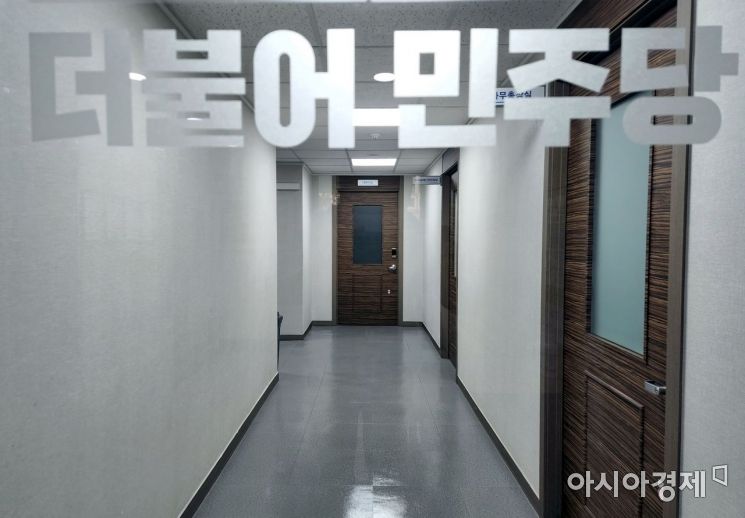 The Emergency Response Committee of the Democratic Party of Korea decided to resign en masse, taking responsibility for the defeat in the June 1 local elections. On the 3rd, the central party office in Yeouido, Seoul, showed a desolate scene. On the same day, the Democratic Party plans to hold a joint meeting of lawmakers and the party affairs committee to discuss measures to recover from the crushing defeat in the June 1 local elections. Photo by Yoon Dong-ju doso7@
[Asia Economy Reporter Naju-seok] The Democratic Party of Korea (DPK), which suffered a crushing defeat in the local elections, has recently shown signs of recovery in approval ratings, drawing attention. Some polls indicated that by the end of June, the DPK was leading the People Power Party (PPP) in support. In Gallup surveys, which regularly publish results, the DPK trailed the PPP by 13 percentage points in the first week of June immediately after the local elections, but the most recent survey showed the gap narrowing to about 6 percentage points.
It is noteworthy that the DPK, which narrowly lost the presidential election and then suffered a heavy defeat in the local elections, has recovered its approval ratings in a short period. After the election losses, the DPK was plagued by severe internal divisions over responsibility for the defeats, and the leadership was dissolved, moving to an emergency committee system.
Initially, political circles attributed the cause to President Yoon Seok-yeol's failure to gain public support since his inauguration. Dissatisfaction grew over inadequate responses to the complex economic crisis, COVID-19 quarantine measures, dissatisfaction with the government's handling symbolized by reinvestigations such as the West Sea public official killing incident and the repatriation of North Korean fishermen, and the People Power Party's Central Ethics Committee's disciplinary decision against party leader Lee Jun-seok. Although there are various analyses of the causes, the result was a sharp drop in President Yoon's approval ratings early in his term, an unprecedented phenomenon in Korean political history, which produced a reflection effect.
However, there are aspects that cannot be explained by the reflection effect alone. The DPK, which had descended into internal conflict over responsibility for the presidential and local election defeats, has managed to navigate through a series of political upheavals smoothly. Especially amid political powder kegs such as the party convention rules decision and the parliamentary organization negotiations, the DPK experienced some twists and turns but avoided major crises.
Summarizing evaluations inside and outside the party, what made this possible was a series of responses by the DPK leadership after the crisis.
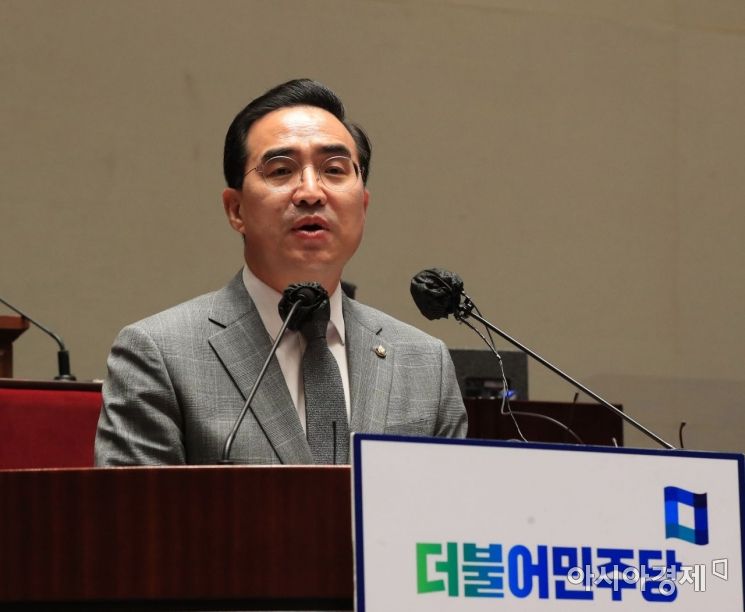 Park Hong-geun, floor leader of the Democratic Party of Korea, is speaking at the party meeting held at the National Assembly on the 22nd. Photo by Yoon Dong-joo doso7@
First, it is noteworthy that Park Hong-geun, the DPK floor leader, did not take on the role of emergency committee chairman and instead, after persuasion, established a system with Woo Sang-ho as the emergency committee chairman. After the collapse of the Yoon Ho-jung-Park Ji-hyun emergency committee system, which was initially intended to be maintained until the party convention, it would have been a natural step for Park to assume the chairmanship. However, there was little time left until the convention to bring in external figures or elders as chairman, and internal conflicts over election responsibility were significant, so there was a strong need to quickly resolve the situation. Above all, Park calculated that taking on the party leader position could increase his political 'weight class.'
However, Park declined the chairmanship citing urgent parliamentary issues such as the parliamentary organization negotiations. Instead, after persistent efforts, he installed Woo, who had declared he would not run in the general election, as the emergency committee chairman.
Since the establishment of Woo's emergency committee system, the party has been operating stably with virtually no major noise except for conflicts over the party convention rules. Considering the turmoil in the DPK in early June, this is a remarkable change. Evaluations within the party indicate that the emergency committee, composed mainly of experienced politicians led by Woo, who has political acumen, is functioning well. There are even voices within the party hoping that "the current system will not end quickly but continue for over a year to allow for organizational reform."
Relieved of burdens related to party affairs such as the convention, Floor Leader Park focused on parliamentary organization negotiations and responding to livelihood issues amid the complex economic crisis. Despite opposition from the ruling party in the parliamentary organization negotiations, the DPK formed a Special Committee on Judicial Reform, which can carry out follow-up work on the Prosecutor Reform Act (or the so-called 'complete prosecution reform' law), with the DPK chairing it. Moreover, even after relinquishing the Legislation and Judiciary Committee, Park Gwang-on, the parliamentary speaker and former chair of the Legislation and Judiciary Committee in the first half of the term, was allowed to handle the National Assembly's legal response to the constitutional court's jurisdiction dispute lawsuit on the Prosecutor Reform Act. Through the formation of the Political Reform Special Committee, the party secured a foundation to push for reforms such as the Legislation and Judiciary Committee reform and strengthening the Budget and Accounts Committee. Considering the ruling party's tough negotiation stance, Park's decision to forgo the emergency committee chairmanship and focus on parliamentary organization negotiations yielded some compensation.
Although the DPK is the largest party in the National Assembly, Floor Leader Park's difficulties as the leader of the opposition party are evident in his negotiation bloc speech. While launching attacks on the Yoon Seok-yeol administration's personnel issues, even using the phrase 'gatekeeper land army,' he also outlined current issues such as pension reform, measures for self-employed workers, and the promotion of the Equality Act. A DPK official said, "Although the message may be somewhat mixed, combining attacks and proposals is the fate of a major opposition party." In fact, while focusing his speech on criticizing the government might have attracted more political attention, he prioritized his responsibility as the floor leader of the largest party in the National Assembly.
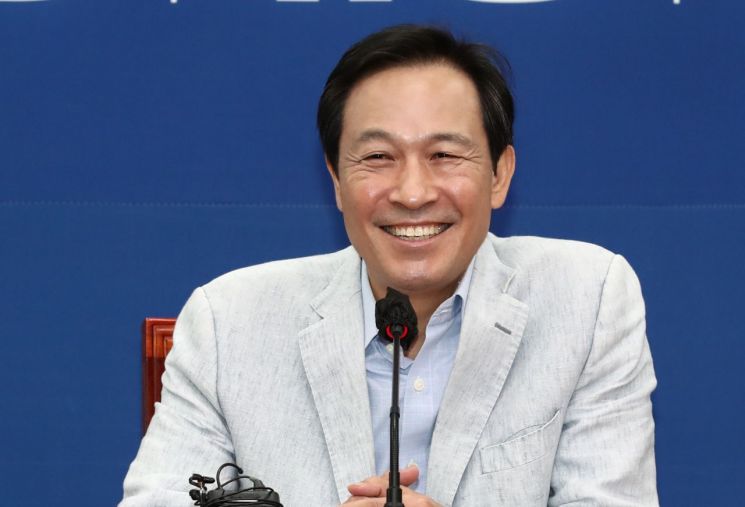 Democratic Party of Korea Emergency Response Committee Chairman Woo Sang-ho is holding a press briefing at the National Assembly on the morning of the 24th.
 [Image source=Yonhap News]
Woo Sang-ho's role has actually received even greater attention. The fact that the DPK, which was on the verge of fragmentation, is maintaining a stable phase like this is largely due to Woo's role as emergency committee chairman. His strongest political asset is his determination not to use the emergency committee chairmanship as a political tool for his next political activity, having declared he would not run in the general election.
In practice, he has refrained from interviews that could attract media attention and instead leads messages through press conferences and public statements. Regarding the party's division that escalated into conflict, he demonstrated highly sophisticated political acumen by managing conflicts through formalizing communication channels rather than blocking them. Instead of the usual parliamentary workshops used to discuss policy issues, he planned political workshops as channels for honest dialogue on internal party issues.
Additionally, Woo has handled well the ruling party's allegations related to incidents during the Moon Jae-in administration, such as the West Sea public official killing incident.
Recently, Woo has shown a selfless attitude regarding the formation of negotiation blocs. The negotiation bloc speech is an opportunity that any politician would covet, as it can gain nationwide attention. Former lawmaker Yoo Seung-min, as the ruling party floor leader, once drew nationwide attention by declaring "welfare without tax increases is a fiction." This speech, broadcast live for 30 to 40 minutes by broadcasters, allows politicians to present their political vision and convictions. When both the party leader and floor leader are members of the National Assembly, they alternate in delivering this speech. Since former DPK floor leader Yoon Ho-jung gave the negotiation bloc speech in September last year, Woo could have requested this opportunity.
However, Woo did not seek this speech opportunity. Considering that Floor Leader Park was recently elected and that the new DPK party leader should have the chance to deliver the negotiation bloc speech during the regular National Assembly session, Woo reportedly declined the opportunity.
© The Asia Business Daily(www.asiae.co.kr). All rights reserved.
!["The Woman Who Threw Herself into the Water Clutching a Stolen Dior Bag"...A Grotesque Success Story That Shakes the Korean Psyche [Slate]](https://cwcontent.asiae.co.kr/asiaresize/183/2026021902243444107_1771435474.jpg)


















