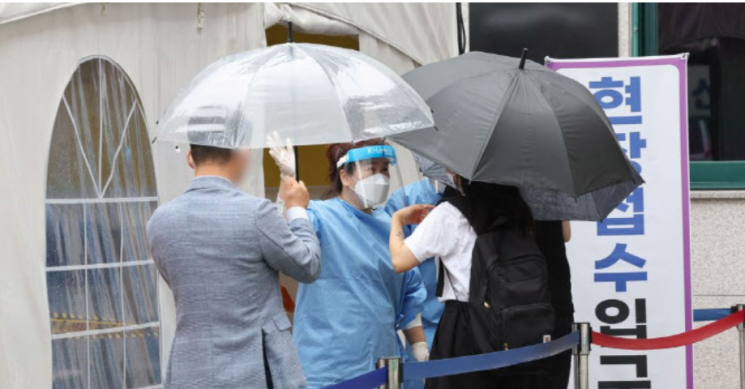
 On the morning of the 21st, medical staff at the COVID-19 screening clinic in Gangnam-gu Public Health Center, Seoul, are guiding citizens who are about to undergo testing. [Image source=Yonhap News]
[Asia Economy Intern Reporter Kim Nayeon] As COVID-19 shows signs of a global resurgence, the British daily newspaper The Guardian reported on the 22nd (local time) about the reasons why first-time infections account for a large proportion of the recent surge in confirmed cases.
The Guardian reported, based on the investigation by the UK Health Security Agency (UKHSA), that in the UK, where 15% of the population has never contracted COVID-19, first-time infections recently accounted for 55% of new confirmed cases.
In South Korea, as of the first week of July, about 97% of confirmed COVID-19 cases were first infections. During this period, reinfection cases were estimated at 2.88%, which is significantly lower than in some countries like the United States, where reinfections account for 10-20% of new confirmed cases.
The Guardian noted that reinfected individuals may experience milder symptoms than during their initial infection, and even if they contract the virus a second or third time, many may not realize they are infected, so these cases might not have been included in recent statistics.
Professor Graham Medley of the London School of Hygiene & Tropical Medicine explained, "If the likelihood of symptoms appearing after the initial infection is low or if it is judged not worthwhile to get tested, many people may be reinfected without realizing it. Therefore, first infections are much more likely to be diagnosed and reported."
Besides the mild symptoms of reinfections leading to unawareness, examining the age groups and timing of recent positive cases also provides some clues.
According to UKHSA, during the initial Omicron wave in December last year, the spread was prominent mainly among young people aged 20 to 40, with a low proportion of confirmed cases among the elderly. Later, in March this year, when the Omicron subvariants BA.2 and last month’s BA.4 and BA.5 hit simultaneously, the highest proportion of cases was among the elderly aged 60 and above who had not been infected previously.
Experts estimate that the BA.5 variant, known to be more transmissible and structurally similar to the Omicron lineage BA.2 variant, has led to immunity in the younger population who were infected earlier. Additionally, according to an analysis by a Qatar research team published this month, people infected with the original Omicron BA.1 have about an 80% chance of being protected against the subvariants BA.4 or BA.5.
In South Korea as well, it is presumed that immunity is maintained among the 14 million cumulative infected individuals who were infected around the time when new COVID-19 cases surged this spring, which explains the high proportion of first infections among new confirmed cases.
Meanwhile, The Guardian reported that the recent proportion of first-time infections in the UK is the lowest throughout the pandemic period except for December last year, indicating that the number of people who have never contracted COVID-19 is gradually decreasing.
© The Asia Business Daily(www.asiae.co.kr). All rights reserved.
![Clutching a Stolen Dior Bag, Saying "I Hate Being Poor but Real"... The Grotesque Con of a "Human Knockoff" [Slate]](https://cwcontent.asiae.co.kr/asiaresize/183/2026021902243444107_1771435474.jpg)
















