[Asia Economy Reporter Changhwan Lee] An analysis has emerged indicating that South Korea's economic status is significantly declining compared to Taiwan.
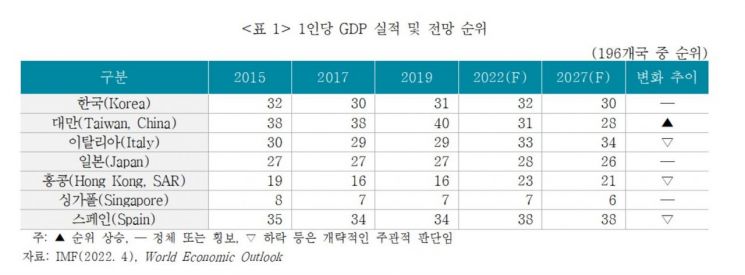
According to the Insurance Research Institute's report titled "Discussion on Recent Changes in Our Economy's Status" on the 24th, it is forecasted that South Korea's per capita GDP (Gross Domestic Product) will surpass Italy this year but will be overtaken by Taiwan.
The report, citing the IMF (International Monetary Fund) survey, predicted that South Korea's per capita GDP will surpass that of Italy, a developed European country, and maintain a relatively high level even in 2027.
If this forecast materializes, South Korea will have surpassed Spain in per capita GDP since 2015 and will also surpass Italy, reaching a considerably high level by European standards.
On the other hand, Taiwan is expected to surpass South Korea in 2022, which would place South Korea at the lowest per capita GDP level among the Four Asian Tigers of the 1980s, including Singapore, Hong Kong, and Taiwan.
When converting per capita GDP into a ranking concept, South Korea is stagnating in the early 30s, while Taiwan is on the rise, and Italy, Spain, and Hong Kong are on a downward trend, according to the report.
South Korea's overall ranking remains in the early 30s, and Japan's ranking is stagnating in the mid to late 20s. In contrast, Taiwan's ranking rose from 40th in 2019 to 31st in 2022, surpassing South Korea, and is expected to enter the top 20 by 2027.
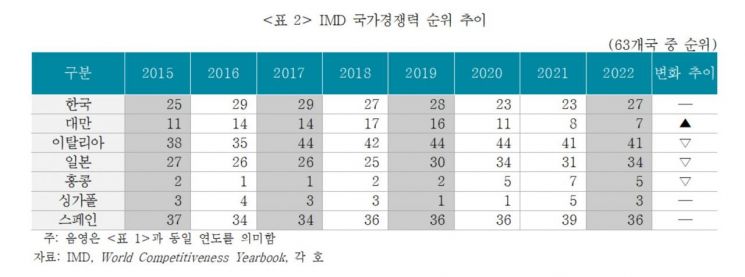
Based on the international competitiveness evaluation of major countries published by Switzerland's IMD (International Institute for Management Development), South Korea significantly lags behind Taiwan. South Korea's national competitiveness ranking fluctuated between 29th in 2016 and 2017 and 23rd in 2020 and 2021 but has generally stagnated in the lower 20s.
In contrast, Taiwan showed a declining trend after 2015 but has rapidly risen to around 7th place since 2019.
Comparing the competitiveness rankings of 20 detailed categories from 2019 to 2022, South Korea's rankings declined in areas such as 'International Investment' in economic performance, 'Finance' and 'Tax Policy' in government efficiency, and 'Labor Market' in corporate efficiency.
Conversely, Taiwan showed improvement or stability in most detailed categories, demonstrating a relatively superior trend.
Despite South Korea's stagnation or decline in rankings, Taiwan's rankings rose in detailed categories such as 'Institutional Framework' and 'Business Environment' in government efficiency, 'Labor Market' in corporate efficiency, and 'Technological Infrastructure,' 'Health Environment,' and 'Education' in infrastructure.
The report pointed out the need to be cautious about the illusion that South Korea's economic status is rising due to the decline in some advanced countries like Italy and Spain, despite South Korea's actual stagnation.
The phenomenon where South Korea recently surpasses or reaches parity with major advanced countries such as Spain and Italy is more reasonably viewed as a result of those countries' rankings falling rather than South Korea's ranking rising.
The report emphasized the necessity of paying particular attention to improving detailed categories such as finance and labor market, which are evaluated as declining, to enhance South Korea's national competitiveness in the future.
Senior Research Fellow Taeyeol Lee of the Insurance Research Institute stressed, "To improve South Korea's competitiveness, it is necessary to focus on improving the four detailed categories that showed a downward trend among the total 20 categories: international investment, finance, tax policy, and labor market."
He added, "Regarding international investment, efforts should be made to actively attract overseas capital, and concerning finance and tax policy, efforts are needed to enhance fiscal soundness and establish a reasonable tax burden system."
Furthermore, he stated, "Regarding the labor market, in addition to the traditionally pointed-out weaknesses in labor-management relations, active measures should be taken to address issues related to talent attraction and brain drain."
© The Asia Business Daily(www.asiae.co.kr). All rights reserved.


















