Renault Korea, Central Labor Relations Commission Decision Expected Around 26th
Korea GM, Labor-Management Conflict Over Bupyeong Plant 2
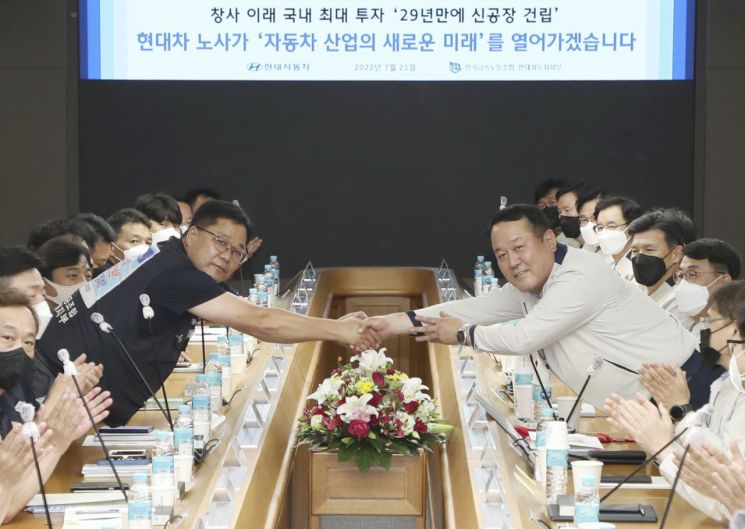 Lee Dong-seok, CEO of Hyundai Motor Company (right), and Ahn Hyun-ho, head of the labor union branch, are shaking hands at the signing ceremony for the 2022 wage negotiations held in the companion room of the main building at Hyundai Motor Ulsan Plant on the 21st.
 [Image source=Yonhap News]
[Asia Economy Reporter Kiho Sung] After many twists and turns, Hyundai Motor Company's labor and management held a signing ceremony to conclude this year's wage negotiations. Meanwhile, Renault Korea and Korea GM are unable to narrow their differences, leading to prolonged conflicts.
According to industry sources on the 23rd, Hyundai Motor's labor and management held a signing ceremony for this year's wage negotiations on the 21st, attended by Vice President Dongseok Lee and Labor Union Chairman Hyunho Ahn, among other negotiation representatives. Hyundai Motor's labor and management have achieved four consecutive years of dispute-free agreements from 2019 through this year. This marks the first time since the Hyundai Motor labor union was established in 1987 that collective bargaining has been completed without strikes for four consecutive years.
During the main negotiations held on the 12th, Hyundai Motor's labor and management reached a tentative agreement including a base pay increase of 108,000 KRW (including step increases), a management performance bonus of 200% plus 4 million KRW, a quality improvement incentive of 1.5 million KRW, a second-half target achievement incentive of 100%, a special stock incentive of 20 shares in response to changes in the future automobile industry, and traditional market gift certificates worth 250,000 KRW. Additionally, through separate demands, both parties agreed on establishing a domestic electric vehicle plant, hiring new personnel, rebuilding aging production lines, and improving the wage system.
The tentative agreement was approved with 61.9% of union members voting in favor during the vote held on the 19th.
On the other hand, negotiations between Renault Korea and Korea GM labor and management are intensifying. The Renault Korea labor union conducted a strike authorization vote on the 13th and 14th, with 1,653 out of 1,852 total members voting in favor, resulting in an 80.6% approval rate (1,332 votes). The union has currently applied to the Central Labor Relations Commission for a decision to suspend mediation. Industry insiders expect the commission to make a mediation suspension decision around the 26th. If so, the union will obtain the legal right to strike.
The union is demanding a base pay increase of 97,472 KRW, a lump-sum payment of 5 million KRW, and regular employment. However, the biggest issue is the 'multi-year agreement.' The company is proposing to change the wage negotiation cycle from annual to multi-year negotiations. Accordingly, the company has proposed a plan to increase the base pay by 60,000 KRW annually for three years starting this year, along with performance bonuses. In contrast, the union insists on conducting annual wage negotiations.
The Korea GM labor union is demanding a monthly base pay increase of 142,300 KRW and a performance bonus of 400% of the ordinary wage (approximately 16.94 million KRW). However, Korea GM is facing conflicts between labor and management in areas other than the content of the wage negotiations.
Korea GM plans to close its Bupyeong Plant 2 by the end of this year. The union insists that investment and plans related to electric vehicles are necessary to reopen the plant and ensure worker stability. However, the company is taking a hardline stance, stating that there will be no additional investment to normalize management.
© The Asia Business Daily(www.asiae.co.kr). All rights reserved.

















