The 5th On-site Meeting for Digital National Agenda Implementation
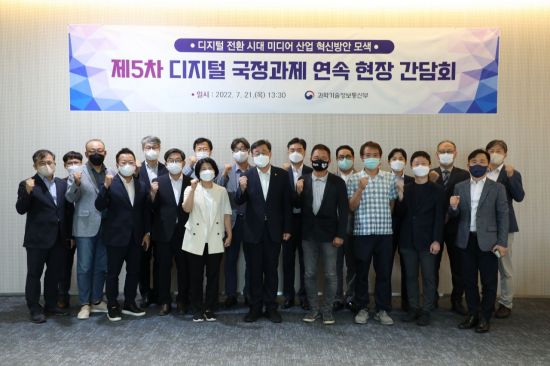 Park Yoon-kyu, the 2nd Vice Minister of the Ministry of Science and ICT, held the '5th Digital National Agenda Continuous On-site Meeting' on the afternoon of the 21st at Grand Central in Seoul. Participants are taking a commemorative photo after attending the meeting. Photo by Ministry of Science and ICT
[Asia Economy Reporter Minyoung Cha] As the Yoon Seok-yeol administration strengthens its stance on deregulating businesses, voices have grown louder calling for the outdated Broadcasting Act to be shifted towards a 'self-regulation' focus to drive change in the stagnant broadcasting market. Online Video Service (OTT) providers also argued that regulatory and promotion policies at the same level as those applied to global OTTs like Netflix are necessary to help them compete in production.
On the afternoon of the 21st, Park Yoon-gyu, the 2nd Vice Minister of the Ministry of Science and ICT, held the '5th Digital National Agenda Continuous On-site Meeting' at Grand Central in Seoul, opening with, "Existing new media has become old media. The media industry is considering leveraging technological advancements to expand globally."
At the event, Dr. Lee Jong-won of the Korea Information Society Development Institute (KISDI), who presented on 'Seeking Innovation Measures for the Media Industry in the Digital Transformation Era,' pointed out, "In the digital transformation era, incorporating new services into existing legal frameworks distorts innovation and weakens the effectiveness of current regulatory systems." He added, "The current siloed system causes direct and indirect costs such as market uncertainty, delayed activation, distortion of service evolution directions, and disputes related to fair competition."
Therefore, there is a call to improve the outdated Broadcasting Act to align with an open media environment. Dr. Lee Jong-won stated, "It should be restructured to allow free market entry and exit," and suggested, "Extending the paid broadcasting license period and gradually easing the registration system for Broadcasting Channel Usage Providers (PP) and the paid broadcasting licensing system in the mid to long term." He further emphasized, "Administrative regulations should transition to a self-regulation system," and added, "A horizontal regulatory framework between broadcasting and OTT should be introduced through the integration of broadcasting media regulatory systems." He also proposed the introduction of universal media to realize the social value and public nature of media.
During the subsequent discussion, paid broadcasting platforms, PP and OTT industries, and academia presented their respective positions. Paid broadcasting representatives agreed that it is unreasonable for only broadcasting to be subject to re-licensing and other regulations when identical content is provided simultaneously via the internet, and that fundamental institutional reform is necessary. Kim Hoon-bae, Head of Media Platform Business at KT, which succeeded with the hit 'Extraordinary Attorney Woo,' said, "There was no content to air on IPTV for two years, so we entered the business last year to try producing content ourselves." He pointed out, "Even looking at the newly produced 'New Recruit' content, the regulatory levels differ by each paid platform, resulting in different content ratings." He argued that the high standards applied to paid broadcasting act as hurdles and constitute unfair regulation.
There were also calls for establishing clear standards for content compensation and normalizing the market based on them. Yoon Yong, Executive Director of LG HelloVision, said, "Paid broadcasting has nearly 30 million subscribers, and if this is not normalized, both the content and PP industries will face difficulties," urging, "Efforts are needed to normalize the market so that content receives fair compensation." Lee Han-oh, CEO of Geumgang Broadcasting, a small cable TV operator (individual SO), appealed, "Due to regulations, it feels like looking at the opponent (OTT) through prison bars in a locked place." He added, "Just as large corporations do not dominate alone, I hope policies for the weak and small businesses will be discussed together at the Ministry of Science and ICT." He further said, "I hope all players participate in creating self-regulation guidelines to ensure fair content compensation."
The OTT industry called for production support and promotion policies to enable competition on equal footing with global giants like Netflix and Disney Plus. Jo Han-gyu, Vice President of Kakao Entertainment, also pointed out, "Directors, actors, and writers already require Netflix participation as a premise from the production stage," and noted, "Since there is cannibalization among Korean content, we must assume that the production volume and the time and money received from Netflix have almost reached their maximum." Lee Hee-joo, Director of Wavve, said, "Regulations on all media platforms and operators competing with Netflix or YouTube should be relaxed to their level. Otherwise, there is no future for the Korean media industry," urging continuous interest from the Ministry of Science and ICT.
Academia also called for the activation of mergers and acquisitions (M&A) based on overseas cases. Professor Park Cheon-il of Sookmyung Women's University said, "In media M&A, the Fair Trade Commission conducts the first review, but the Ministry of Science and ICT should take the lead in regulation," and pointed out, "In the U.S., although the Federal Trade Commission (FTC) handles many cases, the Federal Communications Commission (FCC) is often delegated authority in the media sector." Lee Jong-gwan, Senior Specialist at Sejong Law Firm, said, "(The government's) decision to relinquish licensing authority is a very big resolution, and I hope this policy continues," adding, "I hope the media market becomes like a playground where the market can freely operate under a self-regulation system."
Park Yoon-gyu, 2nd Vice Minister of the Ministry of Science and ICT, emphasized, "Although OTT will be highly emphasized, I believe not all media will disappear or be absorbed entirely by OTT." He added, "Our goal is also for our OTTs to expand overseas and play roles like Netflix." He continued, "We will strive to create an ecosystem where media industry stakeholders can do what they want," and said, "We will explore possible areas such as content tax credits, discuss with KISDI, and proactively identify issues."
Oh Yong-su, Broadcasting Promotion Policy Officer at the Ministry of Science and ICT, said, "Netflix could be more competitive than our native OTTs because it invested massive capital and could pay more money, so there are definitely practical difficulties," and added, "Regarding normative discussions related to paid broadcasting, there may be conflicts with the Fair Trade Commission, but we plan to discuss and resolve them well."
The Ministry of Science and ICT has been promoting the revision of broadcasting media legislation since 2021 to respond to structural changes in the media market such as digital transformation. They plan to continuously improve it in collaboration with experts from industry, academia, and research institutes.
© The Asia Business Daily(www.asiae.co.kr). All rights reserved.

















