[Asia Economy Yeongnam Reporting Headquarters Reporter Lee Seryeong] “Once all the existing tap water inside the pipelines is completely removed through the fire hydrants, areas close to the water purification plant will be able to use clean tap water around the 26th, and some distant areas will have access to clean tap water from the 29th onward.”
Changwon City, Gyeongnam Province, promised a date for the normalization of tap water in Jinhae-gu, where a ‘drinking water crisis’ occurred on the 21st due to the outbreak of chironomid larvae.
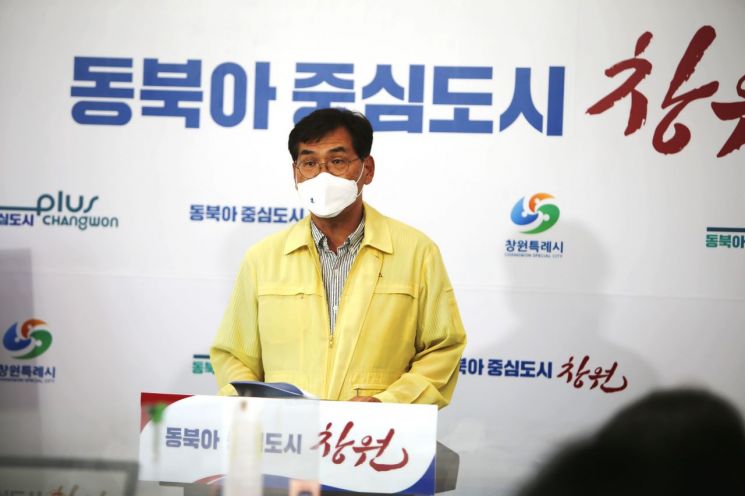
First Deputy Mayor Ahn Kyung-won emphasized, “Since the larvae were first discovered at Seokdong Water Purification Plant on the 7th, our city has taken seven emergency measures to eliminate most of the live larvae.”
He reported that the number of larvae has decreased due to backwashing of rapid filtration and activated carbon filtration, installation of multi-filters at the inlet of the water purification reservoir, and since 6 a.m. on the 16th, all tap water supplied after passing through the purification plant has been clean.
According to the city, water produced at Seokdong Water Purification Plant passes through the intake station that draws raw water from the water source, pre-ozonation contact tank, sedimentation basin, rapid filtration basin, and activated carbon filtration basin.
The water that has passed through the final process, the purification reservoir, is collected in the distribution reservoir before being supplied to each household.
The city stated that it conducts 24-hour daily monitoring at a total of 37 points, including four production process sites, 13 distribution reservoirs, and 20 consumer sites.
Starting from the 22nd, multi-filters will also be installed at 13 distribution reservoirs that receive water from the purification reservoir and send it to households, to doubly block larvae inflow into homes.
Deputy Mayor Ahn said, “We are working on normalizing water production and managing water quality through technical cooperation with the Nakdong River Basin Environmental Office, reviewing various cases, and consulting experts. The comprehensive judgment from 60 legal water quality tests showed suitability, and the current water quality status of Jinhae tap water is maintained at the same level as this time last year.”
He added that the total trihalomethanes, a carcinogenic substance, measured 0.048 ppm, which is lower than 0.057 ppm recorded at the same time last year, and the legal standard is below 0.100 ppm.
He continued, “The reason larvae still appear in tap water at homes is because water already supplied remains inside the pipelines. Water quality tests will continue at regular intervals, and results will be disclosed as soon as they are available.”
“The Special Investigation Committee has approached even the detailed aspects of cause identification and recurrence prevention, and will soon announce interim investigation results,” he also mentioned.
The Special Investigation Committee has held four meetings so far, in addition to individual investigations by each member, and plans to hold the fifth meeting on the 22nd.
Changwon City stated that it is supplying drinking water to kindergartens, daycare centers, and vulnerable groups in Jinhae-gu by receiving 6,000 bottles of 1.8ℓ and 2,000 bottles of 0.4ℓ K-water from Korea Water Resources Corporation, and 2,000 bottles of Cheongasu from Daesan Water Purification Plant.
From the 18th to the 20th, 13,000 bottles of K-water were delivered to 5,856 vulnerable households including basic livelihood security recipients, and 191 daycare centers and kindergartens.
Starting from the 21st, the city plans to expand supply by cooperating with local bottled water suppliers to purchase additional bottled water.
For 16,079 people including basic livelihood security recipients, near-poor groups, daycare centers, and kindergartens, one box containing six packs per person will be supplied, and for 230 locations including senior centers, social welfare facilities, and elementary, middle, and high schools, 666 boxes of 1.8ℓ and 100 boxes of 400ml K-water will be provided.
© The Asia Business Daily(www.asiae.co.kr). All rights reserved.

















