Song Yoon-jung, CEO of Matika Bio
CGT CDMO Market Expected to Reach 25 Trillion KRW by 2030
Aiming for Top 5 Position with 5% Market Share
Establishing Production Base in Texas... "A Traditionally Strong Region for Pharmaceutical Manufacturing"
Will Create Synergy with Cha Bio's Cell Therapy Technology
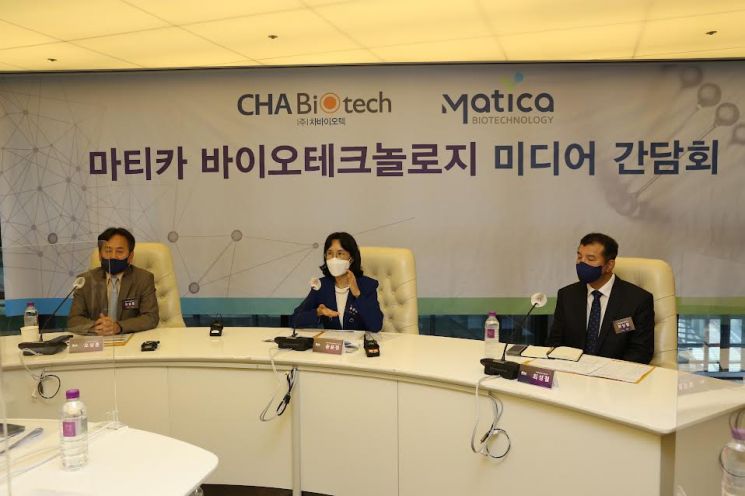 Osanghoon, CEO of Cha Biotech, Song Yoonjung, CEO of Matika Biotechnology, and Choi Seongcheol, CEO of Cha Biolab (from left), are answering questions at a press conference held on the 21st at Cha Biotech Complex in Pangyo, Seongnam-si, Gyeonggi-do.
[Asia Economy Reporter Lee Chun-hee] Matica Biotech, the U.S. subsidiary of Cha Biotech, has set a goal to become a top 5 global cell and gene therapy (CGT) contract development and manufacturing organization (CDMO) by 2030. The plan is to achieve this goal based on the cell and gene bank (CGB) to be established at its U.S. Texas factory and in Pangyo, Seongnam-si, Gyeonggi Province.
On the 21st, Song Yoon-jung, CEO of Matica Biotech, presented this growth vision at a press conference held at Cha Biotech Complex in Pangyo, Seongnam-si, Gyeonggi Province. CEO Song’s confidence was based on the judgment that the CGT market is continuously growing steeply. The CGT CDMO market is expected to grow to about 25 trillion KRW by around 2030. Leveraging this growth, Matica Biotech plans to capture more than 5% of the global market share (MS) and achieve annual sales of 1 trillion KRW.
Regarding the decision to establish a production base in Texas, rather than in the three major U.S. biotech clusters of Boston, San Francisco, and San Diego, Song explained that it was a choice focused on the essence of the CDMO business. He said, “The reason the three major biotech clusters are famous is because they have many clients, but in terms of production, the U.S. Midwest and South have traditionally been strong regions. In particular, there was an opportunity to collaborate with Texas A&M University, and considering that nearby Houston is emerging as a cradle of CGT, we factored these in.”
Since gene therapy has been a lacking area in the Cha Biotech Group’s portfolio, synergy with the group through this field is also being sought. Choi Sung-chul, CEO of Cha Biotech Lab, emphasized, “While we have had various experiences and technologies in the cell therapy field for 20 years, we did not have gene therapy technology. We expect Matica Biotech to secure the gene therapy area and create complementary synergy.”
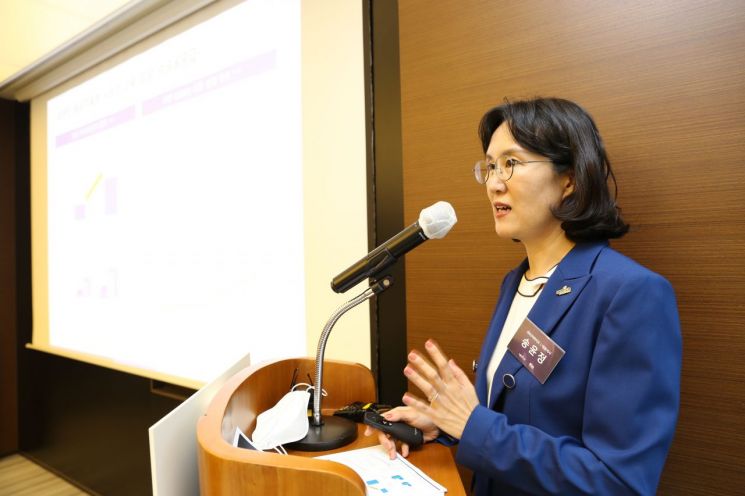 Song Yoon-jung, CEO of Matica Biotechnology, is giving a presentation at a press conference held on the 21st at CHA Bio Complex in Pangyo, Seongnam-si, Gyeonggi-do.
CEO Song cited the relatively small scale of Matica Biotech as an advantage. He said, “Since this is a new modality (therapeutic approach), regulatory agencies keep issuing new guidelines, so we must respond very agilely and flexibly from a technical perspective. The formula for success as a CGT CDMO is fast and nimble decision-making, approaching these aspects, and building the company with people who have flexible thinking.”
Oh Sang-hoon, CEO of Cha Biotech, added, “The current antibody drug market is moving toward production capacity competition, but effective antibody drug production began in the late 1990s, and competitiveness then was based on technology. What Matica Biotech is doing now is at a very early stage, so please understand it as competing through technology.”
Matica Biotech plans to expand manufacturing facilities and equipment reflecting client demands and clinical trends of cell and gene therapies. In addition to the U.S. Texas CDMO facility completed in May, it has already secured an additional 6,600㎡ space to expand CDMO facilities capable of producing commercial-stage pharmaceuticals. The company also plans to expand its business scope to include viral vector process development and production, a core raw material for CGT, as well as various cell therapies.
The technology accumulated by Matica Biotech will be applied to the advanced bio facility ‘CGB’ scheduled to be completed in 2024 at the second Pangyo Technovalley by Cha Biotech. The CGB, with a total floor area of 66,115㎡, will serve as a global production hub for cell and gene therapies, simultaneously producing CGT, messenger RNA (mRNA), viral vectors, and plasmid DNA (pDNA) in one building.
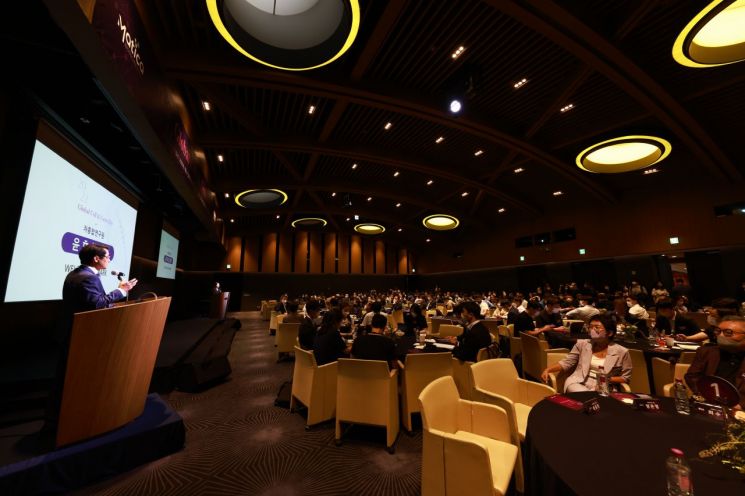
The press conference was held as part of the ‘2022 Global Cell & Gene Day’ co-hosted by Cha Biotech Group and Matica Biotech.
The event was organized to share global market trends and investment patterns in the CGT field and to strengthen networking among companies. In the first session, presentations were made on topics including ‘CGT Development and Production Status’ (Guang Yang, Partner at McKinsey North Carolina Office), ‘Global Investment Trends in the CGT Market’ (Amir Zamani, Managing Director at Bain Capital), and ‘Global CGT Clinical Trials and Regulations’ (Chris Learn, Vice President at Parexel).
In the second session, explanations were given on ‘U.S. Food and Drug Administration (FDA) Regulatory Trends and Development/Production Process Strategies to Increase Success Rates’ (Barry Conner, Vice President of Quality and Regulatory at Matica Biotech, and Mike Stewart, Chief Technology Officer (CTO)) and ‘Cha Biotech’s Major Pipelines’ (Yang Eun-young, CEO of Cha Biotech), followed by a special lecture on ‘Effective CGT Process and Analytical Method Development’ by Kim Deok-sang, CEO of Sartorius.
© The Asia Business Daily(www.asiae.co.kr). All rights reserved.
![Clutching a Stolen Dior Bag, Saying "I Hate Being Poor but Real"... The Grotesque Con of a "Human Knockoff" [Slate]](https://cwcontent.asiae.co.kr/asiaresize/183/2026021902243444107_1771435474.jpg)


















